Showing posts with label austerity. Show all posts

Monday, May 7, 2012

What America Can Learn From The Revolt In Europe

By Robert Reich, cross-posted from his website

Who’s an economy for? Voters in France and Greece have made it clear it’s not for the bond traders.

Referring to his own electoral woes, Prime Minister David Cameron wrote Monday in an article in the conservative Daily Telegraph: “When people think about the economy they don’t see it through the dry numbers of the deficit figures, trade balances or inflation forecasts — but instead the things that make the difference between a life that’s worth living and a daily grind that drags them down.”

Cameron, whose own economic policies have worsened the daily grind dragging down most Brits, may be sobered by what happened over the weekend in France and Greece – as well as his own poll numbers. Britain’s conservatives have been taking a beating.

In truth, the choice isn’t simply between budget-cutting austerity, on the one hand, and growth and jobs on the other. 

It’s really a question of timing. And it’s the same issue on this side of the pond. If government slices spending too early, when unemployment is high and growth is slowing, it makes the debt situation far worse.

That’s because public spending is a critical component of total demand. If demand is already lagging, spending cuts further slow the economy – and thereby increase the size of the public debt relative to the size of the overall economy.

You end up with the worst of both worlds – a growing ratio of debt to the gross domestic product, coupled with high unemployment and a public that’s furious about losing safety nets when they’re most needed.

The proper sequence is for government to keep spending until jobs and growth are restored, and only then to take out the budget axe.

If Hollande’s new government pushes Angela Merkel in this direction, he’ll end up saving the euro and, ironically, the jobs of many conservative leaders throughout Europe – including Merkel and Cameron.

But he also has an important audience in the United States, where Republicans are trying to sell a toxic blend of trickle-down supply-side economics (tax cuts on the rich and on corporations) and austerity for everyone else (government spending cuts). That’s exactly the opposite of what’s needed now.  

Yes, America has a long-term budget deficit that’s scary. So does Europe. But the first priority in America and in Europe must be growth and jobs. That means rejecting austerity economics for now, while at the same time demanding that corporations and the rich pay their fair share of the cost of keeping everyone else afloat.

President Obama and the Democrats should set a clear trigger — say, 6 percent unemployment and two quarters of growth greater than 3 percent — before whacking the budget deficit.

And they should set that trigger now, during the election, so the public can give them a mandate on Election Day to delay the “sequestration” cuts (now scheduled to begin next year) until that trigger is met.

Tuesday, January 10, 2012

Austerity For Dummies

By Richard (RJ) Eskow, cross-posted from Campaign for America's Future

"I feel stupid," someone said the other day. "I consider myself well-informed, but I have no idea what the term 'austerity economics' really means."

Actually it's not that complicated, and most of the lesson plan can be found in today's headlines.

We'll explain austerity to you in six steps, and we promise it it won't take more than 900 words. Since adults read an average of 250-300 words per minute - and we know all of you are above average - our little course shouldn't take more than three minutes.

It's certainly worth knowing. Despite its many failures, "austerity economics" keeps remaking - and unmaking - the global economy. The only disagreement at this weekend's Republican debate was over which candidate would push austerity more aggressively. And austerity dominated the political agenda last year - "Deficit Commission," anyone? - until Occupy came along.

Merriam-Webster named "austerity" the "Word of the Year" for 2010. But like the monster from a 1950's science-fiction movie, it just keeps on growing. This week alone the name was invoked in government houses from Athens to Lagos.

What is this creature called "austerity," and why does it still hold so much power? If you've got three minutes, let's get started.

Friday, January 6, 2012

For A Sane Economy, How About A Little Shame

By Richard (RJ) Eskow, cross-posted from Campaign for America's Future

The other day I was asked what one single thing could do the most to save our economy. What one idea or tool might help us create a more just society? My answer was "shame."

Shame isn't always a wasted or negative emotion. On the contrary, it can perform an important and socially useful function. Shame enforces our moral values even when legal and political institutions are too broken or corrupt to do so. Our society must learn to develop a "moral economics," and morality is often enforced through shame.

We live in a society where it's no longer considered shameful to oppose spending $6 billion to save nearly 8 million lives, even though that's less than $800 apiece. This kind of cynicism is so accepted, in fact, that even the more liberal political party doesn't dare suggest it. We live in a society where it's not shameful to let crooked bankers go unpunished while asking everyone else to pay the cost of their illegal enrichment. Nowadays even the lawbreakers aren't ashamed of themselves!

Incredible.

Perhaps no single change to our culture could do more to improve our lives than the rediscovery of the shame we used to attach to vile, greedy, selfish, and corrupt behavior. Consider how far we've fallen:

Not long ago a person would have been ashamed to appear in public if they had shattered the global economy by cheating millions of innocent people, accepted the outstretched hands of the same people they'd cheated by accepting an unconditional bailout, and then cheated them again.

Not long ago a politician who accepted the corrupting dollars of known criminal bankers immediately paid a steep price. (See the Keating Five, for example.)

Not long ago political figures and pundits were ashamed to openly advocate the deaths of millions of people just to provide tax advantages for the wealthy or ensure more favorable market conditions for predatory corporations.

In 2012, it's time for shame to make a comeback.

Tuesday, December 27, 2011

R.I.P. Austerity Economics (1921-2011)

By Richard (RJ) Eskow, cross-posted from Campaign for America's Future

This is the time of year when we're reminded of all the famous people who died over the last twelve months, a list which includes two of my favorite guitar players (Hubert Sumlin and Cornell Dupree). But there were also some notable non-human deaths in 2011, especially in the world of economic policy.

One of those deaths should have completely altered the political debate in Washington. The name of the deceased was "Austerity Economics," and it was first glimpsed in a 1921 paper by conservative economist Frank Wright. Austerity died of natural causes brought on by prolonged exposure to reality.

But the debate in Washington didn't change nearly enough after its passing. In the nation's capital, dead things still rule the night. 

Why Austerity?

"Austerity economics" backers claim that today's economic woes can only be fixed by dramatic reductions in government spending, which will lead to increased private-sector confidence and therefore to greater investment and growth.

But it's never worked. And if investors have lost confidence in the U.S. government's fiscal stability, they're sure not acting that way. There hasn't been this much demand for Treasury bonds since the government began tracking it twenty years ago, and they haven't performed as well since the go-go 1990s.

It's easy to understand austerity's attraction for power elites inside and outside of government. The people who suffer from austerity budgets aren't the kinds of people they know personally, since they're typically public employees like teachers, police, firefighters and the administrators of social programs; people who need government assistance, like the poor; and middle-class people with the temerity to either grow old or become disabled.

Austerity's attraction became even greater in the U.S. because once it became conventional wisdom that tax increases on the wealthy was "politically infeasible." That made it a program whose sole purpose was to cut government spending, lowering the pressure to increase taxes on the wealthy from today's historically low levels.

For a one-percenter, what's not to love? 

Wednesday, December 21, 2011

"The Protester" Becomes Time's Person Of The Year, Wants More

By J.A. Meyerson, cross-posted from Truthout

Time Magazine Wednesday announced that its 2011 Person of the Year would be "The Protester." In the feature by Kurt Anderson, Time charts the wave of protests that defined 2011, from the Middle East to Europe to the United States and even, lately, to Russia.

By way of prognosticating where from here, Anderson confesses that "as long as government in Washington - like government in Europe - remains paralyzed, I don't see the Occupiers and Indignados giving up or losing traction or protest ceasing to be the defining political mode. After all, the Tea Party protests subsided only after Tea Partyers achieved real power in 2010 by becoming the tail wagging the Republican Party dog. When radical populist movements achieve big-time momentum and attention, they don't tend to stand down until they get some satisfaction."

In that analysis is contained the primary misunderstanding that underlies so much of the mainstream media's coverage of Occupy and its international brothers and sisters (and leads to such widespread misunderstanding about the nature of the movement). This year's "Protester" was not protesting government paralysis.

Governments are not the primary bearers of power in the geopolitical landscape. Bigger things are at work, and the biggest of these is the globalization of capital. Governments are, in fact, toppling in Europe because the political superstructures of the democratic world are so dearly at the mercy of the international financial class. Already in Greece and Italy (a country with a bigger economy than India's, borrowing at 7.2 percent), the democratic leadership has been replaced by what the media euphemistically call "technocrats" - really, these are bankers who have performed coups d'etat.

Monday, December 19, 2011

There They Go Again: Rebublicans Sabotaging The Economy

By Isaiah J Poole, cross-posted from Campaign for America's Future

House Speaker Boehner
House Republicans are expected later today to engage in yet another one of their acts of economic sabotage. After a rare bipartisan agreement in the Senate to temporarily extend a worker payroll tax break and extended unemployment benefits for two months, getting both initiatives past a December 31 deadline and giving Congress more time to work out the details of a full-year extension, House Republicans aim to wreck it in their Tea-Party drunken rage.

Never mind that their refusal to accept "yes" for an answer even to some of their more egregiously out-of-line demands—such as their demand for expedited consideration of the Keystone XL oil pipeline that President Obama had earlier threatened to veto if it appeared in the payroll tax cut extension—will take billions of dollars out of workers' take-home pay, thus slowing a fragile economy and killing jobs.

"There they go again. The country needs these measures to infuse cash into the economy and the Republicans torpedo them for political reasons,” said Roger Hickey, co-director of Campaign for America’s Future, in a news statement today. “House Republicans claim they support extending payroll tax cuts and unemployment insurance, but every time Congress gets close, they add on onerous conditions or renege on previous deals. We call that sabotage.”

“Even if you passed the payroll tax cuts and unemployment insurance, the government would still be doing less to boost the economy than they did last year, which is folly with 23 million Americans unemployed,” said Robert Borosage, co-director of the Campaign for America’s Future. “The Republican House Majority has blocked every proposed bill that would actually create jobs. They have forced the U.S. into austerity. It’s either pure blind stupidity or craven treachery designed for a political purpose.”

Borosage said, “If we don’t assume the Republicans are dim-witted, the only conclusion is that they are happy to go contribute to mass unemployment that they can blame the President for.”

Monday, November 21, 2011

Super Committee Headlines You'll Never See

By Richard (RJ) Eskow, cross-posted from Campaign for America's Future

Discussion of the "Super Committee" debacle continues to misguide and misinform the public in an all-too-familiar way. Once again the consensus in the media and among political leaders reflects the misperceptions of an insular Washington culture, rather than the economic or political realities of most Americans.

The Republican and Democratic co-chairs said today that "we end this process united in our belief that the nation's fiscal crisis must be addressed." That's how this exercise in misplaced priorities ends: With a "bipartisan" statement about the urgency of our "fiscal crisis" - deficits - rather than our massive and much more immediate economic crisis of jobs and stagnating wages. And with that, the media onslaught begins. Now we'll see hundreds of new headlines screaming that the Committee "failed."

What we won't see are headlines explaining what really happened: That this failure was inevitable; that it reflects the wishes of most people, Republicans as well as Democrats; that Occupy Wall Street played a large part in the outcome; that Republicans never intended to compromise and Democrats shot themselves in the foot; that this "failure" will be good for most businesses - and for the rest of us too; or that a misguided and right-leaning consensus turned leaders of both parties into cheerleaders for ill-timed budget cuts even as the economy continued to burn down all around them.

Here are seven more accurate - and more eye-catching - headlines you won't see in your major media outlets.

OCCUPY MOVEMENT WINS MAJOR VICTORY
Unpopular 'Supercommittee' Deal Stymied by Popular Opinion
 
Democrats tried. They really tried. They were ready to accept deal points that the polls - and their hearts - should have forced them to refuse: Benefit cuts to Social Security and Medicare. A permanent extension of the Bush tax cuts for the wealthy. A deal that was heavily weighted toward spending cuts, rather than revenues, even during an economic crisis.

They might very well have done it, too, except for one thing: The Occupy movement has changed the subject from the Washington-driven theme of deficits to the economic hardships faced by most people in this country. Sure, the Tea Party is getting credit (yes, I said "credit") for killing a disastrous deal, and it's true that it played an important role.

But so did the Occupy movement. There was talk of occupying Congress, and even occupying the "Super" meeting's meeting space in the now-infamous Room 200. A march and rally is scheduled for tomorrow, and an Occupy group walking from Wall Street to Washington is scheduled to arrive the day after tomorrow.

Democrats who signed on to this deal were going to feel the wrath of the 99%, and there's no way they couldn't have known it. People who have spent the last two years wishing that they had a Tea Party of their own, one that would pressure Dems the way the Tea Party pressures Republicans, can now rest easy. It's here. And it's changing things.

The moral for Democrats? Embrace jobs and growth, not cuts and austerity. You'll thank yourself next November. Some Republicans will probably thank you, too ...

Saturday, November 19, 2011

Stopping The Austerity Train Wreck

Robert Reich explains on his website with his usual clarity how "Washington is on another planet" and that whether or not the Super Committee reaches an agreement or not, "Washington is on the road to making budget cuts that will slow the economy, increase unemployment, and impose additional hardship on millions of Americans."

 
 He lists four "super principles" that ought to guide the Super Committee:

FIRST: no cuts before jobs are back – until unemployment is down to 5 percent. Until then, the economy needs a boost, not a cut. Consumers – whose spending is 70 percent of the economy – don’t have the money to boost the economy on their own. Their pay is dropping and they’re losing jobs.

SECOND: Make the boost big enough. 14 million Americans are out of work, and 10 million are working part time who need full-time jobs. The President’s proposed jobs program is a start but it’s tiny relative to what needs to be done. It would create fewer than 2 million jobs. We need a big jobs program – rebuilding America’s crumbling infrastructure, and including a WPA and Civilian Conservation Corps.

THIRD: To pay for this, raise taxes on the super-rich. It’s only fair. Never before has so much income and wealth been concentrated at the very top, and taxes on the top so low. Go back to the 70 percent marginal tax we had before 1980. And include more tax brackets at the top. It doesn’t make sense that any income over $375,000 is taxed at the same 35 percent, even if it’s a billion dollars. And tax all sources of income at the same rate, including capital gains.

FOURTH: Cut the budget where the real bloat is. Military spending and corporate welfare. End weapons systems that don’t work and stop wars we shouldn’t be fighting to begin with, and we save over $300 billion a year. Cut corporate welfare – subsidies and special tax breaks going to big agribusiness, big oil, big pharma, and big insurance – and we save another $100 billion. 

 Robert Reich is Chancellor's Professor of Public Policy at the University of California at Berkeley.  He writes a blog at www.robertreich.org.  His most recent book is Aftershock.

Thursday, November 17, 2011

Occupy At Two Months: The Evolution Will Not Be Televised

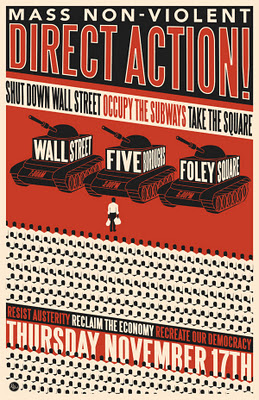
Today, on the two month anniversary of the Occupy Wall Street movement, a  massive day of direct action is planned.  Here's the link for national and international events.

Dave Johnson at Campaign for America's Future writes that the "National Day Of Action looks like it will be really big. People will be out doing things all over the country. There will be all kinds of events that say, "We are the 99%!" My  favorite is people will be gathering in front of various decaying bridges, to demonstrate that our #1 need is jobs and our #1 place to put people to work is rebuilding our decaying infrastructure."

The big day comes on the  heels of polling which suggests support for the Occupy movement is waning.  As David Atkins observes this is hardly surprising given the "constant negative stories in the press about supposed poor behavior" and that the "focus of the movement has become more about the process of occupying ground and conflicts with police, than about the original reasons for the protest in the first place."  He also points out that "advocacy for social justice has never really been publicly popular at the time."

Pollster Tom Jensen explains that the bad poll numbers don't "reflect Americans being unconcerned with wealth inequality"and that "what the downturn in Occupy Wall Street's image suggests is that voters are seeing the movement as more about the 'Occupy' than the 'Wall Street.'  The controversy over the protests is starting to drown out the actual message."

Todd Gitlin at openDemocracy points out that "tactical changes" were already afoot before the clearing of Zucotti Park; that Occupy Wall Street "was already evolving and the movement was, and remains, a lot bigger than the Zuccotti Park’s half-acre."  Spin-off groups "were already organizing direct actions elsewhere around the city, such as demonstrations at bank branches, foreclosure hearings and subway stations."  And, as noted above, massive and varied actions around the country and internationally are planned for today.

Nevertheless, Gitlin warns of traps that have opened up for the movement, which are particularly relevant in light of the recent polling:

Wednesday, November 16, 2011

The Super Committee Must Fail

Donkey Hotey
Robert Borosage has long been a leading voice for progressive politics in the United States. He is the founder and president of the Institute for America’s Future and co-director of its sister organization, the Campaign for America’s Future, vital organizations which develop policies, message and issue campaigns to help forge an enduring majority for progressive change.  The following is prepared testimony from Borosage delivered today to the Congressional Progressive Caucus's Hearing on Jobs, cross-posted from Campaign for America's Future.

I thank the Congressional Progressive Caucus for holding this hearing. I am honored by the invitation to participate. I want to the salute the CPC, and its co-chairs Rep. Keith Ellison and Rep. Raul Grijalva, for being a voice of reason in a Congress and a Capitol that has lost its way. Your leadership – from the People’s Budget, to this summer remarkable Jobs Tour, to the “Rebuild the American Dream” Jobs Framework that you have championed – has provided Americans with a clear way out of the mess that we are in. And now, as we head towards what is a foolish debate about the potential recommendations of the Super Committee, that misbegotten offspring of the calamitous debt ceiling deal this summer, your leadership and your voice are more important than ever.

Today, I want to speak candidly about the situation this nation faces. Tomorrow, tens of thousands of Americans across this country will demonstrate to demand jobs, not cuts, from the Congress. They demand action on jobs, and opposition to cuts in Social Security, Medicare, Medicaid and services vital to Americans. These demonstrators represent the 99%. As poll after poll has shown, they give voice to the priorities of the vast majorities of Americans. Authorities can remove Occupy Wall Street from Liberty Park, but they cannot silence an idea whose time has come. And this Congress should take heed.

Let me lay out the case clearly and make three points. 1. For this nation to succeed, the Super Committee must fail. 2. It is time to put people to work. 3. Shared Sacrifice is for suckers.

Tuesday, November 15, 2011

Super Collusion: Will Obama and The Democrats Betray The Middle Class, Seniors And The Poor?

By Richard (RJ) Eskow, cross-posted from Campaign for America's Future

Two new reports suggest that the President and Congressional Democrats are about to betray everything Democrats once stood for. Under pressure from Barack Obama, Democrats on the "Super Committee" have sketched out an appalling "compromise" proposal that would almost certainly doom both their 2012 electoral chances and his own.

They'd have it coming. Their draft plan literally takes crutches away from poor people to protect tax breaks for the wealthy.

Unfortunately, middle class and impoverished Americans would suffer much more than they would. Career politicians can always look forward to comfortable sinecures from the wealthy interests who will benefit from their proposal. But the rest of us would once again be punished for the excesses of the rich, then left to the untender mercies of our new Republican leaders.

That, and not the fate of a President or a party, would be the real tragedy.

Pain Threshold

The President's actively pressuring Super Committee members from both parties to come up with a budget-slashing deal, according to a report in today's Washington Post. In addition, Obama is also urging them not to cancel the automatic $1.2 trillion in cuts that would be triggered under current law if they fail to make an agreement.

Another story, from the Huffington Post's Sam Stein, gave details on the Democrats' latest proposed "compromise." These two stories paint the picture of a President and a party who are willing to keep taxes low for the wealthy, and who would pay for it by proposing cuts that punish seniors, doctors and the poor.

Why? So they can say they "successfully governed" with extremist Republicans? To please international markets that, in reality, couldn't care less? So the President can campaign as "above left and right," as if differences in principle are a bad thing? Because they've been spiritually suffocated by the cultural norms of Washington's insular culture?

There are more questions than answers. Here's one more: With Democrats like this, who needs Republicans?

Friday, November 11, 2011

Trigger Happy: Why Deficit Cuts Should Only Happen When Unemployment Reaches 5 Percent

By Robert Reich, cross-posted from his website

On planet Washington, where reducing the federal budget deficit continues to be more important than creating jobs, everyone is talking about “triggers” that automatically go into effect if certain other things don’t happen.

Yet no one is talking about the most obvious trigger of all — no budget cuts until the official level of unemployment falls to 5 percent, its level before the Great Recession.

The biggest trigger on the minds of Washington insiders is $1.2 trillion across-the-board cuts that will automatically occur if Congress’s supercommittee doesn’t come up with at least $1.2 trillion of cuts on its own that Congress agrees to by December 23.

That automatic trigger seems likelier by the day because at this point the odds of an agreement are roughly zero.

Here’s the truly insane thing: The triggered cuts start in 2013, a little over a year from now.

Yet no one in their right mind believes unemployment will be lower than 8 percent by then.

The cuts will come on top of the expiration of extended unemployment benefits, the end of a payroll tax cut, and continuing reductions in state and local budgets — all when American consumers (whose spending is 70 percent of the economy) will still be reeling from declining jobs and wages and plunging home prices. Even if Europe’s debt crisis doesn’t by then threaten a global financial meltdown, this rush toward austerity couldn’t come at a worse time.

In other words, what will really be triggered is a deeper recession and higher unemployment.

Tuesday, November 8, 2011

A Super Committee "Failure" Wouldn't Hurt The Economy; But A "Success" Sure Would

By Richard (RJ) Eskow, cross-posted from Campaign for America's Future

An alarmist editorial in today's New York Times urges the Super Committee to reach a deal before their rapidly approaching deadline.  The Times warns that "walking away at this point would be an embarrassment for Congress and a far-reaching blow to Washington’s financial credibility."  As for the first concern, can Congress really be further shamed or embarrassed at this point?  And does it matter?  As for whether the Super Committee's failure would be financially damaging to the country, RJ Eskow writes below that reaching an agreement would be worse.  -- Lovechilde

DonkeyHotey
Some Democrats have come under a lot of criticism lately, much of it deserved, for abandoning popular and important programs that were historically associated with their party. But some of the other Democrats - the ones who are trying to act in the country's best interests - are genuinely concerned about what will happen to the economy if the Super Committee fails to come up with a plan.

This message is for them - and anyone else who has the same concern. You need to know that the evidence is clear: A Super Committee failure won't hurt the economy at all.
But its "success" almost certainly would.

Economic Y2K

Every month it seems as if there's another "bipartisan" process designed to impose austerity on the American people. And every month we're told there will be terrible consequences in the world's markets if it doesn't succeed. These predictions are the economic equivalent of "Y2K" - always apocalyptic, never true, and all too frequently believed.

Democratic officials and staffers are being bombarded by these predictions, delivered by think-tank operatives from their own party who have been steeped in the cult of austerity. It doesn't matter how many times they're refuted by impeccably constructed papers, or by the observations of Nobel Prize winners. And it doesn't matter how many times these predictions are proven wrong.

Some of the experts warning of doom if the "Super Committee" fails said the same thing about last year's Deficit Commission, too. What happened when that "bipartisan" body deadlocked, and the private plan put forward by its co-chairs went nowhere?

Nothing.

Now the same players are telling us the stock market will plummet without a Super Committee plan. They're saying there will be more downgrades of the US government by credit rating "agencies," and that this will bring disastrous consequences. And they're saying that international markets will lose confidence in Treasury bonds.

But recent history teaches us that the exact opposite is likely to happen.

Monday, November 7, 2011

Will We, The People Have A Say On The Supercommittee's Austerity Plan?

By Dave Johnson, cross-posted from Campaign for America's Future

by DonkeyHotey
Congress' "supercommittee" of the 1% is preparing an austerity plan for the 99%. Will We, the People be allowed to vote on this plan, or, like Greece, will the elites just tell us how it is going to be? Our deficits were caused by tax cuts for the rich and huge increases in military spending. But instead of addressing these causes the elite supercommittee is said to be preparing to take money out of the economy by cutting the things We, the People do for each other. That's right, at the very time when 99% of us need more we will get less so that the 1% can enjoy record-low tax rates -- and it looks like We, the People will have no say in it.

Last week Greek Prime Minister George Papandreou proposed a referendum on the austerity plan that European governments are preparing for the country. "The markets" -- another name for the 1% -- went berserk in reaction. Pressure was applied, and now the Greek people will not be allowed to vote on their austerity plan after all, they will just be told. Richard Eskow writes about this elite veto power over democracy, in Vetoing Democracy: In Athens or Washington, Elites Still Call the Shots,
And what was most striking was the assumption the elite - the 1%, if you will - have veto power over the democratic process. In most of the commentary that flowed from the powerful and the press, a surprising number of world leader didn't even acknowledge that Greece had the right to its own democratic decision-making process.
South Korean President Lee Myung-bak, whose nation will benefit from "bipartisan" U.S. actions to create a free trade agreement between the two countries, said that "The world has plunged into fears again because of the Greek prime minister's radical step to hold a referendum." Closer to home, French President Sarkozy said that "the Greek's gesture is irrational and, from their point of view, dangerous."
The first part of that statement is a slur against democracy. The second part is, of course, a threat.
Here we are a year after our first post-Citizens United election, in which corporations were allowed to use money to directly influence our elections (as compared to indirectly influencing elections by funding the conservative movement and their organizations, think tanks, media, operatives, propaganda machine, smear machine, etc.). Here we are with the results, a year with no jobs plan from the corporate-elected House majority and a year of filibusters of jobs plans by the corporate-elected Senate Republicans. Here we are with people in the streets, like in Greece, being met with police force, like in Egypt. Meanwhile our Congress pretends it can just ignore the will of We, the People. Mubarak tried that - didn't end so well for him.

So, will We, the People be allowed to have a say over this austerity plan, or will it be like Greece all over again, told by the 1% how it's gonna be?

Or, maybe, Egypt?

Thursday, November 3, 2011

Washington Pre-Occupied

By Robert Reich, cross-posted from his website

The biggest question in America these days is how to revive the economy.

The biggest question among activists now occupying Wall Street and dozens of other cities is how to strike back against the nation’s almost unprecedented concentration of income, wealth, and political power in the top 1 percent.

The two questions are related. With so much income and wealth concentrated at the top, the vast middle class no longer has the purchasing power to buy what the economy is capable of producing. (People could pretend otherwise as long as they could treat their homes as ATMs, but those days are now gone.) The result is prolonged stagnation and high unemployment as far as the eye can see.

Until we reverse the trend toward inequality, the economy can’t be revived.

But the biggest question in our nation’s capital right now has nothing to do with any of this. It’s whether Congress’s so-called “Supercommittee” – six Democrats and six Republicans charged with coming up with $1.2 trillion in budget savings — will reach agreement in time for the Congressional Budget Office to score its proposal, which must then be approved by Congress before Christmas recess in order to avoid an automatic $1.5 trillion in budget savings requiring major across-the-board cuts starting in 2013.

Have your eyes already glazed over?

Diffident Democrats on the Supercommittee have already signaled a willingness to cut Medicare, Social Security, and much else that Americans depend on. The deal is being held up by Regressive Republicans who won’t raise taxes on the rich – not even a tiny bit.

President Obama, meanwhile, is out on the stump trying to sell his “jobs bill” – which would, by the White House’s own estimate, create fewer than 2 million jobs. Yet 14 million people are out of work, and another 10 million are working part-time who’d rather have full-time jobs.

Republicans have already voted down his jobs bill anyway.

The disconnect between Washington and the rest of the nation hasn’t been this wide since the late 1960s.

The two worlds are on a collision course: Americans who are losing their jobs or their pay and can’t pay their bills are growing increasingly desperate. Washington insiders, deficit hawks, regressive Republicans, diffident Democrats, well-coiffed lobbyists, and the lobbyists’ wealthy patrons on Wall Street and in corporate suites haven’t a clue or couldn’t care less.

I can’t tell you when the collision will occur but I’d guess 2012.

Look elsewhere around the world and you see a similar collision unfolding. The details differ but the larger forces are similar. You see it in Spain, Greece, and Italy, whose citizens are being squeezed by bankers insisting on austerity. You see it in Chile and Israel, whose young people are in revolt. In the Middle East, whose “Arab spring” is becoming a complex Arab fall and winter. Even in China, whose young and hourly workers are demanding more – and whose surge toward inequality in recent years has been as breathtaking as is its surge toward modern capitalism.

Will 2012 go down in history like other years that shook the foundations of the world’s political economy – 1968 and 1989?

I spent part of yesterday in Oakland, California. The Occupier movement is still in its infancy in the United States, but it cannot be stopped. Here, as elsewhere, people are outraged at what feels like a rigged game – an economy that won’t respond, a democracy that won’t listen, and a financial sector that holds all the cards.

Here, as elsewhere, the people are rising.

Robert Reich is Chancellor's Professor of Public Policy at the University of California at Berkeley.  He writes a blog at www.robertreich.org.  His most recent book is Aftershock.

Wednesday, November 2, 2011

Greece's Choice -- And Ours: Democracy Or Finance?

By Robert Reich, cross-posted from his website

Which do you trust more: democracy or financial markets?

Greek Prime Minister George Papandreou decided in favor of democracy yesterday when he announced a national referendum on the draconian budget cuts Europe and the IMF are demanding from Greece in return for bailing it out.

(Or, more accurately, the cuts Europe and the IMF are demanding for bailing out big European banks that have lent Greece lots of money and stand to lose big if Greece defaults on those loans – not to mention Wall Street banks that will also suffer because of their intertwined financial connections with European banks.)

If Greeks accept the bailout terms, unemployment will rise even further in Greece, public services will be cut more than they have already, the Greek economy will contract, and the standard of living of most Greeks will deteriorate further.

If Greeks reject the terms and the nation defaults, it will face far higher borrowing costs in the future. This may reduce the standard of living of most Greeks, too. But it doesn’t have to. Without the austerity measures the rest of Europe and the IMF are demanding, the Greek economy has a better chance of growing and more Greeks are likely to find jobs.

Shouldn’t Greeks be able to make this decision for themselves?

Monday, October 31, 2011

Austerity Class Warfare

We all know that during high unemployment and a stagnant economy, what is needed is a boost from the federal government -- or what one might call "stimulus."  (As John Maynard Keynes explained 75 years ago, and Robert Reich continues to instruct us today, when consumers and businesses can’t boost the economy on their own, the responsibility must fall to the government.)  But instead, the focus over the last two years has been on the need for less federal spending and the overarching concern has been to reduce the long-term deficit.  Only recently, thanks to Occupy Wall Street and the President's belated "pivot" to jobs has the conversation begun to change.  But this still leaves the question why the deficit fetishists remain so prominent  -- why failed policies of the past that involve tax cuts for the rich, reduced federal spending and more federal regulation continue to remain so influential -- and not just in Republican circles.

Ari Berman, in a great new piece in The Nation, describes this as "a central paradox" in American politics:
How, in the midst of a massive unemployment crisis—when it’s painfully obvious that not enough jobs are being created and the public overwhelmingly wants policy-makers to focus on creating them—did the deficit emerge as the most pressing issue in the country? And why, when the global evidence clearly indicates that austerity measures will raise unemployment and hinder, not accelerate, growth, do advocates of austerity retain such distinction today?
Berman provides the answer:
An explanation can be found in the prominence of an influential and aggressive austerity class—an allegedly centrist coalition of politicians, wonks and pundits who are considered indisputably wise custodians of US economic policy. These “very serious people,” as New York Times columnist Paul Krugman wryly dubs them, have achieved what University of California, Berkeley, economist Brad DeLong calls “intellectual hegemony over the course of the debate in Washington, from 2009 until today.”

Its members include Wall Street titans like Pete Peterson and Robert Rubin; deficit-hawk groups like the CRFB, the Concord Coalition, the Hamilton Project, the Committee for Economic Development, Third Way and the Bipartisan Policy Center; budget wonks like Peter Orszag, Alice Rivlin, David Walker and Douglas Holtz-Eakin; red state Democrats in Congress like Mark Warner and Kent Conrad, the bipartisan “Gang of Six” and what’s left of the Blue Dog Coalition; influential pundits like Tom Friedman and David Brooks of the New York Times, Niall Ferguson and the Washington Post editorial page; and a parade of blue ribbon commissions, most notably Bowles-Simpson, whose members formed the all-star team of the austerity class.
This "austerity class" is a relentless presence in Washington and in the mainstream media.  Its various strands "form a reinforcing web that is difficult to break. Its think tanks and wonks produce a relentless stream of disturbing statistics warning of skyrocketing debt and looming bankruptcy, which in turn is trumpeted by politicians and the press and internalized by the public."  The result is what Greg Sargent calls "a Beltway Deficit Feedback Loop, wherein the hypothetical possibility of a US debt crisis somewhere in the future takes precedence over the very real jobs crisis now."

In addition, much to our misfortune, this group is profoundly influential over the current Administration:

Monday, October 24, 2011

Occupy Wall Street For Dummies (aka Pundits)

Tom Tomorrow
"If you are a political pundit and you still don't know what Occupy Wall Street stands for, you are an idiot," says Hunter at Daily Kos.  And to help those idiots, he provides a primer.  Here is a condensed version:

-- It a protest specifically against the members of the financial sector, who were bailed out at taxpayer expense after wrecking the economy
-- It is a protest against the perceived entitlement of the wealthy, for whom any slight economic injury (say, from taxes) is seen as an apocalyptic event, and for whose sake austerity must be imposed on every other group.
-- It is a protest against a government that seems to exist solely to meet the needs of wealthy and corporate benefactors.
-- It is not a protest against TARP; it is a protest against the failure of TARP to achieve even a stick of reform in exchange for the body blow dealt to the rest of us.
-- It is not a protest against political parties, but against a system that has been so corrupted that the needs of the one percent are considered of greater merit than that of the entire rest of the population.
-- It is not "against corporations." It is against the excesses of corporations
-- It is not "against the rich." It is against the rich being catered to at the expense of every other citizen.
-- It is about the unemployment crisis being absolutely ignored.
-- It is pro-worker, in that it is a reaction against workers being treated as increasingly disposable, abusable commodities by the companies that employ them.
-- It is neither pro-tax or anti-tax; it is against the disparity of treatment between rich and poor, when it comes time to pay those taxes.
-- It demands a voice in government, and a voice in the punditry that struggles so painfully to grasp what the little people are going on about.
-- Above all, perhaps, it is an objection to the notion that corporations do not just have rights and privileges equal to people, but in fact have rights superior to the rights of people, rights which are appended on in the name of free enterprise and seen by lawmakers and courts alike as being far more obvious and inviolate than those of you or me.

Pretty straightforward.  And for those pundits who remain baffled by the Occupy movement, Hunter concludes:
If you feel ideologically bound to ignore it, fine, but claiming you do not understand it only brands you as a mind too easily taxed to be of much use in the public sphere.  If you understand the grievances of the Occupy movement, feel free to either engage or rebut those complaints. If you do not understand them, then go away, for you are too lazy, too self absorbed, or too ignorant to do the job.

Saturday, October 15, 2011

Wall Street: Icon Of Revusion

Thousands of Occupy Wall Street-related demonstrations are happening today, not only here in the U.S., but in at least 80 countries.  (Chris Bowers at Daily Kos has the rundown.)  Below, Steve Fraser provides a historical perspective, explaining that the OWS movement has tapped into a long and vibrant tradition.

A Century of Our Streets vs. Wall Street

By Steve Fraser, cross-posted from Tom Dispatch
 
Occupy Wall Street, the ongoing demonstration-cum-sleep-in that began a month ago not far from the New York Stock Exchange and has since spread like wildfire to cities around the country, may be a game-changer.  If so, it couldn’t be more appropriate or more in the American grain that, when the game changed, Wall Street was directly in the sights of the protesters.

The fact is that the end of the world as we’ve known it has been taking place all around us for some time.  Until recently, however, thickets of political verbiage about cutting this and taxing that, about the glories of “job creators” and the need to preserve “the American dream,” have obscured what was hiding in plain sight -- that street of streets, known to generations of our ancestors as “the street of torments.”

After an absence of well over half a century, Wall Street is back, center stage, as the preferred American icon of revulsion, a status it held for a fair share of our history.  And we can thank a small bunch of campers in Manhattan’s Zuccotti Park for hooking us up to a venerable tradition of resistance and rebellion.
  
The Street of Torments

Peering back at a largely forgotten terrain of struggle against “the Street,” so full of sound and fury signifying quite a lot, it’s astonishing -- to a historian of Wall Street, at least -- that the present movement didn’t happen sooner.  It’s already hard to remember that only weeks ago, three years into the near shutdown of the world financial system and the Great Recession, an eerie unprotesting silence still blanketed the country.

Stories accumulated of Wall Street greed and arrogance, astonishing tales of incompetence and larceny.  The economy slowed and stalled.  People lost their homes and jobs. Poverty reached record levels.  The political system proved as bankrupt as the big banks.  Bipartisan consensus emerged -- but only around the effort to save “too big to fail” financial goliaths, not the legions of victims their financial wilding had left in its wake.

The political class then prescribed what people already had plenty of: yet another dose of austerity plus a faith-based belief in a “recovery” that, for 99% of Americans, was never much more than an optical illusion.  In those years, the hopes of ordinary people for a chance at a decent future withered and bitterness set in. 

Strangely, however, popular resistance was hard to find.  In the light of American history, this passivity was surpassingly odd.  From decades before the Gilded Age of the late nineteenth century through the Great Depression, again and again Wall Street found itself in the crosshairs of an outraged citizenry mobilized thanks to political parties, labor unions, or leagues of the unemployed.  Such movements were filled with a polyglot mix of middle-class anti-trust reformers, bankrupted small businessmen, dispossessed farmers, tenants and sharecroppers, out-of-work laborers, and so many others.

If Occupy Wall Street signals the end of our own, atypical period of acquiescence, could a return to a version of “class warfare” that would, once upon a time, have been familiar to so many Americans be on the horizon?  Finally!

Monday, October 3, 2011

What Should Progressives Do About The President

By Richard (RJ) Eskow, cross-posted from Campaign for America's Future

Progressives may sometimes feel like they're in a backdoor high-school affair with the president. You know the kind: The popular kid will make out with someone from the wrong side of the tracks. But he'll only take a rich kid from "the right kind of family" to the school dance.

The president often courts the left when he needs it, only to pitch his actions to the right at clinch time. Right-wing ideology is often mistakenly called the "center" today, despite holding views that are so conservative they're often rejected by Republicans as well as Democrats. But it's the right all the same.

Lately the president has made some significant moves toward the left, but the response has been cool in some progressive corners. The skepticism's understandable. His 2008 platform was progressive too, but after he was elected he tacked sharply right without even bothering to explain the shift. Progressives don't want to keep feeling like the kid who 'puts out' in the backseat of a convertible and then is all alone on prom night.

But if you believe (as I do) that the progressive movement should be independent of Barack Obama and the Democrats, then the decision to work with them should be made strategically. There are times to oppose them, but there are also times to support, encourage, and persuade them.

The president's new progressive moves aren't enough, and they're still watered down with unproductive and unpopular rightwing notions. But they are a move in the right direction. He deserves some credit for that.

The progressive movement does too. So what's next?