Showing posts with label #Occupy. Show all posts

Friday, June 15, 2012

Occupy Rio+20

By Marcia Ishii-Eiteman, cross-posted from PAN's website

Governments are gathering in Brazil, twenty years after the historic 1992 Earth Summit where nations around the world pledged to devote themselves to ending hunger and conserving the planet’s resources for future generations.

This week, governments gather once again, and food and agriculture are high on the agenda of “Rio+20.” Global leaders will be discussing which way forward to feed the world amidst growing food, climate and water crises. Monsanto & Co. have geared up with slick websites and sound bytes — to the point where some have dubbed the official meeting “Greenwash +20.” But the good news is that people around the world are mobilizing like never before for a new food system.

What, GE won’t feed the world?! 

The first Rio gathering in 1992 marked an important historical moment when nations came together with inspiring goals and commitments to keep our planet from going off the rails and to save and replenish the ecosystems that are required for life to continue. But 20 years on, the report card on progress is bleak, and tragically, this meeting (like Copenhagen and too many others) promises more hot air and no progress.

Of profound concern is the undue influence exerted by multinational corporations who have entered the “sustainability” and “green” debate with predictable zeal. The recently released report Greenwash +20 documents how multinational corporate interests thwart government action toward real sustainable development. In food and agriculture, the report exposes the Big 6 player Syngenta, in particular, for its role in suppressing science, influencing the public conversation to bolster profits, and shadow-writing public policy.

Despite the best attempts of the Big 6 pesticide/biotech companies to persuade us that their toxic chemicals and expensive patented seeds are needed, here’s the real deal: GE crops haven’t delivered on 20 years of empty promises. No yield gains, no drought-tolerance, no nutritional improvement.

Rather, farmers signing contracts with Big 6 players have lost their land and their right to save and exchange seed, have fallen deeper into debt, seen their communities wither, stores shuttered, schools closed...The greatest benefits from the sale of GE seeds and the pesticides that go with them have consistently accrued to their manufacturers, companies like Monsanto which more than doubled its profits at the height of the global food price crisis of 2008. We know this to be true from the words of farmers — whether in Iowa or India — and from the hard facts presented to us by independent scientists.

People Power

The heartening news is that farmers and scientists around the world know better than to believe the Biotech Brigade. From Berkeley to Brazil, there is incredible momentum gathering like never before to democratize our food system. This momentum is manifested in the thousands of people gathering at the People’s Summit in Rio. Here peasant farmers, community and social movement leaders, policy advocates, researchers and academics are sharing their knowledge and stories of how communities and entire nations are building strong and vibrant local and regional food systems without buying into corporate dependency.

This “unofficial” meeting, already going on, is where the smarts and solutions lie. Two full days will be dedicated to agroecology and the science and organizing required to build an ecologically sane and democratic food and farming system. While official meetings miles away in walled-off rooms promise entrenchment and false hope, the agroecology meeting has sparked the analysis and relationship-building needed to fuel our movement for change.

Here are some exciting products already coming out of Rio:
The global people’s gathering in Rio shows that there’s more movement than ever for Food Democracy. It’s up to us to create this change. Here are three ways to engage today:
  • Sign the statement from Occupy Rio+20.
  • Join PAN’s alert list, where you’ll get updates on how to take action for food democracy and a healthy planet. Right now, we’re supporting the brave Mothers of Argentina vs. Monsanto in our online action with the White House.
  • Play “Game Change Rio,” a game that raises awareness of the issues we’ll need to address if future generations are to enjoy life on this planet. (Demo video here).
As the leader of PAN’s Food Democracy campaign team, I’m thrilled by the public conversations taking place in Rio and the momentum powering social movements around the world. Join us.

Monday, June 11, 2012

Hijacking The Wisconsin Uprising

Why Electoral Politics Sold Out the Popular Uprising in the Badger State -- and Why It’s Not All Over 

By Andy Kroll, cross-posted from TomDispatch

The revelers watched in stunned disbelief, cocktails in hand, dressed for a night to remember. On the big-screen TV a headline screamed in crimson red: "Projected Winner: Scott Walker." It was 8:49 p.m. In parts of Milwaukee, people learned that news networks had declared Wisconsin’s governor the winner while still in line to cast their votes. At the election night party for Walker's opponent, Milwaukee Mayor Tom Barrett, supporters talked and cried and ordered more drinks. Barrett soon took the stage to concede, then waded into the crowd where a distraught woman slapped him in the face.

Walker is the first governor in American history to win a recall election. His lieutenant governor, Rebecca Kleefisch, dispatched her recall challenger no less decisively. So, too, did three Republican state senators in their recall elections. Democrats avoided a GOP sweep with a win in the sixth and final senate recall vote of the season, in Wisconsin's southeastern 21st district, but that was small consolation. Put simply, Democrats and labor unions got rolled.

The results of Tuesday's elections are being heralded as the death of public-employee unions, if not the death of organized labor itself. Tuesday's results are also seen as the final chapter in the story of the populist uprising that burst into life last year in the state capital of Madison. The Cheddar Revolution, so the argument goes, was buried in a mountain of ballots.

But that burial ceremony may prove premature. Most of the conclusions of the last few days, left and right, are likely wrong.


The energy of the Wisconsin uprising was never electoral. The movement’s mistake: letting itself be channeled solely into traditional politics, into the usual box of uninspired candidates and the usual line-up of debates, primaries, and general elections. The uprising was too broad and diverse to fit electoral politics comfortably. You can't play a symphony with a single instrument. Nor can you funnel the energy and outrage of a popular movement into a single race, behind a single well-worn candidate, at a time when all the money in the world from corporate “individuals” and right-wing billionaires is pouring into races like the Walker recall.

Tuesday, May 1, 2012

Quote Of The Day

"Today, the struggle continues to celebrate May Day not as a "law day" as defined by political leaders, but as a day whose meaning is decided by the people, a day rooted in organizing and working for a better future for the whole of society."
-- Noam Chomsky, Zuccotti Park Press

Welcome To The 2012 Hunger Games

Sending Debt Peonage, Poverty, and Freaky Weather Into The Arena

By Rebecca Solnit, cross-posted from TomDispatch

When I was growing up, I ate books for breakfast, lunch, and dinner, and since I was constantly running out of reading material, I read everyone else’s -- which for a girl with older brothers meant science fiction. The books were supposed to be about the future, but they always turned out to be very much about this very moment.

Some of them -- Robert Heinlein’s Stranger in a Strange Land -- were comically of their time: that novel’s vision of the good life seemed to owe an awful lot to the Playboy Mansion in its prime, only with telepathy and being nice added in. Frank Herbert’s Dune had similarly sixties social mores, but its vision of an intergalactic world of disciplined desert jihadis and a great game for the substance that made all long-distance transit possible is even more relevant now.  Think: drug cartels meet the oil industry in the deep desert.

We now live in a world that is wilder than a lot of science fiction from my youth. My phone is 58 times faster than IBM’s fastest mainframe computer in 1964 (calculates my older brother Steve) and more powerful than the computers on the Apollo spaceship we landed on the moon in 1969 (adds my nephew Jason). Though we never got the promised jetpacks and the Martians were a bust, we do live in a time when genetic engineers use jellyfish genes to make mammals glow in the dark and nerds in southern Nevada kill people in Pakistan and Afghanistan with unmanned drones.  Anyone who time-traveled from the sixties would be astonished by our age, for its wonders and its horrors and its profound social changes. But science fiction is about the present more than the future, and we do have a new science fiction trilogy that’s perfect for this very moment.

Sacrificing the Young in the Arenas of Capital 

The Hunger Games, Suzanne Collins’s bestselling young-adult novel and top-grossing blockbuster movie, is all about this very moment in so many ways. For those of you hiding out deep in the woods, it’s set in a dystopian future North America, a continent divided into downtrodden, fearful districts ruled by a decadent, luxurious oligarchy in the Capitol. Supposedly to punish the districts for an uprising 74 years ago, but really to provide Roman-style blood and circuses to intimidate and distract, the Capitol requires each district to provide two adolescent Tributes, drawn by lottery each year, to compete in the gladiatorial Hunger Games broadcast across the nation.

That these 24 youths battle each other to the death with one lone victor allowed to survive makes it like -- and yet not exactly like -- high school, that concentration camp for angst and competition into which we force our young. After all, even such real-life situations can be fatal: witness the gay Iowa teen who took his life only a few weeks ago after being outed and taunted by his peers, not to speak of the epidemic of other suicides by queer teens that Dan Savage’s “It Gets Better” website, film, and books aspire to reduce.

But really, in this moment, the cruelty of teens to teens is far from the most atrocious thing in the land. The Hunger Games reminds us of that.  Its Capitol is, of course, the land of the 1%, a sort of amalgamation of Fashion Week, Versailles, and the KGB/CIA. Collins’s timely trilogy makes it clear that the 1%, having created a system of deeply embedded cruelty, should go, something highlighted by the surly defiance of heroine Katniss Everdeen -- Annie Oakley, Tank Girl, and Robin Hood all rolled into one -- who refuses to be disposed of.

Now, in our world, gladiatorial entertainment and the disposability of the young are mostly separate things (except in football, boxing, hockey, and other contact sports that regularly result in brain damage, and sometimes even in death). But while the Capitol is portrayed as brutal for annually sacrificing 23 teenagers from the Districts, what about our own Capitol in the District of Columbia? It has a war or two on, if you hadn’t noticed.

In Iraq, 4,486 mostly young Americans died.  If you want to count Iraqis (which you should indeed want to do), the deaths of babies, children, grandmothers, young men, and others total more than 106,000 by the most conservative count, hundreds of thousands by others. Even the lowest numbers represent enough kill to fill nearly 5,000 years of Hunger Games.

Then, of course, there are thousands more Americans who were so grievously wounded they might have died in previous conflicts, but are now surviving with severe brain damage, multiple missing limbs, or other profound mutilations. And don’t forget the trauma and mental illness that mostly goes unacknowledged and untreated or the far more devastating Iraqi version of the same. And never mind Afghanistan, with its own grim numbers and horrific consequences.

Our wartime carnage has been on a grand scale, but it hasn’t been on television in any meaningful way; it’s generally been semi-hidden by most of the American media and the government, which censored images of returning coffins, corpses, civilian casualties, and anything else uncomfortable (though in our science-fiction era when every phone is potentially a video camera, the leakage has still been colossal). Most of us did a good job of being distracted by other things -- including reality TV, of course.  The US Ambassador and military commander in Afghanistan were furious not that our soldiers struck jokey poses with severed limbs, but that the Los Angeles Times dared to publish them last month. And those whistleblowers who took the effort to reveal the little men behind the throne are facing severe punishment.  Witness one Hunger-Games-style hero, Bradley Manning, the slight young soldier turned alleged leaker, long held in inhumane conditions and now facing a potential life sentence.

Monday, April 30, 2012

Occupy May Day

Eric Drooker
 By Sarah Van Gelder, cross-posted from Yes Magazine

If the mainstream media was confused about Occupy Wall Street in its early days in Zuccotti Park, they’re bound to be completely befuddled this May Day.

May Day already has a lot piled on it. In pre-Christian Europe, May Day was a time to dance, light bonfires, sing, and carry on in celebration of the changing seasons. May Day also marks the anniversary of the 1886 Haymarket massacre, which occurred during a Chicago strike for the eight-hour work day. Also called International Workers’ Day, it’s a holiday in more than 80 countries.

And most recently, the U.S. immigrants right movement has used May 1st for massive street demonstrations and strikes aimed at reforming laws and policies that result in imprisonment, deportation, and discrimination against undocumented people.

This May Day, the Occupy movement is getting involved, calling it “The day without the 99 percent.” What will May Day look like with so many traditions riding on it?

May Day Collaborations—from Bike Caravan to Free University

The way plans are shaping up, in at least some locations around the United States, it could be big, festive, and importantly, include elements of all the May Day traditions. And it could be profoundly different than the big days of action we’ve seen in the past. In the weeks leading up to May Day, various movements have been collaborating. And people will not only be protesting, they’ll be liberating spaces for education, the arts, general assemblies, and teach-ins.

There will be marches, of course. Some permitted, planned, and predictable. Others will be spontaneous, possibly disruptive. In spite of all the police planning (and collaboration with Wall Street private security forces) law enforcement will be kept guessing.

There will be fairs, free food, teach-ins, music, bicycling, marches, and fiestas.

In New York, occupiers are leading up to May Day by organizing 99 pickets in support of workers around the city, from jazz musicians to taxi drivers to laundry workers. The LGBTQTSGNC (Lesbian, Gay, Bisexual, Queer, Trans, Two-Spirit and Gender Non-Conforming) contingent will be out in force. They’ll be a “Guitarmy” marching from New York’s Bryant Park to Madison Square Park, with 1,000 guitars.

At Madison Square Park, there will be a Free University, organized by students fed up with tuition hikes and a student debt burden that’s now reached $1 trillion. Educators will bring classes to the park, there will be skill sharing and workshops.

At Bryant Park, they’ll be a “free” market—where everything is actually free— as well as public art and “opportunities for action.”

In Los Angeles, bike and car caravans will travel to the city center from the four cardinal directions. Along the way, there may be union strike action, and there will be “flash occupations,” free food, and direct action along the way, targeting the foreclosure crisis. Tuition hikes, income inequality, immigrant rights, police violence, the criminalizing of the homeless—the Los Angeles caravans each will focus on some combination of these topics.

In the San Francisco Bay area, nurses and social workers have declared a strike. Bridge and transportation workers and occupiers will attempt to shut down the Golden Gate Bridge. There will be “flying pickets” to shut down banks and business associations.

In Seattle, the group Hip Hop Occupiers to Decolonize is inviting artists, families, and the general public to a day of music, dance, live art, and speakers. There will also be marches of immigrants, occupiers, and workers.

Seattle occupiers will be serving free breakfasts to get the day off to a good start, something that can get you fined in Philadelphia, where the mayor has made it illegal to feed the hungry in city parks.
In Portland, occupiers plan to occupy a vacant home and hold a block party.

In Kalamazoo, Mich., they’ll be camped out on the sidewalk in front of the Bank of America, and there’s a good chance they’ll be doing civil disobedience to stop the auction of public land for hydraulic fracking.

The list goes on and on, from small towns in Wyoming to the place where it all started, lower Manhattan.

This broad range of topics and tactics may bewilder mainstream pundits, but it reflects a transformation in activism as profound as anything that’s happened in social change over the past decades. People are moving out of their isolated interest groups and causes. They’re coming together in a shared analysis, demonstrating their agreement about sources of some of our biggest problems—the overwhelming power of Wall Street and big corporations and our society’s continuing struggle with exclusion of people based on their race, gender, sexual orientation, immigration status, etc. And they’re developing shared ambitious goals and bold strategies that add up to real power and real possibility.

As often happens in the planning of a big event, some of the most important work began well before the actual day, with undocumented workers, union organizers, occupiers, and students coming together to plan events. They’re mixing it up across races, ages, backgrounds, and interests.

It’s a day without the 99 percent, say organizers. No work. No school. No housework. No shopping. No banking.

Even more than what people won’t be doing on May 1, though, the day is about showing up and protesting, but also building the world we want.

Monday, March 19, 2012

Occupy At Six Months

Eric Drooker
As the Occupy movement comes out of its winter hibernation, it is worth looking at its impressive record of achievement over its first six months.

As Travis Waldon puts it, "Occupy groups have shifted the national debate on taxes and inequality, helped homeowners stay in their homes, forced major policy issues to the forefront of debate at the state and federal level, and gotten the attention of the institutions they’ve challenged most forcefully."

Here is list compiled by ThinkProgress of Occupy's accomplishments:

Income Inequality: The 99 Percent movement refocused America’s political debate, forcing news outlets and eventually politicians to focus on rising income inequality. While debt and deficits were the primary focus of the media before the movement started, their attention after the movement began shifted to jobs, Wall Street, and unemployment. By the end of October, even Republicans were talking about income inequality, and a week later, Time Magazine devoted its cover to the topic, asking, “Can you still move up in America?

Occupy Our Homes: The movement has drawn attention to many of the predatory, discriminatory, and fraudulent practices perpetrated by banks during the foreclosure crisis, and across the country, Occupy groups, religious leaders, and community organizations have helped homeowners prevent wrongful foreclosures on their homes. Activists in Detroit are working to save their fifth home, and similar actions have taken place in cities like Minneapolis, Los Angeles, Cleveland, and Atlanta. The movement has drawn so much attention that local political leaders and even members of Congress have stepped in to help homeowners facing foreclosure.

Move Your Money: On Bank Transfer Day, activists helped more than 40,000 Americans move their money from large banks to credit unions, and more than 650,000 switched to credit unions last October. Religious groups have taken up the cause as well, moving $55 million before Thanksgiving. This year, a San Francisco interfaith group moved $10 million from Wells Fargo and other groups marked Lent by moving more money from Wall Street. As a result, analysts say the nation’s 10 biggest banks could lose $185 billion in customer deposits this year “due to customer defections.”

Fighting For Positive Policies: Occupy groups have pushed for positive policy outcomes at both the state and federal levels. Occupy The SEC submitted a 325-page comment letter on the Volcker Rule, a regulation to rein in big banks. Pressure from protesters forced New York Gov. Andrew Cuomo (D) to reverse his opposition to a millionaire’s tax, and activists fought Indiana Republicans’ union-busting “right-to-work” law, and have pushed big banks to stop financing destructive environmental practices like mountaintop removal mining in coal states.
Waldon notes that while "many of the camps across the country have been disbanded, the 99 Percent Movement isn’t going away," with organizers continuing to fight on the state level, "pushing back against banks on fraudulent foreclosures and other issues, and [turning] their attention to the 2012 presidential elections."  Meanwhile, leaders in New York "are developing high-tech ways to organize protests and keep the movement going" and "Occupy is starting to assert a political influence, pushing multiple candidates and even running for office themselves — in both Maine and Pennsylvania, former Occupy activists are running for public office."

Tuesday, March 6, 2012

The Dismantling Of California's Schools

By Rose Aguilar, cross-posted from Al Jazeera

I recently invited University of California-Davis sophomore Sarena Grossjan-Navarro to join my radio show - focusing on the Occupy Education actions taking place across the country, and the recent plan to descend on Sacramento to Occupy the Capitol, but she wasn't available. She's taking a heavy load this term, hoping to incur as little debt as possible. She was almost forced to drop out last term because the financial aid she receives is not enough to cover the basics. She's currently sleeping on friends' couches because she can't afford housing.

Grossjan-Navarro was one of the UC-Davis students who got pepper-sprayed by a police officer wearing riot gear during a peaceful protest on November 18, 2011. The students were speaking out against tuition hikes and the brutal treatment of Occupy demonstrators at UC-Berkeley, who were beaten and billy-clubbed a week earlier.

You've might have seen the video, which went viral and received international outrage. Nineteen UC-Davis students and alumni recently sued the University for constitutional violations over the incident, which was not only traumatising, but caused them burning sensations for days.

To say that students and faculty are angry and fed up is putting it lightly. Over the past year, we've seen students across the United States protest, hold walk-outs and teach-ins, and even shut down freeways and bridges. The Occupy movement has energised and yes, even radicalised, a new generation of students who haven't been politically active until now.

They're barely making ends meet. They're going to the school food pantry because they can't afford enough food. They're either racking up debt or are on the verge of dropping out because of ongoing tuition hikes. They deserve better.

Tuesday, February 21, 2012

Occupy Heads Into The Spring

Mad, Passionate Love -- And Violence.  Or Why The Media Loves The Violence Of Protestors And Not Of Banks.

By Rebecca Solnit, cross-posted from Tom Dispatch

Robbie Conal
When you fall in love, it’s all about what you have in common, and you can hardly imagine that there are differences, let alone that you will quarrel over them, or weep about them, or be torn apart by them -- or if all goes well, struggle, learn, and bond more strongly because of, rather than despite, them. The Occupy movement had its glorious honeymoon when old and young, liberal and radical, comfortable and desperate, homeless and tenured all found that what they had in common was so compelling the differences hardly seemed to matter.

Until they did.

Revolutions are always like this: at first all men are brothers and anything is possible, and then, if you’re lucky, the romance of that heady moment ripens into a relationship, instead of a breakup, an abusive marriage, or a murder-suicide. Occupy had its golden age, when those who never before imagined living side-by-side with homeless people found themselves in adjoining tents in public squares.

All sorts of other equalizing forces were present, not least the police brutality that battered the privileged the way that inner-city kids are used to being battered all the time. Part of what we had in common was what we were against: the current economy and the principle of insatiable greed that made it run, as well as the emotional and economic privatization that accompanied it.

This is a system that damages people, and its devastation was on display as never before in the early months of Occupy and related phenomena like the “We are the 99%” website. When it was people facing foreclosure, or who’d lost their jobs, or were thrashing around under avalanches of college or medical debt, they weren’t hard to accept as us, and not them.

And then came the people who’d been damaged far more, the psychologically fragile, the marginal, and the homeless -- some of them endlessly needy and with a huge capacity for disruption. People who had come to fight the power found themselves staying on to figure out available mental-health resources, while others who had wanted to experience a democratic society on a grand scale found themselves trying to solve sanitation problems.

And then there was the violence.

Tuesday, February 14, 2012

Occupy Has Raised Class Consciousness: Now What?

By Rose Aguilar, cross-posted from Truthout

Eric Drooker
The year 2011 will go down in history as the year in which citizens used their collective power to make economic justice part of the national conversation and force the media to focus on real issues rather than the manufactured deficit crisis. Last February, Wisconsinites began demonstrating and, eventually, occupying their state Capitol to stop attacks on public workers, collective bargaining and unions.

Since Occupy Wall Street kicked off on September 17, Occupy demonstrators across the country have raised awareness about the widening wealth gap, inequality, rising student debt, criminal activity on Wall Street, poverty and home foreclosures.

Politico's Dylan Byers did a quick search of the news via Lexis Nexis and found a significant rise in the use of the term "income inequality," from less than 91 instances in the week before Occupy Wall Street started to almost 500 instances in November 2011.

"The Occupy movement is an extraordinary breakthrough," says David Korten, co-founder and board chair of YES! Magazine, and author of "Agenda for a New Economy." 

"On the progressive side, we tend to focus on individual issues. The Occupy movement has given us an overall framing umbrella with a focus on inequality. It may be one of the most effective branding exercises in history."

"They tapped into something that millions and million of Americans obviously felt," adds Gar Alperovitz, professor of political economy at the University of Maryland and author of "America Beyond Capitalism: Reclaiming Our Wealth, Our Liberty, and Our Democracy."

"The response tells you far more about where most Americans are than we had known before. Those ideas touch something in the understanding of millions of people that something is profoundly wrong in America."

Tuesday, January 31, 2012

Occupy Is Not An Armed Conflict

The San Francisco Chronicle published an article today about a deepening split in the Occupy movement in Oakland and San Francisco.  The dispute is over whether violent tactics, street battles with police and destruction of property are unacceptable and have the potential to undermine the movement or are justified responses to police repression.  The article, which reported that the debate was "turning into a wrestling match for the soul of the Occupy movement in the Bay Area," failed to note that those advocating or accepting of violence were a very small minority.   And that, of course, illustrates the problem:  it does not take many people to hijack the movement and the message.

Tina Dupuy, award-winning writer, investigative journalist and managing editor of Crooks and Liars has been following Occupy closely from Day One.  She has been to eight Occupy camps in two countries: "One raid. One near-arrest. One march on the U.S. Consulate. A couple of barricaded streets. I was at the largest GA the movement has had thus far (Cal Berkeley) and at the first ever national one (in DC)."  In short, she knows what she is talking about.

Dupuy has written an important piece for Alternet, "Why #OWS Needs to Denounce Violent Tactics on Display at Occupy Oakland" on how the movement is on the brink of being marginalized.  

The Occupy Movement, “the 99 percent,” has, ironically, been hijacked by a small minority within its ranks. I speak of a small percentage of Occupiers who are okay with property destruction. As we saw in Oakland over the weekend: They’re okay with breaking windows, trashing city buildings and throwing bottles at the police. In short: They are not nonviolent. They are willing to commit petty criminal acts masked as a political statement.

These are Black Bloc tactics and they're historically ineffective at spurring change. The now Gingrich-vilified Saul Alinsky in 1970 said the Weather Underground (the terrorist wing of the anti-war movement) should be on the Establishment’s payroll. “Because they are strengthening the Establishment,” said the “professional radical” Alinsky. Nothing kneecapped the call for the war to end quicker than buildings being bombed in solidarity with pacifist sentiments.

Here’s the key point: Occupy is not an armed conflict – it’s a PR war. Nonviolent struggle is a PR war. Gandhi had embedded journalists on his Salt March. He wasn’t a saint. That was a consciously cultivated media image. He used the press and its power to gain sympathy for his cause. What he didn’t do is say he was nonviolent “unless the cops are d*cks,” a sentiment voiced at Occupy. Nonviolent struggle has nothing to do with how the cops react. In actual nonviolent movements they welcome police overreaction because it helps the cause they’re fighting for.

At some General Assemblies this issue is referred to as “diversity of tactics.” It means basically if you’re not okay with property damage, but if someone else is, you’re not going to stand in the way. To a liberal ear it sounds like affirmative action or tolerance. It sounds like diversity of opinion – it’s not. It’s 3,000 people peacefully marching and two *ssholes breaking windows; which becomes 3,000 people breaking some windows in news reports.

Violent tactics taint everyone involved evenly – consenting or not.
Read the whole piece here.

Monday, January 30, 2012

Press Freedom: We're Number 47!

A couple of weeks ago, I posted Jim Hightower's piece which reported on a German foundation's analysis of the social justice records of all 31 members of the Organization for Economic Co-operation and Development (OECD), which concluded that, based on "such categories as health care, income inequality, pre-school education, and child poverty," the United States came in 27th. 

The news isn't better when it comes to our government's respect for a free press.  Reporters Without Borders, in their annual Press Freedom Index, dropped the United States from 20th in 2011, to a three-way tie for 47th with Argentina and Romania this year.

The report made clear that the United States "owed its fall of 27 places to the many arrests of journalists covering Occupy Wall Street protests."  This is sadly not surprising given, as Jack Mirkinson writes in Huffington Post, how well documented the treatment of journalists by the police has been in 2011: "Reporters were beaten, arrested and prevented from covering police action against Occupy protesters. Tensions heightened so much that the New York Police Department had to meet with journalists and remind its officers not to mistreat them."

Hightower noted that "our bottom-of-the-heap ranking in social justice confirms the economic and political inequality that the Occupy movement is protesting."  But, Laurence Lewis states at Daily Kos, while "the Occupy Movement has changed the conversation in this country . . . those who don't want it changed are scared."

Saturday, January 28, 2012

Stress Testing Tim Geithner

By Mary Bottari, cross-posted from Campaign for America's Future

DonkeyHotey
Thanks to Occupy Wall Street, in the State of the Union this week President Obama struck some of his most populist themes yet. He wants to tax millionaires, bring back manufacturing and prosecute the big banks. He touted his Wall Street reforms saying the big banks are “no longer allowed to make risky bets with customers deposits” and “the rest of us aren’t bailing you out ever again.”
But are we safe from the next big bank bailout?

Many experts are dubious and Wednesday the consumer advocacy group Public Citizen decided to test the theory in the most direct way possible. They used the administrative law process to formally petition the nation’s top bank regulators to move swiftly to break up Bank of America (BofA) asserting in their petition: “The bank poses a grave threat to U.S. financial stability by any reasonable definition of that phrase.”

A Ticking Time Bomb

BofA is not just big, its behemoth. With assets of $2.1 trillion, equal to more than 14 percent of U.S. GDP, it is bigger than many small countries. Yet, its stock is trading at $7.

What does Wall Street know that we don’t?

The petition provides a compelling list of disturbing data points. In 2008-2009, BofA publicly took $45 billion in TARP bailout funds and secretly took another $1 trillion in emergency Federal Reserve loans. Yet, several analysts predict that BofA is woefully short of capital reserves and facing potentially billions in legal liability for its role in the crisis.

Although the bank declared net profits in recent quarters, these profit comes from accounting tricks, one-time asset sales and stock swaps. BofA’s share price to tangible book value is extremely low. The market suspects the bank is worth roughly half of what management claims and the price of credit default swaps (a type of insurance) on BofA recently rose to record highs.

“The bank is a ticking time bomb,” says David Arkush of Public Citizen. “If Bank of America in its current form were to fail, it would devastate the financial system. We’re asking the regulators to make sure that never happens. The only way to be sure is to reform the institution into something safer before any crisis materializes.”

Public Citizen asked the new Financial Stability Oversight Council (FSOC), which is chaired by Treasury Secretary Tim Geithner and made up of the nation's top bank regulators, to use the tools provided in the Dodd-Frank Wall Street reform law to act before a crisis occurs and to break BofA into smaller separate institutions. The law allows the FSOC to limit big bank mergers and acquisitions, restrict products and services or order it to divest assets or off-balance-sheet items after a vote to designate the institution a “grave threat” to financial stability.

Wednesday, January 25, 2012

Occupy The SOTU

It is hard to imagine that the State of the Union would have included the populist rhetoric and the series of policy proposals aimed at redressing "economic unfairness" if the Occupy movement had not given voice to the concerns and demands of the 99%. 

And so, we get:
(1)  The "Buffet Rule," which calls for a minimum 30 percent income tax rate for millionaires;
(2) A Financial Crimes Unit to investigate abusive lending and packaging of risky mortgages that will "hold accountable those who broke the law, speed assistance to homeowners, and help turn the page on an era of recklessness that hurt so many Americans;
(3)  A mortgage refinancing plan, paid for by a new fee on the largest banks in the country which "gives every responsible homeowner the chance to save about $3,000 a year on their mortgage, by refinancing at historically low interest rates; and
(4)  A defense of public investment in the manufacturing sector of the economy and infrastructure.

And we get an unapologetic push back against the Republican's time-honored accusation that Obama is engaging in "class warfare," as well as their new one, that he is succumbing to the politics of "envy."
Washington should stop subsidizing millionaires.  In fact, if you’re earning a million dollars a year, you shouldn’t get special tax subsidies or deductions.  On the other hand, if you make under $250,000 a year, like 98 percent of American families, your taxes shouldn’t go up.  You’re the ones struggling with rising costs and stagnant wages.  You’re the ones who need relief.  
Now, you can call this class warfare all you want.  But asking a billionaire to pay at least as much as his secretary in taxes?  Most Americans would call that common sense.
We don’t begrudge financial success in this country.  We admire it.  When Americans talk about folks like me paying my fair share of taxes, it’s not because they envy the rich.  It’s because they understand that when I get tax breaks I don’t need and the country can’t afford, it either adds to the deficit, or somebody else has to make up the difference – like a senior on a fixed income; or a student trying to get through school; or a family trying to make ends meet.  That’s not right.  Americans know it’s not right.
This is a far cry from last year's address, which focused far more on such misguided themes as bipartisanship, national unity, deficits and belt-tightening.  (Although there were too many times tonight when he groused about the disconnect between "Washington" and the American people, and about obstructionist tactics and filibustering from "both sides of the aisle," when I wished he would have said "Republicans" instead.)

We have now have a sense of the narrative Obama will use to frame his re-election campaign and, hopefully, his second term.  As Greg Sargent summarized, "Obama not only argued that inequality and the precarious state of the middle class are the 'central challenge of our time,' but that this state of affairs flowed from a set of specific policy choices and priorities that Republicans would restore if they get back into power.

This is all good, but not quite good enough.  As Robert Borosage points out, the President is assuming we are on the road to economic recovery without the need for urgent action on job creation -- even on his own jobs plan.  And he can't quite let go of his deficit fetish, which has led to his "politically toxic willingness to trade Social Security and Medicare cuts (“reform) for broader deficit reduction."

Isaiah J. Poole sums it up well. "The America we want to build holds true to the promise that Obama mentioned in his speech: that each person has an opportunity to prosper, and each person who prospers has a responsibility to the society from which that prosperity was earned."  But to get there, Borosage asserts, "the movement that began in Madison, Wisconsin and spread from Wall Street across the country will need to continue to build"

So, as Poole, concludes:
At least on this defining issue of our time, conservatives have it catastrophically wrong, and the president is pointed in the right direction. The challenge for the progressive movement is to add the bold demands and sharp contrasts needed to fill out the vision of the America we must move toward.

Tuesday, January 24, 2012

Newt's Sugar Daddy

How is it possible that such an unethical, nasty, sleazy, mean-spirited, polarizing, egotistical, hypocritical jerk can be winning primaries and surging in the polls?  One reason, of course, is that his remaining competition consists of a liar, a creep and a full bore crank.  And not to be underestimated is the power of the Occupy movement, which has dramatically changed the national conversation so that Romney's efficient and ruthless behavior at his equity firm, his refusal to disclose his tax returns and his "corporations are people" rhetoric make him the perfect symbol for the despised 1%.  Third, the Republican base can't resist a fire-breathing blowhard with the shamelessness to relentlessly attack and demonize our Kenyan-Muslim-Socialist President.

But Newt, not known for his organizational or fund-raising skills, has emerged as a threat to Mitt Romney's ascendancy to the GOP nomination thanks in large part to the Supreme Court's Citizens United decision and the Super PACs the ruling has spawned.  It has allowed one couple, the Adelsons, to give $10 million to Gingrich's "independent" Destroying Winning Our Future Super PAC, and thereby completely upend the political process.

Sheldon Adelson, a "casino and hotel magnate," gave the first $5 million, which was used to launch the negative ads against Mitt Romney in South Carolina that were pivotal to Gingrich's primary victory there.  Now, as the New York Times reports, Sheldon's wife Miriam is giving the Super PAC another $5 million to help with the upcoming Florida primary.  And thus, as the Times noted:
The wealth of a single couple has now leveled the playing field in two critical primary states for Mr. Gingrich, a candidate who ended September more than $1 million in debt, finished out of the running in Iowa and New Hampshire and, unlike Mr. Romney, has yet to attract the broad network of hard-money donors and bundlers that traditionally propel presidential campaigns.
According to Wikipedia, Sheldon Adelson is the eighth richest American, with a net worth of over $ 23 billion.  Our post-Citizens United campaign finance laws are allowing him to the opportunity to buy the Republican nomination for President.  What will he want in return?  

Monday, January 23, 2012

Tell Obama: Just Say "No" To Bank Sweetheart Deal

By Robert Borosage, cross-posted from Campaign for America's Future

Americans from across the political spectrum are angry that the Wall Street banks blew up the economy and got bailed out, while home owners and taxpayers were stuck with the bill. And now, with fresh reports today of a pending state attorneys general settlement with the big banks that would immunize them from prosecution and civil suits in exchange for $25 billion, largely for principal reduction for underwater homeowners, the Campaign For America’s Future has joined in a broad coalition to oppose any sweetheart deal.

We're asking you to send an email to President Obama right now: Reject the sweetheart bank settlement. Do not follow through with your plan to announce it in the State of the Union address Tuesday. Instead, investigate the banks that caused the housing crisis.

This is an issue that raises a fundamental question about the nature of our justice system and the nature of our democracy. The law is respected only if it is enforced. Cutting a settlement with the big banks before we understand the scope of what the FBI has called "an epidemic of fraud" violates our basic sense of justice. No one who robbed a bank would be offered immunity, a modest fine and no admission of guilt before there was any investigation into who stole the money and how much they took.

And for our democracy, politically Americans are increasingly cynical about the ability of Washington to deal with special interests. They increasingly believe Washington can be bought and sold by Wall Street. This is destructive to our democracy. The President’s campaign will sensibly highlight his commitment to fair rules and a fair shot for every American. Needless to say, a sweetheart deal with the banks would be a glaring contradiction to that theme, and any deal enforced over the objections of the most independent attorneys general, such as New York’s Eric Schneiderman, will fail that test.

What the people want is clear: Investigation before immunity. Penalize the perpetrators, not their victims. Any settlement must have sufficient scope to deal with the scale of the problem. There is an estimated $700 billion of negative equity in underwater homes. While 1 million homeowners have been helped by efforts to save homeowners, 10.7 million homeowners are underwater and that does not count people who have already suffered foreclosure. The top six banks paid bonuses worth $140 billion last year alone; experts conservatively estimate this totals $420 billion over the last three years. They hold assets of $9.5 trillion. The rumored settlement of $25 billion is barely a slap on the wrist.

It is vital to this country that the banks are made accountable. It is vital that they do not see the law as simply a minor price of doing profitable business, a speed bump on the way to their bonuses.

With Occupy Wall Street inspiring activists and with citizens across the country being asked to pay to clean up the mess the banks created in the economy, every state attorney general and the Obama administration should understand that any deal will receive widespread public scrutiny. Any settlement must be able to satisfy the standards of justice and fairness. What is now on the table does not come close.

Act now: Tell President Obama: No sweetheart deal for the banks in the State of the Union address.

Thursday, January 19, 2012

We're Number 27!

By Jim Hightower, cross-posted from OtherWords

Eric Drooker
"USA: We're No. 1!"

Oh, wait — Iceland is No. 1. But we did beat out Poland and Slovakia, right? Uh...no. But go on down the rankings and there we are! No. 27, fifth from the bottom. So our new national chant is, "USA: At Least We're Not Last!"

A foundation in Germany has analyzed the social justice records of all 31 members of the Organization for Economic Co-operation and Development (OECD), ranking each nation in such categories as health care, income inequality, pre-school education, and child poverty. The overall performance by the United States — which boasts of being an egalitarian society — outranks only Greece, Chile, Mexico, and Turkey. Actually, three of those countries performed better than ours in the education of pre-schoolers, and Greece did better than the United States on the prevention of poverty.

Our bottom-of-the-heap ranking in social justice confirms the economic and political inequality that the Occupy movement is protesting. It also helps explain why this grassroots uprising in America has spread so rapidly to more than 600 communities and has generated such broad public support. After all, our nation is fabulously rich, ranking well ahead of nearly every other OECD member in national wealth, so there's no excuse for us sitting at the bottom of the list in education, health care, poverty, and other measures of a democratic and egalitarian society.

Bluntly put, We the People have let today's elites abandon America's founding principles of fairness, justice, and equal opportunity for all.

These privileged few have purchased our government, stolen the wealth and economic future of working families, and reduced America to a plastic imitation of the country we thought we had. The Occupy rebellion is long overdue and on target.

Join it.

Jim Hightower is a radio commentator, writer, and public speaker. He's also editor of the populist newsletter, The Hightower Lowdown.

Friday, January 6, 2012

Armed With Naïvete

Time to Stop Being Cynical About Corporate Money in Politics and Start Being Angry

By Bill McKibben, cross-posted from Tom Dispatch

My resolution for 2012 is to be naïve -- dangerously naïve.

I’m aware that the usual recipe for political effectiveness is just the opposite: to be cynical, calculating, an insider. But if you think, as I do, that we need deep change in this country, then cynicism is a sucker’s bet. Try as hard as you can, you’re never going to be as cynical as the corporations and the harem of politicians they pay for.  It’s like trying to outchant a Buddhist monastery.

Here’s my case in point, one of a thousand stories people working for social change could tell: All last fall, most of the environmental movement, including 350.org, the group I helped found, waged a fight against the planned Keystone XL pipeline that would bring some of the dirtiest energy on the planet from Canada through the U.S. to the Gulf Coast. We waged our struggle against building it out in the open, presenting scientific argument, holding demonstrations, and attending hearings.  We sent 1,253 people to jail in the largest civil disobedience action in a generation.  Meanwhile, more than half a million Americans offered public comments against the pipeline, the most on any energy project in the nation’s history.

And what do you know? We won a small victory in November, when President Obama agreed that, before he could give the project a thumbs-up or -down, it needed another year of careful review.  (The previous version of that review, as overseen by the State Department, had been little short of a crony capitalist farce.)  Given that James Hansen, the government’s premier climate scientist, had said that tapping Canada’s tar sands for that pipeline would, in the end, essentially mean “game over for the climate,” that seemed an eminently reasonable course to follow, even if it was also eminently political.

A few weeks later, however, Congress decided it wanted to take up the question. In the process, the issue went from out in the open to behind closed doors in money-filled rooms.  Within days, and after only a couple of hours of hearings that barely mentioned the key scientific questions or the dangers involved, the House of Representatives voted 234-194 to force a quicker review of the pipeline.  Later, the House attached its demand to the must-pass payroll tax cut.

That was an obvious pre-election year attempt to put the president on the spot. Environmentalists are at least hopeful that the White House will now reject the permit.  After all, its communications director said that the rider, by hurrying the decision, “virtually guarantees that the pipeline will not be approved.”

As important as the vote total in the House, however, was another number: within minutes of the vote, Oil Change International had calculated that the 234 Congressional representatives who voted aye had received $42 million in campaign contributions from the fossil-fuel industry; the 193 nays, $8 million.

Monday, January 2, 2012

Progressive Resolutions For 2012

Every candidate for the Republican nomination for president, consistent with their Party's leadership, favors, as ThinkProgress reports today, "an economic agenda that will benefit the wealthiest 1 percent of Americans at the expense of the other 99 percent," policies that will increase economic inequality, exacerbate joblessness, and further erode the safety net.  The current President and his fellow Democrats must do more than play defense, and they need to offer more than a kinder and gentler version of these failed Bush-Era  policies.  Travis Waldon at ThinkProgress provides a great list of progressive policies that not only would help boost the economy but would also be good politics, focusing on jobs, housing, education, consumer protection, education, income equality and financial regulation -- issues that go directly to the grievances that have energized the Occupy movement

Seven Economic Policy Goals For 2012

By Travis Waldon, cross-posted from ThinkProgress

At best, 2011 can be described as a middling year for progressives when it comes to the economy. Though the economy continued its modest recovery, and despite recent positive signs of improvement, many progressive goals went unfulfilled.

Thanks to GOP obstruction, no widespread jobs package passed, the Consumer Financial Protection Bureau is still without a director, and important areas of investment faced unnecessary budget cuts on both the state and federal level. Progressives were, however, able to block much of the House GOP’s radical agenda — preventing Republicans from gutting Medicare and thwarting repeated efforts to repeal the Affordable Care Act and Wall Street reform laws.

In a perfect world, Congress would make job creation its highest priority when it returns in 2012. But that is unlikely given Republican control of the House, where the GOP continues to push an agenda that would actually kill jobs. With that in mind, ThinkProgress compiled a list of seven goals for progressives that could boost the economic recovery over the next year:

Address the housing crisis: The housing crisis continues to threaten America’s economic recovery, but while Republicans continue to offer no solutions, multiple state attorneys general have launched investigations into deceptive and fraudulent foreclosure processes. Those investigations could lead to prosecutions and fines for banks that knowingly defrauded customers. And while they could help homeowners who were hurt by predatory banks and lenders, other solutions — like expanding mortgage relief programs, ensuring that settlements with banks and lenders includes substantial money for homeowners, and pressuring federal regulators to punish predatory lenders — should be on the agenda for 2012, especially with millions of Americans owing more on their homes than they are worth.

Keep focusing on income inequality: Occupy Wall Street thrust income inequality onto the political radar in the last half of 2011, making it such a hot topic that even conservative budget hawks like Rep. Paul Ryan (R-WI) were talking about it. With American income inequality now worse than in many poorer countries (and maybe even worse than it was in Ancient Rome) and dragging the recovery, it is an area that must be addressed. Furthering the 99 Percent Movement and keeping the issue of income inequality alive should keep Congress focused on the lower and middle classes who were hit hardest both by the recession and the GOP’s widespread budget cuts that followed.

Friday, December 30, 2011

2011's Occupied Hearts And Minds

Compassion Is Our New Currency

By Rebecca Solnit, cross-posted from Tom Dispatch

Usually at year’s end, we’re supposed to look back at events just passed -- and forward, in prediction mode, to the year to come. But just look around you! This moment is so extraordinary that it has hardly registered. People in thousands of communities across the United States and elsewhere are living in public, experimenting with direct democracy, calling things by their true names, and obliging the media and politicians to do the same.

The breadth of this movement is one thing, its depth another. It has rejected not just the particulars of our economic system, but the whole set of moral and emotional assumptions on which it’s based. Take the pair shown in a photograph from Occupy Austin in Texas.  The amiable-looking elderly woman is holding a sign whose computer-printed words say, “Money has stolen our vote.” The older man next to her with the baseball cap is holding a sign handwritten on cardboard that states, “We are our brothers’ keeper.”

The photo of the two of them offers just a peek into a single moment in the remarkable period we’re living through and the astonishing movement that’s drawn in… well, if not 99% of us, then a striking enough percentage: everyone from teen pop superstar Miley Cyrus with her Occupy-homage video to Alaska Yup’ik elder Esther Green ice-fishing and holding a sign that says “Yirqa Kuik” in big letters, with the translation -- “occupy the river” -- in little ones below.

The woman with the stolen-votes sign is referring to them. Her companion is talking about us, all of us, and our fundamental principles. His sign comes straight out of Genesis, a denial of what that competitive entrepreneur Cain said to God after foreclosing on his brother Abel’s life. He was not, he claimed, his brother’s keeper; we are not, he insisted, beholden to each other, but separate, isolated, each of us for ourselves.

Think of Cain as the first Social Darwinist and this Occupier in Austin as his opposite, claiming, no, our operating system should be love; we are all connected; we must take care of each other. And this movement, he’s saying, is about what the Argentinian uprising that began a decade ago, on December 19, 2001, called politica afectiva, the politics of affection.

If it’s a movement about love, it’s also about the money they so unjustly took, and continue to take, from us -- and about the fact that, right now, money and love are at war with each other. After all, in the American heartland, people are beginning to be imprisoned for debt, while the Occupy movement is arguing for debt forgiveness, renegotiation, and debt jubilees.

Thursday, December 29, 2011

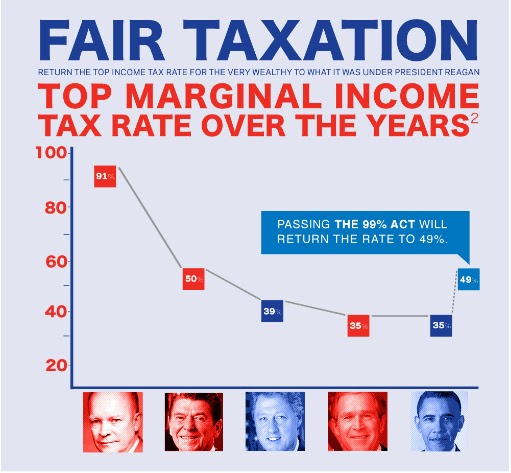
Occupy Congress: How The 99% Act Would Work

"The Restore the American Dream for the 99% Act," proposed by the Congressional Progressive Caucus, as previously noted, is the "most serious effort to bring together the tools needed to address today's economic crisis" and "is a direct answer to the economic anger at the heart of the Occupy movement."

Here are some of the key highlights of the bill with helpful infographics:
  • It would create more than 5 million jobs.
  • Impose new taxes for millionaires and Wall Street speculation
  • Add a public option to the Affordable Care Act
It would also:
  • Create a national infrastructure bank and invest in America
  • Eliminate handouts to big oil
  • End the wars and reduces Pentagon waste
  • Save $2.4 trillion over 10 years
This bill deserves attention and support.  As Isaiah Poole put it:
The Progressive Caucus legislation offers a different choice. We can put people to work today building the foundation of the economy of the future, or allow the stubborn subservience of congressional conservatives to millionaires and big corporations to cause more economic pain, widen the gulf between the very wealthy and struggling workers, and fuel more Occupy movements. 
Click here to endorse the Restore the American Dream for the 99% Act.