Showing posts with label lovechilde. Show all posts

Friday, February 16, 2018

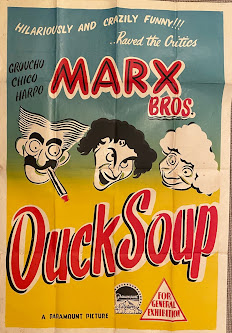
Who Said It: Mitt Or Groucho?

Mitt Romney has announced that he is running for the U.S. Senate in the State of Utah (it must be nice having residences in multiple states).  It is a sign of how degraded our politics have become that he is now considered by some to be an honest broker and paragon of American values -- and compared to the current occupant of the White House, I suppose he is.  But only by comparison.  We should not forget the mendacity of this loser of both the popular vote and the electoral college in the 2012 presidential election.  (See, e.g., Mitt Romney and the Odor of Mendacity)  In the piece below, originally posted on May 18, 2012, I attempted to make this point with more humor and less rancor.

Mitt Romney is sounding more and more like Groucho Marx all the time -- except he's not trying to be funny.  Take the quiz below, and identify the quote as coming from Mitt or Groucho.  (And here's wishing Mitt would sound more like Harpo.)

(a) "Those are my principles, and if you don't like them, well, I have others."
(b) "I’m not familiar precisely with what I said, but I’ll stand by what I said, whatever it was.”
(c) "People ask me, 'what would you do to get the economy going?’ and I say, 'well look at what the president's done and do the opposite.’"
(d) " I don't know what they have to say, it makes no difference anyway, whatever it is, I'm against it."
(e)  "The president should have built a credible threat of military action and made it very clear that the United States of America is willing, in the final analysis, if necessary, to take military action to keep Iran from having a nuclear weapon."
(f)  "It's too late [to prevent war]. I've already paid a month's rent on the battlefield."
(g) "I'm not a big-game hunter. I've made that very clear. I've always been a rodent and rabbit hunter. Small varmints, if you will."
(h) "I shot an elephant in my pajamas. How he got in my pajamas I'll never know."
(i) "I believe marriage should be preserved as an institution for one man and one woman."
(j) "Marriage is a wonderful institution, but who wants to live in an institution?"
(k) "Money frees you from doing things you dislike. Since I dislike doing nearly everything, money is handy."
(l) "My wife drives a couple of Cadillacs."
(m) "My dog likes fresh air."
(n) "Outside of a dog, a book is man's best friend. Inside of a dog it's too dark to read."
(o) "I worked my way up from nothing to extreme poverty."
(p) "I should tell my story. I'm also unemployed."
(q) "I believe in an America where millions of Americans believe in an America that's the America millions of Americans believe in. That's the America I love."
(r) "Members of the faculty, faculty members, students of Huxley and Huxley students.  Well I guess that covers everything."
(s) "America cannot continue to lead the family of nations around the world if we suffer the collapse of the family here at home."
(t) "Behind every successful man is a woman and behind her is his wife."
(u) "If you think this country's bad off now, just wait till I get through with it."

Answers: (a) Groucho; (b) Mitt; (c) Mitt; (d) Groucho; (e) Mitt; (f) Groucho; (g) Mitt; (h) Groucho; (i) Mitt; (j) Groucho; (k) Groucho; (l) Mitt; (m) Mitt; (n) Groucho; (o) Groucho; (p) Mitt; (q) Mitt; (r) Groucho; (s) Mitt; (t) Groucho; (u) Mitt Groucho

Follow Fair and Unbalanced on Twitter @FairUnbalanced1 and on Facebook 

Tuesday, August 8, 2017

Gone Fishin'

The imperturbable Robert Mueller has reportedly convened a grand jury in Washington D.C.  This implies that the Special Counsel's probe is ramping up, not winding down, and that Mueller intends to take the investigation of "any links or coordination" between the Russian government and the Trump campaign wherever it happens to lead him.  His mandate is quite broad, including "any matters that arose or may arise directly from the investigation," and informed speculation suggests this will include not just the Trump campaign's possible collusion with Russia and obstruction of justice, but also the financial shenanigans of Trump, his family and his campaign team.

Not surprisingly, this isn't sitting well with the malevolent orange shit-gibbon, who smolders, rages and then tweets about witch hunts and fake news, and who has come to realize that he will soon have to make a choice between complying with requests for his financial records and other potentially damning documents and information or fomenting a constitutional crisis.  Luckily, amazingly, some Senate Republicans are proposing legislation that will make it harder for him to remove Mueller and thwart the investigation.  That's critical, because Trump will not go quietly.

Indeed, he and his enablers are doing all they can to throw shade on the investigation -- doing so, as Greg Sargent argues, in a manner that "undermines our democratic norms and processes" by relentlessly sowing doubt on U.S. intelligence agencies and the news media.  They refuse to accept conclusive facts of Russian interference, insisting that it is a Democratic Party fabrication.  They disingenuously disparage Mueller and his staff, contending that they are biased and plagued by conflicts of interest.   And, rather dangerously, they stoke the fears of their volatile base, as Trump did at a rally over the weekend, insisting that the investigation is an effort to “cheat” them out of "out of the leadership [they] want with a fake story that is demeaning to all of us. And most importantly, demeaning to our country."

But Mueller keeps rolling along, undeterred by the madness and by accusations that the investigation is going too far afield and is nothing more than a fishing expedition. 

Deputy Attorney General Rod J. Rosenstein (Mueller's supervisor) took to the airwaves on Sunday to defend the scope of the Special Counsel's investigation, explaining that it can pursue any crimes that are discovered in the course of the investigation. 

Mueller can thus cast his net widely.  As Jack Shafer colorfully put it:
Once impaneled, any grand jury can sail the seven seas for months or years trawling for big fish, shellfish, pinnipeds, cetaceans—even kelp and algae blooms, should it be so moved. In the event that space travel proves feasible, nothing will stop grand juries from touring the planets on a quest to serve subpoenas. If a portal into the fifth dimension ever makes itself apparent, grand juries will mount expeditions there, too.
Perhaps it is because Trump's poll numbers are cratering.  Or maybe it is because Trump has proven completely inept at helping Republicans pursue their agenda.  Or maybe Republicans believe that Mueller's investigation will lessen their responsibility to undertake a meaningful investigation.  Whatever it is, if Republicans really do protect Mueller from Trump's attempts to undermine him, a lot of fish are going to be caught, and that will include one nasty, bloated orange one.

Tuesday, April 25, 2017

Ella At 100

I would so much rather talk about Ella Fitzgerald's 100 years (she was born on April 25, 1917) than Donald Trump's 100 days. The rap on Ella was that she couldn't sing the blues.  Maybe not, but she was probably the greatest interpreter of what has come to be known as the Great American Songbook.

Here's some proof:


This is what I wrote about Ella a while back when I was doing profiles of fifty jazz albums:
The Songbook series of recordings is essential listening; her live albums are remarkable, especially the classic Ella in Berlin, and the albums in which she is paired with Louis Armstrong are fun.  But when I feel like listening to Ella, my go-to album is Clap Hands, Here Comes Charlie.  In a small combo setting (piano, guitar, bass, drums), she swings, scats, and settles down for some lovely ballads too.  Highlights include, but are definitely not limited to, A Night in Tunisia, Stella By Starlight, Jersey Bounce and The Music Goes Round and Round.
 Enjoy!

Tuesday, September 6, 2016

Wilco Rocks -- And Not Just For Dads

I originally wrote this piece on February 1, 2012, after Wilco played a fabulous show at the Warfield in San Francisco.  This week they are playing at the Fillmore and I can't wait to see them again.   

Dad Rock, my ass.  OK, I'll admit that I am over 50 and the father of two, and that when I saw Wilco at the Warfield in San Francisco the other night, I fit comfortably within the demographic most represented -- relatively immobile white men over 40, holding plastic cups of beer and shaking nothing but their heads to the music.  So, maybe that's the audience for Wilco these days.  But that should not diminish their stature as one of the truly great rock bands or that of their front man, Jeff Tweedy, who is the most compelling singer/songwriters of his generation.

For me, the pantheon of (North) American rock musicians who not only capture the spirit of their time but leave a legacy well beyond it are Bob Dylan, Neil Young and Bruce Springsteen.  If the torch must be passed, I don't think it is that outrageous to think of Tweedy, the 44-year old leader of Wilco, as the one to pick it up.  (It is not surprising that along with Billy Bragg, Tweedy (with the rest of Wilco) recorded the brilliant Mermaid Avenue albums based on unreleased material written by Woody Guthrie.)

Jeff Tweedy is an elegant lyricist who crafts deeply effecting, unsparingly honest songs, often about pain and loss, self-doubt and self-destruction, and sings them with his nasally but soulful and quite captivating voice.  Part way through the show at the Warfield, he paused to check in with the audience.  He somewhat jokingly conceded, "this has been kind of a morbid show so far," and asked, "are you guys okay?"  He then added, "we figured if you're here, you probably enjoy being sad -- at least a little bit. I know I do."  One reviewer described the show in a way that aptly describes Tweedy's music generally.  Rather than morbid, "it felt like a solemn celebration . . . the songs themselves may have expressed misery, but the grace and energy given to them imparted a kind of a buzzing, heartworn elation."

What makes the Dad Rock moniker so misplaced in my view is that Tweedy and Wilco are not merely an easy throw back to those artists and bands of my generation's heyday.  While the influences of the Byrds, the Band, Neil Young, John Lennon and others can be heard, there is also a hard driving, progressive sensibility coursing through the music.  Some tunes are simple and straightforward, others experimental and complex or, as is often the case, a combination as one critic described of "elaborate constructs surrounding their simple melodies."


 Tweedy has evolved from when he practically co-invented the genre of alt-country rock in the late 1980s-early 1990s with the band Uncle Tupelo.  Wilco's albums over the years have taken very welcome if "unexpected detours" into psychedelia, power pop, soul, R&B and electronica.  Or, as David Dye put it, Wilco has alternated between folk-tinged alt-country and experimental pop, surprising fans and critics with its sonic inventiveness along the way," and in the process "made some of the finest albums of the '90s and '00s, while establishing itself as a virtually peerless live band."

Another reviewer explained that "Wilco's great strength lies not just in Jeff Tweedy's world-weary inscrutability, but the ways he and the band matched those stark, sometimes startling sentiments to expectation-defying deconstructions of Americana." 
Yankee Hotel Foxtrot is now ten years old, but it remains for me one of the greatest Rock 'n Roll albums of all time.  As the notoriously stingy Pitchfork beams:  "Complex and dangerously catchy, lyrically sophisticated and provocative, noisy and somehow serene" it is "simply a masterpiece."

Wilco is known as a great band to see live, a reputation cemented by their release in 2005 of Kicking Television: Live in Chicago, "a recording that doesn't merely retread a band's back catalog, but puts their songs in a new perspective, and in this case these performances reveal that one great band has actually been getting better."

The concert at the Warfield did not disappoint.  It included several songs from their fine new album, A Whole Love, as well as compelling renditions of some of the band's impressive catalog, including I Must Be High and Shouldn't Be Ashamed (from A.M.); Sunken Treasure, Misunderstood and Forget the Flowers (from Being There); Shot In The Arm (from Summerteeth); Ashes of American Flags, Heavy Metal Drummer (from Yankee Hotel Foxtrot); At Least That's What You Said, Handshake Drugs (from Ghost Is Born), and Impossible Germany (from Sky Blue Sky).

As I waited eagerly for each gem, I was struck by how many more great songs there are in the Wilco oeuvre.  Personal favorites not covered on this night included How To Fight Loneliness, She's A Jar, Via Chicago, Jesus Etc, Poor Places, Pot Kettle Black . . . .  I could go On and On and On.  (Click on the "Wilco" tag below for a sampling.)

Given how Wilco changes up the set list for each show, I was tempted to go see them again at the Fox Theater in Oakland, where they played last night.  But two shows in one week for a 50+ year old family man would be pushing it.

Dad Rock?  Here's what Tweedy himself had to say about Dad Rock:
I recently had a revelation about it: When people say dad rock, they actually just mean rock. There are a lot of things today that don’t have anything to do with rock music, so when people hear something that makes them think, “This is derived from some sort of continuation of the rock ethos,” it gets labeled dad rock. And, to me, those people are misguided. I don’t find anything undignified about being a dad or being rocking, you know?
Indeed, I do.

Monday, January 19, 2015

Proud To Be Maladjusted

Originally posted on January 17, 2011

Mountain Top by Romare Bearden
Over the weekend, I grabbed from my bookshelf A Testament of Hope: The Essential Writings of Martin Luther King, Jr., and literally dusted it off.  I flipped through it looking for something profound with which to pay tribute to the day.  There was so much eloquence to choose from, so many familiar, but nevertheless timeless speeches and essays defending the morality of non-violence and demanding racial justice, social justice and human rights. As I leafed through the book, I kept returning -- as Dr. King did -- to the theme of embracing "maladjustment;" refusing to be comfortable in an unjust world and insisting on action to achieve a better one.

In the summer of 1957, King addressed students at UC Berkeley, where he spoke of being maladjusted:
Now we all should seek to live a well adjusted life in order to avoid neurotic and schizophrenic personalities.  But there are some things within our social order to which I am proud to be maladjusted and to which I call upon you to be maladjusted.  I never intend to adjust myself to segregation and discrimination.  I never intend to adjust myself to mob rule.  I never intend to adjust myself to the tragic effects of the methods of physical violence and to tragic militarism.  I call upon you to be maladjusted to such things. . . . God grant that we will be so maladjusted that we will be able to go out and change the world and our civilization.  And then we will be able to move from the bleak and desolate midnight of man's inhumanity to man to the bright and glittering daybreak of freedom and justice.
Dr. King reiterated this theme in 1958, in an article he wrote for a Christian publication.  The article criticizes churches for failing to be more vocal in denouncing racism.  He stated "it may well be that the greatest tragedy of this period of social transition is not the flaring noisiness of the so-called bad people, but the appalling silence of the so-called good people . . . .  What we need is a restless determination to make the ideal of brotherhood a reality in this nation and all over the world."  King then reprised the notion of being maladjusted, almost verbatim from the speech he gave in Berkeley.

And then, in 1961, Martin Luther King gave the commencement address at Lincoln University, in which he talked about "The American Dream," "a dream where men of all races, of all nationalities and of all creeds can live together as brothers."  (I'm sure he meant sisters too.)  King urged the students to "not be detached spectators, but involved participants, in this great drama that is taking place in our nation and around the world."  He concluded this remarkable speech with many of the same words on being maladjusted that he used earlier: 
Every academic discipline has its technical nomenclature, and modern psychology has a word that is used, probably more than any other.  It is the word maladjusted.  This word is the ringing cry of modern child psychology.  Certainly all of us want to live a well-adjusted life in order to avoid the neurotic personality.  But I say to you, there are certain things within our social order to which I am proud to be maladjusted.

If you will allow the preacher in me to come out now, let me say to you that I never did intend to adjust to the evils of segregation and discrimination.  I never did intend to adjust myself to religious bigotry.  I never did intend to adjust myself to economic conditions that will take necessities from the many to give luxuries to the few.  I never did intend to adjust myself to the madness of militarism, and the self-defeating effects of physical violence.  And I call upon all men of good will to be maladjusted because it may well be that the salvation of our world lies in the hands of the maladjusted.

So let us be maladjusted as the prophet Amos, who in the midst of the injustices of his day could cry out in words that echo across centuries, "Let justice run down like waters and righteousness like a might stream."  Let us be as maladjusted as Abraham Lincoln, who had the vision to see that this nation could not exist half slave and half free.  Let us be as maladjusted as Jesus of Nazareth, who could look into the eyes of the men and women of his generation and cry out, "Love your enemies.  Blequss them that curse you.  Pray for them that despitefully use you."

I believe that it is through such maladjustment that we will be able to emerge from the bleak and desolate midnight of man's inhumanity to man into the bright and glittering daybreak of freedom and justice.  That will be the day when all of God's children, black men and white men, Jews and Gentiles, Catholics and Protestants, will be able to join hands and sing in the words of the old Negro spiritual, "Free at last!  Free at last!  Thank God almighty, we are free at last."

Tuesday, June 3, 2014

Zen and the Misery of Being a Met Fan

Being a Met fan is not a choice.  As a recent study published in the New York Times confirmed, if your team wins a championship when you are between the ages of 8 and 12, you are far more likely to maintain a lifetime loyalty to that team.  In 1969, I was ten years old.  Quod erat demonstrandum. 

If my parents had only waited and had me 8 years later, I would be an insufferable Yankees fan instead of a suffering Mets fan.  Alas, there is nothing to be done despite the unrelenting misery over the last six or seven years.  Who am I kidding, with rare exceptions, over the last 45-plus years.

By the time the Mets miraculously won the World Series in 1969, I was already hooked (thanks to my father, who adopted the Mets after being abandoned by the Brooklyn Dodgers) and was inured to their lovable losing ways. But, as David Searles wrote a while back, "the miracle year of 1969 changed everything."   Indeed.

"It was the first year where legitimate excitement surrounded the team," when they "seemed to perform a new miracle every day down the stretch that season." And after they won, it was never the same -- losing would no longer be lovable.

I will always cherish that 1969 team -- Tom Seaver, Tommie Agee, Cleon Jones, Bud Harrelson, Tug McGraw, Jerry Koosman, Jerry Grote and the rest. And, only a few years later, with many of the same players, minus a few (like Agee) and some key additions (like John Milner, Jon Matlack, Rusty Staub, Felix Millan and even Willie Mays), they pulled off another miracle, winning their division after being in fifth place at the end of August, and then beating the mighty Reds in the playoffs before losing in seven games to the A's in the World Series.

But that was it for a decade. Things got so bad that in 1979, the 10th Anniversary of The Miracle Mets, my friend Michael and I went to Old Timers' Day at Shea Stadium and after watching our beloved 1969 stalwarts play a couple of ceremonial innings we left prior to the start of the "real" game. We simply couldn't bear the stark contrast with the then-current team, led by the likes of Willie Montanez, Richie Hebner and the detritus from the catastrophic Tom Seaver trade two years earlier.

Finally, in 1983, despite another last place finish, there were some hopeful signs. Darryl Strawberry, with his great name and incredible talent made his debut, and in mid-season the Mets acquired a star from the Cardinals, Keith Hernandez. Then in 1984, after seven straight losing seasons, the Mets became a fun team to watch. With a full year from Keith, and a youth movement led by Strawberry and phenomenal rookie sensation Dwight Gooden, the Mets won 90 games and finished in second place.  And then, before the 1985 season, the Mets acquired the great Gary Carter, who had succeeded Johnny Bench as the dominant National League catcher.

Of course, in 1986, the Mets won the World Series, with the help of Bill Buckner's wobbly legs, after a stunning playoff against Houston. Miracles abounded once again, and so did expectation. The Mets had a fabulous team filled with great young talent. But it was not to be. 1987 started with Dwight Gooden in drug rehab and 1988 ended with an excruciating loss to the Dodgers in the playoffs. After that, the Mets began dismantling the 1986 team, replacing iconic players like Len Dykstra, Strawberry and Mookie Wilson with spectacular underachievers like Juan Samuel, Bobby Bonilla and Vince Coleman (see Mets or Bust), resulting in six losing seasons in a row.

Even after signing Mike Piazza in 1998, the team would consistently cause heartburn and heartbreak. The Mets lost their last five games Piazza's first year to miss the playoffs by one game, followed in 1999 with a defeat by the Braves in the playoffs after Kenny Rogers walked in the winning run of the deciding game. The 2000s were not much better, starting with the crushing loss to the Yankees in the World Series (Armando Benitez, anyone?) followed by several mediocre seasons.

An exciting 2006 team reached the playoffs but lost a devastating final seventh game to the Cardinals. Two searing images from that game form the perfect Met microcosm: Endy Chavez makes one of the most incredible catches ever in the post season in the 6th inning only to have Carlos Beltran strike out looking with the bases loaded three innings later to end the game.

And since then, historic collapses to miss the playoffs, baffling player moves, an unprecedented number of injuries to star and potential star players, culminating in the entanglement with Bernie Madoff, which has caused ownership to shrink payroll and behave like they own a small-market team.


So, to paraphrase legendary announcer Bob Murphy, here's the "(un)happy recap": The Mets were laughably bad until they won in 1969. By the mid-1970s they were awful again, and it wasn't so cute. They peaked again in 1986, but couldn't sustain their greatness, and in the 28 years since, if anything could go wrong it invariably did.

After Matt Harvey, the Mets' dynamic young phenom, went down with an elbow injury last year at the height of his remarkable rookie season, I penned the Seven Stages of Being A Met Fan, which  starts with hope, works its way through anger and despair, and invariably reaches acceptance. 

Despite the Mets better play of late, and the excitement surrounding the bevy of young arms in the system, I, along with many Met fans, am currently somewhere between anger and despair.  The owners, general manager and field manager have lost what little trust they had left.  They hire PR men instead of HR men.  They blame the fans for not showing up to support their lousy product.  They make bad choices when they finally ease the tightening of purse strings (e.g., Chris Young), they dither  interminably when it comes to choosing among the players they do have (e.g., the Lucas Duda-Ike Davis drama), they confuse promising youngsters by bringing them up only to bench them in favor of players they previously disparaged (e.g., Wilmer Flores, Ruben Tejada) or play mediocre veterans (e.g., Eric Young, Chris Young) instead of their very few exciting young players (e.g., Juan Lagares).

Jake deGrom

Confronting yet another season of misery and frustration, I need to somehow move past anger and despair and get to acceptance.  I need to remind myself that while there have been only two miraculous championship years, smaller miracles happen all the time -- even now:  a Lagares catch, a Flores grand slam, a Mejia save, an Abreu double, a deGrom anything.  Being a Met fan is about expecting the worst, which will probably happen, although in ways that are unexpected; but it is also about reveling in these spectacular surprises and moments of beauty that make it all worthwhile.  Om shanti.

Wednesday, November 13, 2013

Going Nuclear: GOP Uses Filibuster As A Weapon Of Mass Destruction Because They Hate Our Freedoms

Just when you think the Republican's ideological assault on democracy can't get worse, it does.  But this time it isn't the Tea Party nihilists in the House but Establishment Republicans in the Senate who are obstructing the legitimate operation of government, making a mockery of majority rule by requiring that virtually everything must pass a 60-vote threshold.

After the Supreme Court, the D.C. Circuit Court of Appeals is the nation's most important appellate court.  It has jurisdiction over challenges to executive orders, federal regulations and decisions of many federal agencies on topics, as Nan Aron, President of Alliance for Justice, notes, like the environment, consumer protections, workers' rights, banking regulations, executive power, and other vital issues."  Four of the current Supreme Court justices sat on the D.C. Circuit (Roberts, Ginsburg, Thomas and Scalia).

The court is currently evenly split (4-4) between Democrat and Republican-nominated judges, with three vacancies.  President Obama has nominated three extremely qualified judges to fill the three empty seats (after already withdrawing the nomination of another unassailable choice who was blocked by Republicans earlier this year).  Two of the three have already been filibustered by Senate Republicans, who intend to block the third, advancing the specious argument that Obama is engaged in court-packing when he is merely filling existing vacancies. 

Republicans claim the D.C. Circuit, with its relatively smaller (although exceedingly complex) caseload doesn't need all 11 judges.  Of course, as Harry Reid  pointed out, the contention that 11 judges are not needed it "not what they said when President Bush filled several vacant seats on the court. When George W. Bush was President, Senate Republicans happily filled the 9th, 10th and 11th seats on the D.C. Circuit -- the same three seats President Obama seeks to fill today -- even though the court had a smaller caseload at the time."

Republican hypocrisy doesn't end there.  Recall those bygone days when Democrats used the filibuster effectively to thwart some of George W. Bush's more extreme judicial appointments (although not by any means all of them).  Republicans argued back then that use of the filibuster was not just wrong, it was unconstitutional.  They threatened to employ the so-called "nuclear option," to change the Senate rules to preclude filibusters for judicial nominees.  Of course, the Democrats blinked.  Seven Democrats joined seven Republicans to form the "Gang of Fourteen," and signed an agreement in which the Republicans in the gang would not vote for the nuclear option and the Democrats would not filibuster except in "extraordinary circumstances."  In practical terms, this meant that Bush was able appoint the conservatives he wanted to the bench and the Democratic minority, without the seven members of the gang, could not stop him.  Thus, five nominees who had originally been filibustered, and several other conservatives, became federal judges, and, perhaps most significantly, Samuel Alito's nomination to the Supreme Court was permitted an up-or-down vote.  He was confirmed by a vote of 58-42, with enough Senators voting against him to have successfully filibustered and prevented a vote on his confirmation. 

Republicans, now in the minority, are blatantly violating the agreement not to filibuster judges except in extraordinary circumstances but Democrats are balking at going nuclear.  Recalcitrant Democrats fear that when they are in the minority, a Republican president could nominate a right wing radical to the Supreme Court and Democrats would no longer have the filibuster as a tool to stop it.  Indeed, Charles Grassley, the senior Republican on the Senate Judiciary Committee, explicitly threatened that if Democrats eliminate the filibuster it would be easier for a future Republican president to appoint more justices like Antonin Scalia and Clarence Thomas: "All I can say is this -- be careful what you wish for. . . So if the Democrats are bent on changing the rules, then I say go ahead. There are a lot more Scalias and Thomases that we'd love to put on the bench. The nominees we'd nominate and put on the bench with 51 votes would interpret the constitution as it was written."

Of course, if there were a Republican president and Republican majority and Democrats tried to employ the filibuster, Republicans would either go nuclear anyway, or the Democrats would cave as they did in the last go round.  Moreover, what makes anyone think that the Democrats would filibuster a  Supreme Court nominee?  There are already four right wing radicals on the high court and Democrats failed to use the filibuster to stop any of them.  To review, Scalia was nominated by Ronald Reagan in 1986.  The Democratic minority, perhaps distracted by the (ultimately unsuccessful) fight over Justice Rehnquist's nomination for Chief Justice, joined Republicans to approve Scalia unanimously.  In 1991, with Democrats in the majority, the Senate voted in George H.W. Bush's nominee, Clarence Thomas, by a vote of 52-48.  George W. Bush's nomination of John Roberts for Chief Justice was approved by a vote of 78-22, and as discussed above, Alito was confirmed after an agreement not to filibuster.

Republican abuse of the filibuster to prevent a president from filling vacancies no matter who is nominated so as not to tip the majority on the court is unprecedented.  If successful, what is to stop them from blocking nominees in every other court where the ideological split would potentially change in the Democrats' favor -- even the Supreme Court?

The "nuclear" option is really a misnomer.  It is the Republican Party that is using the filibuster as weapon of mass destruction -- a weapon to upend the democratic process.  As George W. would say, it is because "they hate what they see right here in this chamber:  a democratically elected government  . . .  They hate our freedom . .  ."  The smoking gun might not be a mushroom cloud, but if the Democrats refuse to change the filibuster rules and allow Republicans to block Obama's nominees for the D.C. Circuit, they may as well cede the federal judiciary branch -- indeed, our federal government -- to a Republican cabal for the foreseeable future. 

Wednesday, October 2, 2013

Assaulting Democracy Instead of the Democrats May Be Too Radical For Prime Time

Dukakis' Assault on the White House
The lunatic wing of the lunatic party has taken over Washington, D.C. 

As Dan Froomkin puts it: "holding the entire government hostage while demanding the de facto repeal of a president's signature legislation and not even bothering to negotiate is by any reasonable standard an extreme political act." 

This may be historically unprecedented, but James Fallows warned us to be on the look out for false equivalence in the media:  "As a matter of journalism, any story that presents the disagreements as a 'standoff,' a 'showdown,' a 'failure of leadership,' a sign of 'partisan gridlock,' or any of the other usual terms for political disagreement, represents a failure of journalism and an inability to see or describe what is going on."  Because "this isn't 'gridlock.' It is a ferocious struggle within one party, between its traditionalists and its radical factions, with results that unfortunately can harm all the rest of us -- and, should there be a debt default, could harm the rest of the world too."

Unsurprisingly, the initial reporting failed Fallows' False Equivalence Test, and would lead one to believe that this was simply business as usual in the Beltway.  No one is at fault because both sides do it.  Republican lies are just one side of the "he said, she said" style of reporting.  Indeed, Chuck Todd, the posterchild for the traditional media, admitted it that he did not believe it was the media's job to correct the Republican lies -- its the President's job.

At first, the media appeared unable to tell the truth if it meant siding with one political party over the other or as Froomkin describes it, "the political media's aversion to doing anything that might be seen as taking sides — combined with its obsession with process — led them to actively obscure the truth in their coverage of the votes. If you did not already know what this was all about, reading the news would not help you understand."

Joshua Holland aptly described journalists as "frogs in the proverbial pot . . . slowly acclimat[ing] to these extreme, democracy-suffocating circumstances and now seem incapable of describing what’s they’re seeing. Framing everything as a standard-issue partisan fight is almost a professional imperative for many journalists."

So, Joe Nocera, from his perch at the New York Times, points out that, sure, the Republicans have Ted Cruz, but the Democrats used to have their own radicals, like Mike Dukakis.  How's that for false equivalence?  (Rick Perlstein takes on this maddening nonsense)

The consequence of years of this kind of failed journalism, as Froomkin points out, is more extremism: 
When the media coverage seeks down-the-middle neutrality despite one party's outlandish conduct, there are no political consequences for their actions. With no consequences for extremism, politicians who have succeeded using such conduct have an incentive to become even more extreme. The more extreme they get, the further the split-the-difference press has to veer from common sense in order to avoid taking sides. And so on.
The Democratic Party has usually been complicit in this dynamic by trying to appear reasonable and open to compromise no matter how obstructionist the other side is being.  But, with Obama and the Democrats remaining unified and refusing to cave to the craziness (at least for now), while the Republicans appear beholden to the wackiest in their party, there appear to be some cracks in the media's knee-jerk neutrality. (The fact that Wall Street is getting nervous helps too)

Even Thomas Friedman, wanker extraordinaire, who always seems to hope for some moderate leadership to bridge the divide between left and right -- has finally seen the light:  "What is at stake in this government shutdown forced by a radical Tea Party minority is nothing less than the principle upon which our democracy is based: majority rule. President Obama must not give in to this hostage taking — not just because Obamacare is at stake, but because the future of how we govern ourselves is at stake."

Editorial pages of newspapers around the country are taking note, blaming the Republican Party for shutting down the government, undermining democracy and threatening the health of the economy. 

The Washington Post, the establishment's establishment paper, a few days ago argued, in a both-sides do it editorial entitled "U.S. Congress’s dereliction of leadership on government shutdown" that "the grown-ups in the room will have to do their jobs, which in a democracy with divided government means compromising for the common good" has come around.  Now its: "House Republicans are failing Americans in their effort to kill Obamacare," calling Republican's actions "beyond the pale" and demanding that they "fulfill their basic duties to the American people or make way for legislators who will." 

What a difference a few days make.  The Republicans have launched an assault on Democracy not the Democratic Party.  Have they finally gone too far?

Monday, August 26, 2013

The Seven Stages of Being a Met Fan

Game 7 of the 2006 National League Championship Series perfectly encapsulates what it means to be a Met fan.  Mets' outfielder Endy Chavez made a spectacular catch, leaping above the fence and snagging what would have been a tie-breaking 2-run homer in the 6th inning.  Pure joy.  But ... three innings later, in the top of the 9th, Yadier Molina hit a ball out of Chavez's reach for a two-run home run, putting the Cards ahead 3-1.  In the bottom of the inning, with the bases loaded, Carlos Beltran looked at strike three with his bat on his shoulders to end the game and end the Mets' season.  Pure despair.

Met fans have had little to cheer about since.  And when they have, bad news, devastating news, is sure to follow.  So, there was Johan Santana's thrilling no hitter -- the first in Met history -- which was followed by Santana's Met-career ending shoulder injury.  R.A. Dickey, a wonderfully refreshing and engaging player, had a remarkable Cy Young season for a dismal Met team last year, but was unceremoniously traded in the off season (admittedly for some great prospects, only one of whom has gotten injured so far).

But could anything be worse than what has just befallen us?  Matt Harvey, in his first (almost) full season with the team emerged this year as one of the very best pitchers in baseball and one of the most thrilling Met players ever.  He is a dynamic force on and off the field, a tremendous competitor, an absolute joy to watch.  He is having an historic season (that would have been even more incredible if the team had given him any run support).  Not since Dwight Gooden almost 30 years ago (and don't get me started on his dramatic rise and tragic fall -- you can read about it here) have the Mets showcased such an incredible homegrown talent who brought such excitement to the mound every time he pitched. 

Today, after undergoing an MRI, it was learned that Matt Harvey has a partial tear of the ulnar collateral ligament in his right elbow.  He was put on the disabled list and may require surgery, which could put him out of action until 2015. 

And so, once again, we must go through the familiar stages of being a Met fan:

1.  Hope.  Every year, no matter how bad the team looks, how many question marks the team invariably has, Met fans always find some glimmer of hope for the season ahead.  They bestow heroic-like powers on otherwise mediocre players, pin their hopes on new acquisitions and highly-touted prospects, and claim that if "everything goes right" they could have a pretty good squad this year.

2.  Joy.  The Mets have pulled off a miracle or two, have given us some wonderful moments, and have even fielded the occasional great team.  And, at least since Tom Seaver's rookie year on a last place team, there has usually been (although not always -- see, e.g., most of the 1990s) at least one player on the team whose performance was cherished, who gave us that sensation -- however fleeting -- of joy.  This year, every 5th or 6th day was celebrated in my house and throughout Metdom as "Harvey Day."  Even when the Mets were otherwise unwatchable it was a thrill to watch Harvey pitch. 

3.  Shock.  The ignominious 1977 Seaver trade showed that Met fans should never attach their devotion to one player.  Love a Met?  Be prepared to suddenly get your heart ripped out.  Trades and injuries of those we loved or were relying on to take the team to the next level have been all too common.  (Equally familiar, if less shocking, has been the flame out of new players who were brought in with great fanfare (see Mets or Bust).)  If something bad could happen, it will.  Matt Harvey?  We should have seen this coming.

4. Denial.  Maybe when the swelling in the elbow goes down it will show less damage than anticipated.  A few weeks off, and Harvey will be able to pitch again, and if not to finish off this season, he will be ready by Opening Day.

5.  Anger.  If Harvey's arm had been sore for months as has been reported, why weren't any MRI's done earlier just to be safe?  Why was Harvey allowed to throw so deep into games and throw so many sliders, which put more stress on the arm?  How could the Mets' manager, pitching coach and trainer been so negligent?  They should be fired!

6.  Despair.  The plan for the Mets' success was to build a team around its young arms -- Matt Harvey and a strong supporting cast.  Not only that, they were going to trade their surplus of arms for someone -- anyone -- who could hit with a little power.  Now?  There ain't no surplus.  There ain't no hitters with power.  There ain't no Matt Harvey.  I should have fallen in love with Dillon Gee.

7.  Acceptance.  Being a Met fan means enduring agony and misery while waiting for the occasional miracle.  It is what we do.  So, back to #1:  Hope.   

Tuesday, August 13, 2013

Finding Sandra Coke

I never really thought about the victims.

As a lawyer representing death row inmates for almost 25 years, I focused on the trial – whether the judge and jury acted properly, whether the prosecutor tried the case fairly, and whether defense counsel investigated and presented a constitutionally adequate defense. Mostly, I focused on my clients – on the (mostly) men who were found guilty of committing terribly brutal crimes, and tried to figure out and then explain to the courts the myriad of life circumstances that led them there. The victims and their loves ones were generally not a central part of this story.

I have known many people convicted of murder and sentenced to death. I had never known anyone who was killed.

Sandra Coke and I worked together in the early 1990s.  She developed the social histories of our clients, painstakingly gathering vital records, skillfully conducting sensitive, uncomfortable interviews with relatives, teachers, and friends, consulting with mental health experts, and researching communities. Sandra uncovered the evidence of horrific childhood trauma and impaired mental functioning, of family histories filled with abuse, addiction and mental illness, of multi-generational experiences scarred by poverty and racism, of failed social institutions.

Sandra continued to work as an investigator, most recently at the Federal Defender’s Office. With empathy and compassion, she was committed to showing how every client, no matter what despicable acts they had committed, were human beings – they were not monsters to be despised and disposed of.

Sandra disappeared last Sunday evening. She was 50 years old. A single mother of a teenage girl. She was beloved by her family, by many friends, and by the criminal defense community – my community – who have worked with her for over two decades.

After she failed to return home, Sandra’s friends, family and co-workers spent the next few days canvassing her Oakland neighborhood. At the forefront of the search was Sandra's sister, Tanya -- herself married to one of the most respected and revered death penalty lawyers in the country.  In an unfamiliar role, criminal defense lawyers worked with law enforcement, searching for clues that would lead them to Sandra. Sandra’s car and cell phones were found. A man with an extremely violent past, recently released from prison, was arrested on a parole violation as a person of interest. He and Sandra had dated briefly 20 years ago, and it was reported that they had been seen together on Sunday.

In the wake of these ominous signs, we still held out hope that Sandra would return to us.  But on Friday, during the course of a massive search, a woman’s body was found near a park in Vacaville (about 45 miles from Sandra’s home). And then today (on Tuesday), the Oakland Police Department identified that body as Sandra's.

Sandra Coke, one of our own – someone from my professional family – has been killed by one of those people who we have long defended.  Killed by someone who in any other circumstance I would ward off others’ attempts to demonize – to point out the humanity even in someone who acted inhumanely. “You can’t define someone by the worst thing they have ever done,” I would say.

It isn’t that I don’t still believe those things. I do. But that doesn’t matter right now. The perpetrator has receded into the background. I don’t care about his history or life struggles, his impairments or his vulnerabilities. But I don’t feel anger or hatred either. I don’t have feelings of vengeance. I don’t want him dead. I don’t feel anything for him at all. This isn’t about him. This is about the horror, shock, pain and overwhelming sadness over the irreplaceable loss of a remarkable person. For the first time in 25 years, my focus has shifted from perpetrator to victim.

Please give generously to the Sandra Coke Fund, which will provide for the care and education of Sandra’s daughter.

Thursday, January 3, 2013

Hypocrisy in the Hall of Fame

A rare exception to my abdication from Fair and Unbalanced.
-- Lovechilde

“Voting shall be based on the player's record, playing ability, integrity, sportsmanship, character, their contributions to the team on which the player played.” -- BWAA's Hall of Fame Rules
Spitballer Gaylord Perry
Racists and segregationists who conspired to keep African Americans out of baseball are in the Hall of Fame.  So are players who regularly used amphetamines to "enhance" their performance on the field and others who took illegal drugs off the field.  Cheaters are in the Hall, from spitballers to sign stealers.  The Hall includes adulterers, sexual assaulters, drunks and batterers.  But some of the greatest players of the past couple of decades, including some of the greatest in the game's history, will likely be denied induction into the Baseball Hall of Fame next week because they allegedly used steroids, probably used steroids or simply looked like they used steroids.

Such arbitrary application of the so-called "integrity clause" is seriously misplaced.  It is unquestionable that steroids were used by a large group of players --  hitters and pitchers -- from about 1995 until 2005, when the baseball establishment, under pressure, finally began to crack down on the use of performance enhancing drugs.  During this time, when offensive numbers (and players’ heads) were suspiciously inflated, the fans cheered and the owners gleefully looked the other way.  For better or worse, steroids were part of the game and unless we are going to disqualify everyone who played during these years, we simply have to accept it.  Moreover, with the exception of the few players who have admitted steroid use or where the evidence appears overwhelming, we have no way of knowing with any hope of accuracy who juiced and who didn’t. 

The best and most dominant players of every era should be enshrined in the Hall of Fame, and steroid use or other alleged character flaws should not be insurmountable barriers to entry.  Without Barry Bonds, Roger Clemens, and Mike Piazza -- who is apparently now suspect based on nothing more than hearsay and weak anecdotal information (as is Jeff Bagwell, perhaps a more borderline candidate)-- the Hall of Fame's avowed goals of "preserving history and honoring excellence" will be greatly diminished.

And don't get me started on Pete Rose.

Saturday, July 7, 2012

Fair And Unbalanced Radio 9

Here is the ninth edition of Fair and Unbalanced Radio, consisting of ten previously posted songs:


1.   Neil Young and Crazy Horse:  Oh Susannah
2.   Wilco, Nick Lowe and Mavis Staples:  The Weight
3.   Jack White:  Love Interruption
4.   Real Estate:  Easy
5.   Cloud Nothings:  Stay Useless
6.   The Walkmen:  Heaven
7.   Alabama Shakes:  Hold On
8.   The Shins:  September
9.   The Kills:  Baby Says
10.  Bettye Lavette:  I'm Not The One

You can always click the radio icon on the right of the blog for the latest playlist.

[Here are the previous playlists:  Fair and Unbalanced Radio, Volume 1; Volume 2; Volume 3; Volume 4; Volume 5; Volume 6; Volume 7; Volume 8]

Friday, July 6, 2012

Scalia Watch

DonkeyHotey
There has long been a consensus in mainstream circles, if not necessarily in the legal community, that whether you agreed with him or not, Justice Scalia possesses a great legal mind.  Indeed, the conventional wisdom for decades, as Jeremy Leaming writes, "has held that Justice Antonin Scalia is the high court’s most brilliant, disciplined, albeit ideological, member."

It may be that exposure through the internet "has altered the narrative by giving forums to an array of writers who have been quick to poke holes in an increasingly tiresome and shoddy line of reporting" or simply that Scalia's over-the-top rants and overt partisanship have finally reached a critical mass.

But as the country becomes more politically polarized, Scalia, as Dana Milbank wrote a while back, has had more difficulty containing his rabid partisanship.  He noted that “Scalia’s tart tongue has been a fixture on the bench for years, but as the justices venture this year into highly political areas such as health-care reform and immigration, the divisive and pugilistic style of the senior associate justice is very much defining the public image of the Roberts Court.”

Leaming is absolutely correct that "with each passing high court term, Scalia seems to be coming wackier, more out-of-touch, increasingly shrill. And he’s being called out for his nuttiness with growing frequency." 

"The Madness of Justice Scalia," Leaming's piece, cites various legal scholars and reporters, including law professor Paul Campos, who observed that Scalia “has in his old age become an increasingly intolerant and intolerable blowhard: a pompous celebrant of his own virtue and rectitude, a purveyor of intemperate jeremiads against the degeneracy of the age, and now an author of hysterical diatribes against foreign invaders, who threaten all that is holy.”

Perhaps Scalia has finally gone too far.  In a column last Wednesday (before the ACA decision), E.J. Dionne called for Scalia to resign:
So often, Scalia has chosen to ignore the obligation of a Supreme Court justice to be, and appear to be, impartial. He’s turned “judicial restraint” into an oxymoronic phrase. But what he did this week, when the court announced its decision on the Arizona immigration law, should be the end of the line.

Not content with issuing a fiery written dissent, Scalia offered a bench statement questioning President Obama’s decision to allow some immigrants who were brought to the United States illegally as children to stay. Obama’s move had nothing to do with the case in question. Scalia just wanted you to know where he stood.

After this case was argued and while it was under consideration, the secretary of homeland security announced a program exempting from immigration enforcement some 1.4 million illegal immigrants,” Scalia said. “The president has said that the new program is ‘the right thing to do’ in light of Congress’s failure to pass the administration’s proposed revision of the immigration laws. Perhaps it is, though Arizona may not think so. But to say, as the court does, that Arizona contradicts federal law by enforcing applications of federal immigration law that the president declines to enforce boggles the mind.

What boggles the mind is that Scalia thought it proper to jump into this political argument. And when he went on to a broader denunciation of federal policies, he sounded just like an Arizona Senate candidate.

Dionne takes Scalia to task for being a "blatantly political actor" and justice at the same time:  "Unaccountable power can lead to arrogance. That’s why justices typically feel bound by rules and conventions that Scalia seems to take joy in ignoring."

Recall, as Dionne reminds us, 2004, when "three weeks after the Supreme Court announced it would hear a case over whether the White House needed to turn over documents from an energy task force that Dick Cheney had headed, Scalia went off on Air Force Two for a duck-hunting trip with the vice president."

Then there was the speech Scalia gave at Switzerland’s University of Fribourg a few weeks before the court was to hear a case involving the rights of Guantanamo detainees:  "I am astounded at the world reaction to Guantanamo,” he declared in response to a question. “We are in a war. We are capturing these people on the battlefield. We never gave a trial in civil courts to people captured in a war. War is war and it has never been the case that when you capture a combatant, you have to give them a jury trial in your civil courts. It’s a crazy idea to me.”

Dionne does not even mention how Scalia (as well as his fellow conservative justices Thomas and Alito) regularly attend right-wing events and political fundraisers.  (Indeed, Clarence Thomas, in particular, is far quieter, but similarly nakedly partisan and ethically challenged.  See, e.g., here and here.)

Scalia is 76 years old but despite the urging of E.J. Dionne does not appear to be leaving the bench any time soon.  What is of far greater concern is that Justice Ginsburg turns 80 next year and Justice Breyer turns 75.  When you throw in Justice Kennedy (75), you have what the New York Times points out is "among the oldest courts since the New Deal era."  As a result, "the winner of the race for president will inherit a group of justices who frequently split 5 to 4 along ideological lines," suggesting "the next president could have a powerful impact if he gets to replace a justice of the opposing side."

And while it is true that Chief Justice Roberts showed some modicum of sanity in voting to uphold the Affordable Care Act, he has not been magically transformed into the new swing justice.  It should be noted that while the outcome was welcome, his legal reasoning was, as Justice Ginsburg put it, "stunningly retrogressive."  (See 10 Ways John Roberts Is Still A Conservative's Best Friend.)

What shouldn't be lost in all the hoopla over the validation of Obamacare is that the Scalia and the other three dissenters (Thomas, Alito and Kennedy), as Paul Krugman points out, "did so in extreme terms, proclaiming not just the much-disputed individual mandate but the whole act unconstitutional. Given prevailing legal opinion, it’s hard to see that position as anything but naked partisanship."

As I have previously written, Romney's choice of Robert Bork as co-chair of his Justice Advisory Committee is a disturbing sign of the kind of radical jurists Romney would nominate.  (See Romney Gets Borked.)  In the wake of Roberts' "defection," there will be even more pressure on Romney to choose right wing extremists in the Scalia-Thomas mold, a fact he is essentially admitting on the campaign trail.  Dionne is right that Scalia should resign but that isn't going to happen.  But there remains an even more disturbing prospect than Scalia staying put.  It is that a President Romney will  add more right-wing ideologues to the Supreme Court (and throughout the federal judiciary), forming a solid block of partisan operatives.

Tuesday, July 3, 2012

All Star Outrage

I have always revered the All Star game.  When I was growing up, it meant seeing Willie Mays, Hank Aaron and Roberto Clemente in the same outfield.  It also meant getting to see how some of my favorite Met players measured up to the greats.  True, the Mets did not usually populate the team, but at least Tom Seaver could be counted on to dominate American League hitters, and occasionally Bud Harrelson at short, Jerry Grote behind the plate, Jerry Koosman or Jon Matlack on the mound were worthy additions. 

Beginning in 1969, fans have been given the privilege of voting for All Star starters.  I used to fill out two ballots as a kid.  I would diligently scour statistics and choose players based purely on merit.  Then I did a second one which included Met players, regardless of the season they were having.  On this second ballot I admit, I voted for Wayne Garrett over Ron Santo, Felix Millan over Joe Morgan, Tommie Agee over Cesar Cedeno, Jerry Grote over Johnny Bench, and even Ed Kranepool over Willie McCovey.

Over the years, the fans generally got it right.  The popularity contest and bias towards one's home team was, for the most part, outweighed by votes for the players having the best years.  What helped making this system relatively fair was the rule that each team received the same number of ballots to hand out.  But with the advent of internet voting and organized campaigns by the teams themselves, the process has gotten out of balance.

The San Francisco Giants' marketing department was particularly relentless and creative this year in urging their fans to vote for Giants players early and often.  As a result, the Giants can boast three starters in this year's game:  Pablo Sandoval, Buster Posey and Melky Cabrera.  Sandoval, who spent a good deal of time on the disabled list, is having a season that pales in comparison to David Wright, who is having an MVP-type year. Wright leads all third basemen in every offensive category.  (Padres' third baseman Chase Headley is also having a far better year than Sandoval.)

Giants' catcher Buster Posey is having an excellent season, coming back from last year's injury, but he should not be the All Star starter -- despite receiving more votes than any other player in history.  Phillies catcher Carlos Ruiz, who is having a remarkable year, is far more deserving.  So is Yadier Molina of the Cardinals.

Melky Cabrera is arguably worthy of a start in the NL outfield, but the outsized votes for Sandoval and Posey, and for other Giants such as 1B Brandon Belt and SS Brandon Crawford -- who just missed starting nods (and 2B Freddie Sanchez came in fourth despite being sidelined all year) -- demonstrate that the system is broken.

Fans have been disenfranchised before.  In 1957, an organized campaign in Cincinnati resulted in seven Reds players being elected as starters:  Johnny Temple (2B), Roy McMillan (SS), Don Hoak (3B), Ed Bailey (C), Frank Robinson (LF), Gus Bell (CF), and Wally Post (RF). (The only non-Red elected was Cardinal first baseman Stan "the Man" Musial.)  The Cincinnati Enquirer apparently printed up pre-marked ballots to allow fans to vote early and often.  After an investigaton, Commissioner Ford Frick substituted Willie Mays and Hank Aaron for Gus Bell and Wally Post as NL starters, and changed the system so that managers, coaches and players voted instead of fans.

It is time to take the vote away from the fans again.

At Least Those Supreme Court Conservatives Aren't Influenced By The New York Times

Clarence and Virginia Thomas
After the theory that Chief Justice Roberts' vote to uphold ACA was caused by his epilepsy medication didn't fly, the latest conservative narrative making the rounds (thanks to a "scoop" by CBS's Jan Crawford) is that Roberts switched his vote, buckling to external political pressure, and then withstood a ferocious month-long campaign by Justice Kennedy to bring him back around. 

Who knows what truth there is to this story (or who inside the Court leaked it), but I was particularly struck by a remarkable nugget in Crawford's article which describes the conservative wing of the Court, in contrast to Chief Justice Roberts, as impervious to outside influences -- or at least liberal ones.  Thus, while Roberts "pays attention to media coverage," the conservatives, "such as Justice Clarence Thomas, deliberately avoid news articles on the court when issues are pending (and avoid some publications altogether, such as The New York Times). They've explained that they don't want to be influenced by outside opinion or feel pressure from outlets that are perceived as liberal."

What the article left out are the right-wing influences on Justices Thomas, Scalia and Alito.  As I've previously written, these three justices have attended, headlined and spoken at political fund-raising events for right wing organizations.   In another piece, Activist Judges, I pointed out that Justice Alito attended a major fundraising event for the notorious right wing magazine American Spectator (notorious for smearing President Clinton with false stories as part of the "Arkansas Project," an effort to get Clinton impeached), and that Justice Scalia and Justice Thomas have also attended secret political fundraisers.

And as stated here, Scalia and Thomas were featured guests at a retreat of wealthy Republicans and conservative leaders organized by Charles and David Koch, the brothers who finance right wing causes from the money they made from their energy conglomerate.  One of the Koch brothers pet causes had long been ending financial regulations on elections.  Indeed, according to Common Cause, they funded many of the groups who filed amicus briefs in the Citizens United case.  What is so unseemly about the appearances of Thomas and Scalia at the Koch Industries-sponsored event is that it occurred while Citizens United was pending before the Court.

And then, of course, there is the influence of Justice Thomas's wife, Ginni Thomas, a right-wing activist and powerful lobbyist, who worked to repeal the health care law.  Thomas was employed by the Heritage Foundation, a right wing think tank, between 2003 and 2007, and then set up a political consulting business, Liberty Central, which is described as an advocate for “liberty-loving citizens" fighting against the left wing "tyranny" of President Obama and the Democrats.

Well, at least the conservative members of the Court are not influenced by the New York Times and other dreaded liberal media.

Sunday, July 1, 2012

Mets Hit Parade

A player with the most hits in a team's history usually possesses two qualities:  greatness and longevity.  Several legendary stars lead their teams with 3000 or more hits, including Willie Mays (Giants), Ty Cobb (Tigers), Pete Rose (Reds), Carl Yastrzemski (Red Sox), Hank Aaron (Braves), Cal Ripken (Orioles), Stan Musial (Cardinals), Roberto Clemente (Pirates), and most recently, Derek Jeter (Yankees).

Even some of the 1960s expansion teams can claim players with 3000 or more hits:  George Brett (Royals), Robin Yount (Brewers), Craig Biggio (Astros) and Tony Gwynn (Padres).

Hall of Famers such as Mike Schmidt (Phillies), Cap Anson (Cubs), Sam Rice (Senators/Twins), Zack Wheat (Dodgers) and Luke Appling (White Sox), while not reaching the hallowed 3000, have the most hits on their long-time teams.

And then there are teams like the Mets, celebrating their 50th Anniversary this year, whose all-time hit leader can boast longevity but not greatness.  Except for the Marlins, Rays and Diamondbacks, who all came into existence in the 1990s, no team other than the Mets have a career hit leader with less that 1500 hits.

Ed Kranepool, who played for the Mets in their inaugural season of 1962, all the way through 1979, is their all-time hit leader with 1418.  For better or worse Kranepool played in far more games than any other Met and, as a result, is in the top 10 in most offensive categories.  But pretty soon we won't have Kranepool to kick around anymore.

29-year old David Wright, is in his ninth year with the Mets and having his greatest season.  After starting off his career in spectacular fashion, the five-time All Star has had an uneven last few years, which included a beaning and a concussion in 2009, and missing more than two months from another injury last year.  But he is putting it all together in 2012, with an MVP-type year.

David Wright is the Met all-time leader in runs scored, RBIs, and doubles.  He is about 75 hits behind Kranepool, and is sure to pass him sometime this year.  Hopefully, he will be a Met for many years to come, and if so, he will fit right in there with the great hit leaders of the other Major League clubs.

Friday, June 29, 2012

California's Cruel And Unusual Death Penalty 40 Years And $4 Billion After Furman v. Georgia

San Quentin State Prison
40 years ago today, the United States Supreme Court decided Furman v. Georgia, which struck down existing death penalty laws as unconstitutional in violation of the Eighth Amendment's cruel and unusual clause.  California's death penalty was quickly reinstated.

Attempting to comply with Furman, the new statute made the death penalty mandatory for certain first degree murders and other crimes.  But in 1976, the U.S. Supreme Court struck down death penalty laws that provided for mandatory death sentences. The California Supreme Court, relying on the high court's ruling, once again found the state's statute to be unconstitutional.

Undeterred, the California legislature passed a new death penalty law in 1977.  This was followed in 1978 by a ballot proposition, known as the Briggs Amendment, which was similar but more expansive version that sought to encompass more -- virtually all -- categories of murder (including unintentional murders committed during certain felonies).  Briggs passed and it is the law we are living with, so to speak, today.   

Forty years after Furman: $4 billion dollars, over a thousand death sentences, over 720 currently on death row, and 13 executions, none since January 2006.

Tani Cantil-Sakauye, after one year as the Chief Justice of the State of California, has concluded that the state's capital punishment system is "not effective" and requires "structural changes" that the State cannot afford.  Her predecessor, Ron George, who was Chief Justice for 15 years, came to the same conclusion, describing California's death penalty scheme as "dysfunctional."

An extensive study by Arthur Alarcon, long-time judge of the Ninth Circuit Court of Appeal, who, together with law professor Paula Mitchell, determined that California's death penalty system is currently costing the state about $184 million per year.  They concluded that "since reinstating the death penalty in 1978, California taxpayers have spent roughly $4 billion to fund a dysfunctional death penalty system that has carried out no more than 13 executions."

Justice Byron White observed in Furman that:
When imposition of the penalty reaches a certain degree of infrequency, it would be very doubtful that any existing general need for retribution would be measurably satisfied.  Nor could it be said with confidence that society’s need for specific deterrence justifies death for so few when for so many in like circumstances life imprisonment or shorter prison terms are judged sufficient, or that community values are measurably reinforced by authorizing a penalty so rarely invoked.” 
The infrequency of executions and the randomness with regard to which condemned inmates actually will be executed have made a mockery of the supposedly rational justifications for the death penalty.  In addition, given the current backlog and the serious problems identified by the California Commission for the Fair Administration of Justice (CCFAJ) -- problems that would require an enormous influx of state funds to fix -- it simply is not possible that defendants who are only now being sentenced to death will have their death sentences carried out.  Because it is “so wantonly and so freakishly” used, California’s death penalty has become a wholly arbitrary punishment in the same sense as the death penalty laws that were struck down in Furman.

Justice Potter Stewart famously characterized the Texas and Georgia statutes at issue in Furman as being “cruel and unusual in the same way that being struck by lightning is cruel and unusual.”  What he meant was that of all those who committed death eligible crimes, the petitioners were “among a capriciously selected random handful upon whom the sentence of death has in fact been imposed . . . [and] the Eighth and Fourteenth Amendments cannot tolerate the infliction of a sentence of death under legal systems that permit this unique penalty to be so wantonly and so freakishly imposed.”

Application of Furman’s benchmark for determining arbitrariness demonstrates that only a “capriciously selected random handful” of death-sentenced inmates in California will actually be executed.  A new death row prisoner would have to get in line behind 720 condemned inmates.  He or she would then have to wait years for appointment of appellate counsel (currently a 5 year wait) and even longer for the appointment of state habeas counsel (8-10 years).  Even after these lawyers are appointed and appellate briefs and habeas petitions are filed, the case will not be heard and decided before the several hundreds of cases that have preceded it.  And then, after all this time and expense, the California Supreme Court, in virtually every case regardless of the merits, will uphold the death sentence.   Then the case moves on to federal court, which has its own backlog, and often requires new counsel, with proceedings currently averaging over six years in district court followed by over four years of appellate review. 

Justice White noted in Furman that where the “penalty is so infrequently imposed that the threat of execution is too attenuated to be of substantial service to criminal justice” it is unconstitutional.  As he stated, when the death penalty “ceases realistically to further [the social ends it was deemed to serve] . . .  its imposition would then be the pointless and needless extinction of life with only marginal contributions to any discernible social or public purposes.  A penalty with such negligible returns to the State would be patently excessive and cruel and unusual punishment violative of the Eighth Amendment.”

We have far surpassed this point in California.

The SAFE California Act is on the November ballot.  If it passes it would replace California's multi‑billion dollar death penalty with life imprisonment without parole and require those convicted of murder to work and pay restitution to victim families through the victim compensation fund.  It would also set aside $100 million in budget saving for local law enforcement for the investigation of unsolved rape and murder cases.

Please join the effort to replace the death penalty by clicking here:  SAFE California.