Showing posts with label Global Economy. Show all posts

Monday, May 7, 2012

What America Can Learn From The Revolt In Europe

By Robert Reich, cross-posted from his website

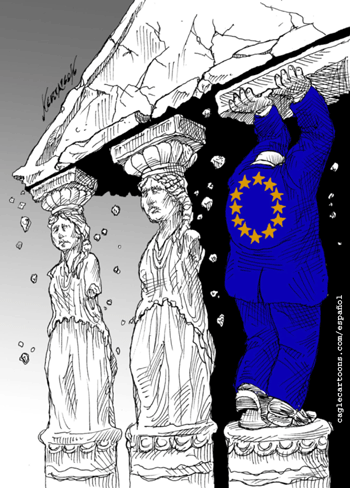
Who’s an economy for? Voters in France and Greece have made it clear it’s not for the bond traders.

Referring to his own electoral woes, Prime Minister David Cameron wrote Monday in an article in the conservative Daily Telegraph: “When people think about the economy they don’t see it through the dry numbers of the deficit figures, trade balances or inflation forecasts — but instead the things that make the difference between a life that’s worth living and a daily grind that drags them down.”

Cameron, whose own economic policies have worsened the daily grind dragging down most Brits, may be sobered by what happened over the weekend in France and Greece – as well as his own poll numbers. Britain’s conservatives have been taking a beating.

In truth, the choice isn’t simply between budget-cutting austerity, on the one hand, and growth and jobs on the other. 

It’s really a question of timing. And it’s the same issue on this side of the pond. If government slices spending too early, when unemployment is high and growth is slowing, it makes the debt situation far worse.

That’s because public spending is a critical component of total demand. If demand is already lagging, spending cuts further slow the economy – and thereby increase the size of the public debt relative to the size of the overall economy.

You end up with the worst of both worlds – a growing ratio of debt to the gross domestic product, coupled with high unemployment and a public that’s furious about losing safety nets when they’re most needed.

The proper sequence is for government to keep spending until jobs and growth are restored, and only then to take out the budget axe.

If Hollande’s new government pushes Angela Merkel in this direction, he’ll end up saving the euro and, ironically, the jobs of many conservative leaders throughout Europe – including Merkel and Cameron.

But he also has an important audience in the United States, where Republicans are trying to sell a toxic blend of trickle-down supply-side economics (tax cuts on the rich and on corporations) and austerity for everyone else (government spending cuts). That’s exactly the opposite of what’s needed now.  

Yes, America has a long-term budget deficit that’s scary. So does Europe. But the first priority in America and in Europe must be growth and jobs. That means rejecting austerity economics for now, while at the same time demanding that corporations and the rich pay their fair share of the cost of keeping everyone else afloat.

President Obama and the Democrats should set a clear trigger — say, 6 percent unemployment and two quarters of growth greater than 3 percent — before whacking the budget deficit.

And they should set that trigger now, during the election, so the public can give them a mandate on Election Day to delay the “sequestration” cuts (now scheduled to begin next year) until that trigger is met.

Tuesday, February 28, 2012

The Ongoing Housing Crisis And The End Of An Era

By Robert Reich, cross-posted from his website

Economic cheerleaders on Wall Street and in the White House are taking heart. The US has had three straight months of faster job growth. The number of Americans each week filing new claims for unemployment benefits is down by more than 50,000 since early January. Corporate profits are healthy. The S&P 500 on Friday closed at a post-financial crisis high.

Has the American recovery finally entered the sweet virtuous cycle in which more spending generates more jobs, more jobs make consumers more confident, and the confidence creates more spending? > On the surface it would appear so.

American consumers in recent months have let loose their pent-up demand for cars and appliances. Businesses have been replacing low inventories and worn equipment. The richest 10 per cent, owners of approximately 90 per cent of the nation’s financial capital, have felt freer to splurge. Consumer confidence is at a one-year high, according to data released on Friday.

The U.S. government has not succumbed entirely to the lunacy of austerity. Republicans in Congress have just agreed to extend both a payroll tax cut and extra unemployment benefits, and the US Federal Reserve is resolutely keeping interest rates near zero.

Yet the US economy has been down so long that it needs substantial growth to get back on track – far faster than the 2.2 - 2.7 per cent projected by the Federal Reserve for this year (a projection which itself is likely to be far too optimistic).

A strong recovery can’t rely on pent-up demand for replacements or on the spending of the richest 10 per cent. Consumer spending is 70 per cent of the US economy, so a buoyant recovery must involve the vast middle class.

But America’s middle class is still hobbled by net job losses and shrinking wages and benefits. Although the US population is much larger than it was 10 years ago, the total number of jobs today is no more than it was then. A significant portion of the working population has been sidelined – many for good. And the median wage continues to drop, adjusted for inflation. On top of all that, rising gas prices are squeezing home budgets even more.

Yet the biggest continuing problem for most Americans is their homes.

Tuesday, January 24, 2012

State Of Disunion: A Globalizing Private Sector, A Government Overwhelmed By Corporate Money

By Robert Reich, cross-posted from his website

Who should have the primary strategic responsibility for making American workers globally competitive – the private sector or government? This will be a defining issue in the 2012 campaign.

In his State of the Union address, President Obama will make the case that government has a vital role. His Republican rivals disagree. Mitt Romney charges the President is putting “free enterprise on trial,” while Newt Gingrich merely fulminates about “liberal elites.”

American business won’t and can’t lead the way to more and better jobs in the United States. First, the private sector is increasingly global, with less and less stake in America. Second, it’s driven by the necessity of creating profits, not better jobs.

The National Science Foundation has just released its biennial report on global investment in science, engineering and technology. The NSF warns that the United States is quickly losing ground to Asia, especially to China. America’s share of global R&D spending is tumbling. In the decade to 2009, it dropped from 38 percent to 31 percent, while Asia’s share rose from 24 to 35 percent.

One big reason: According to the NSF, American firms nearly doubled their R&D investment in Asia over these years, to over $7.5 billion.

GE recently announced a $500 million expansion of its R&D facilities in China. The firm has already invested $2 billion.

GE’s CEO Jeffrey Immelt chairs Obama’s council on work and competitiveness. I’d wager that as an American citizen, Immelt is concerned about working Americans. But as CEO of GE, Immelt’s job is to be concerned about GE’s shareholders. They aren’t the same.

Tuesday, January 10, 2012

Austerity For Dummies

By Richard (RJ) Eskow, cross-posted from Campaign for America's Future

"I feel stupid," someone said the other day. "I consider myself well-informed, but I have no idea what the term 'austerity economics' really means."

Actually it's not that complicated, and most of the lesson plan can be found in today's headlines.

We'll explain austerity to you in six steps, and we promise it it won't take more than 900 words. Since adults read an average of 250-300 words per minute - and we know all of you are above average - our little course shouldn't take more than three minutes.

It's certainly worth knowing. Despite its many failures, "austerity economics" keeps remaking - and unmaking - the global economy. The only disagreement at this weekend's Republican debate was over which candidate would push austerity more aggressively. And austerity dominated the political agenda last year - "Deficit Commission," anyone? - until Occupy came along.

Merriam-Webster named "austerity" the "Word of the Year" for 2010. But like the monster from a 1950's science-fiction movie, it just keeps on growing. This week alone the name was invoked in government houses from Athens to Lagos.

What is this creature called "austerity," and why does it still hold so much power? If you've got three minutes, let's get started.

Thursday, December 29, 2011

China Currency Manipulation -- From "Enough Is Enough" To "Not Enough To Certify"

By Dave Johnson, cross-posted from Campaign for America's Future

In November President Obama said, "enough is enough" to China's currency manipulations. Today the Treasury Department said it hasn't seen enough to call China a currency manipulator. This is happening because certain powerful interests are benefiting tremendously and using their wealth and power to keep things from changing.

China's Currency Manipulation
 
China manipulates its currency to keep it "undervalued." This means that things made there cost less in world markets than things made in other countries. The result is that manufacturing moves there, bringing them entire industries, supply chains, and the "industrial commons" of expertise, suppliers and culture that brings with it new businesses and industries. Many economists say that China's currency is undervalued by 25 to 40% meaning products made there have a 25-40% pricing advantage before any other advantages, subsidies, manipulations, etc. are considered. The currency it does not rise to market levels because China takes steps like preventing open trading and buying other currencies -- most of us wold call this manipulation -- to keep this from happening.

Instead of competing fairly China uses this manipulation and others, throwing world trade completely out of balance. Countries "make their living" by producing things and selling them to the rest of the world. This imbalance is costing our country jobs, factories, industries and trillions of dollars but we can't seem to get our government to do anything about it.

Tuesday, December 27, 2011

R.I.P. Austerity Economics (1921-2011)

By Richard (RJ) Eskow, cross-posted from Campaign for America's Future

This is the time of year when we're reminded of all the famous people who died over the last twelve months, a list which includes two of my favorite guitar players (Hubert Sumlin and Cornell Dupree). But there were also some notable non-human deaths in 2011, especially in the world of economic policy.

One of those deaths should have completely altered the political debate in Washington. The name of the deceased was "Austerity Economics," and it was first glimpsed in a 1921 paper by conservative economist Frank Wright. Austerity died of natural causes brought on by prolonged exposure to reality.

But the debate in Washington didn't change nearly enough after its passing. In the nation's capital, dead things still rule the night. 

Why Austerity?

"Austerity economics" backers claim that today's economic woes can only be fixed by dramatic reductions in government spending, which will lead to increased private-sector confidence and therefore to greater investment and growth.

But it's never worked. And if investors have lost confidence in the U.S. government's fiscal stability, they're sure not acting that way. There hasn't been this much demand for Treasury bonds since the government began tracking it twenty years ago, and they haven't performed as well since the go-go 1990s.

It's easy to understand austerity's attraction for power elites inside and outside of government. The people who suffer from austerity budgets aren't the kinds of people they know personally, since they're typically public employees like teachers, police, firefighters and the administrators of social programs; people who need government assistance, like the poor; and middle-class people with the temerity to either grow old or become disabled.

Austerity's attraction became even greater in the U.S. because once it became conventional wisdom that tax increases on the wealthy was "politically infeasible." That made it a program whose sole purpose was to cut government spending, lowering the pressure to increase taxes on the wealthy from today's historically low levels.

For a one-percenter, what's not to love? 

Friday, November 4, 2011

What's Your Beef (And Why's It Coming From Tanzania)?

By Marcia Ishii-Eiteman, cross-posted from PAN's website


What does an American businessman, Iowa State University and 162,000 refugees in Tanzania have in common? 

Answer: they are all either directly involved in or soon-to-be impacted by a small group of U.S. investors’ plans to acquire 800,000 acres (1,250 square miles) of land in Tanzania and transform it into large-scale industrial crop, beef and agrofuel production. They plan to use genetically engineered (GE) seed and other inputs supplied by Monsanto, Syngenta and other global agribusinesses.

As you might guess, not everyone is going to benefit from this mega-project! The deal, if it goes through, would force 162,000 former refugees from Burundi off land they have tended for the past 40 years, destroying their livelihoods and the communities they have built to give their children a future. 

Follow the money (sigh, yes — again)

So who wins? The Tanzanian government might make a few dollars off the deal, but it won’t be much, once negotiations over a suite of investor incentives (tax holidays, duty waivers, and relaxed rules for repatriation of dollars out of Tanzania) are concluded. The three biggest winners would be Iowa-based AgriSol Energy, Summit Group (a large-scale farming and livestock operation headquartered in Alden, Iowa) and Pharos Global Agriculture Fund. Iowa State University is also a key supporter of the project.

These three private entities stand to gain the most, not only by ramping up lucrative agrofuel production for export, but even more significantly, by requiring — as a condition of the deal — that the Tanzanian government overturn its current prohibition of genetically engineered crops. They are demanding creation of a regulatory framework that allows importation and cultivation of GE crops in that country.

Rewriting Southern countries’ biosafety legislation in order to start flooding the region with exports of U.S. GE crops has long been a tactic of the U.S. State Department and Agency for International Development (USAID). And it’s no coincidence that the Obama administration’s Feed the Future initiative targets Tanzania for “agricultural development” based on public-private partnerships and transgenic biotechnology.

The deal requires the Tanzanian government to overturn its current prohibition of GE crops.

And who loses? Obviously, the Burundi people who are getting kicked off the land. But the threats go well beyond the 800,000 acres and 162,000 people in question there. Tanzanian farmers, consumers, their agricultural markets and biodiversity are all at risk.

Until recently, Tanzanians were somewhat protected from the intrusion of transgenic crops by the country’s placement of the precautionary principle at the center of its biosafety legislation. That has shifted, as under intense industry pressure, the government has relaxed its laws and allowed research and field trials of GE corn and cassava, with GE cotton around the corner. The last legal protections against GE crops could fall, if the AgriSol land grab is able to effectively rewrite Tanzania’s biosafety laws. And this is why Tanzanians have formed an alliance to fight back.

Here in the U.S. the Oakland Institute is leading the charge to expose and block the Tanzanian land grab and is calling on concerned individuals to take action and urge the wealthy Iowa investor Bruce Rastetter (who is simultaneously CEO of Pharos Ag and Summit Farms as well as Managing Director of AgriSol Energy) and the Prime Minister of Tanzania to drop the project. Joining the call, the Sierra Club has brought the voices of its one million members to bear, sending its own letter urging Rastetter and the Prime Minister to abandon “this ill-advised project.” It's easy to follow Oakland Institute's lead by sending a letter of your own. 

Global policy stalled

The Tanzanian case is one of many such land grabs — more formally described as large-scale land acquisitions — that have been sweeping across the Global South in recent years. The epidemic reached such disastrous proportions, with such gross violations of human rights, that the United Nations finally turned its attention to the issue and began in 2008 to draft “voluntary guidelines” to protect communities from the harmful effects.

Earlier this month, 800 farmers’ rights, environment and development groups joined victims of land grabs in petitioning the Chair of the U.N. Food and Agriculture Organization’s Committee on Food Security to swiftly finalize the guidelines. Governments meeting in Rome were to adopt the voluntary guidelines by October 17, but failed to do so.

The U.N. body came close to approving the guidelines, explained U.N. Special Rapporteur on the Right to Food, Olivier de Schutter, but foundered over the specific provisions affecting large-scale investments in farmland. The Committee on Food Security will meet again in early 2012 and de Schutter expects that the guidelines could be ratified later in the year. Civil society groups and farmers’ coalitions like La Via Campesina continue to play a critical role in these negotiations, pressing for strong and enforceable language. 

Stand with Tanzania

While adoption of the voluntary guidelines in 2012 is urgently needed, every additional week of delay puts hundreds of thousands of farmers’ livelihoods at risk.

Take Action » Join Oakland Institute’s campaign to block the Tanzanian land grab. Send a letter to AgriSol’s Bruce Rastetter and the Tanzanian Prime Minister urging them to abandon the land deal.

Wednesday, November 2, 2011

Greece's Choice -- And Ours: Democracy Or Finance?

By Robert Reich, cross-posted from his website

Which do you trust more: democracy or financial markets?

Greek Prime Minister George Papandreou decided in favor of democracy yesterday when he announced a national referendum on the draconian budget cuts Europe and the IMF are demanding from Greece in return for bailing it out.

(Or, more accurately, the cuts Europe and the IMF are demanding for bailing out big European banks that have lent Greece lots of money and stand to lose big if Greece defaults on those loans – not to mention Wall Street banks that will also suffer because of their intertwined financial connections with European banks.)

If Greeks accept the bailout terms, unemployment will rise even further in Greece, public services will be cut more than they have already, the Greek economy will contract, and the standard of living of most Greeks will deteriorate further.

If Greeks reject the terms and the nation defaults, it will face far higher borrowing costs in the future. This may reduce the standard of living of most Greeks, too. But it doesn’t have to. Without the austerity measures the rest of Europe and the IMF are demanding, the Greek economy has a better chance of growing and more Greeks are likely to find jobs.

Shouldn’t Greeks be able to make this decision for themselves?

Friday, October 7, 2011

Follow The Money: Behind Europe's Debt Crisis Lurks Another Bank Bailout Of Wall Street

By Robert Reich, cross-posted from his website, October 4, 2011.

Today Ben Bernanke added his voice to those who are worried about Europe’s debt crisis.

But why exactly should America be so concerned? Yes, we export to Europe – but those exports aren’t going to dry up. And in any event, they’re tiny compared to the size of the U.S. economy.
If you want the real reason, follow the money. A Greek (or Irish or Spanish or Italian or Portugese) default would have roughly the same effect on our financial system as the implosion of Lehman Brothers in 2008.

Financial chaos.

Investors are already getting the scent. Stocks slumped to 13-month low on Monday as investors dumped Wall Street bank shares.

The Street has lent only about $7 billion to Greece, as of the end of last year, according to the Bank for International Settlements. That’s no big deal.

But a default by Greece or any other of Europe’s debt-burdened nations could easily pummel German and French banks, which have lent Greece (and the other wobbly European countries) far more.

That’s where Wall Street comes in. Big Wall Street banks have lent German and French banks a bundle.

Tuesday, September 27, 2011

How Many Jobs Has Deregulation Cost Us, Senator Shelby?

By Richard (RJ) Eskow, cross-posted from Huffington Post

The Republicans have opened another front in their never-ending war against regulations, those tools that help government protect us from greedy corporations. Leading the charge once again is Sen. Richard Shelby, the willing servant of Wall Street who weakened the regulations in Dodd/Frank during negotiations with Sen. Dodd ... and then refused to vote for it anyway.

After that little bit of procedural treachery, Sen. Shelby attacked the Consumer Financial Protection Bureau (Protect consumers? How dare they?) with outright falsehoods about the extent of that organization's power.

Now Shelby's fighting urgently-needed regulations by proposing something called the "Financial Regulatory Responsibility Act." It would, according to the Senator, "determine the economic impacts of proposed rule-makings, including their effects on growth and net job creation."

Sen. Shelby added: "My colleagues and I are simply proposing that each financial regulator determine whether the economic cost of a new regulation exceeds its economic benefit. If it does, then the regulation should not be implemented."

Here's where you're probably expecting a hostile comment about the Senator's proposal. Forget it. I think it's a great idea ... one one condition: The bill should be revised so that every politician who proposes de-regulating an industry, and every regulator who fails to use their powers properly, must be held to the same standard. They must first "determine the economic impact of the proposed deregulation, including its effects on growth and net job creation."

Saturday, September 24, 2011

Seeding Justice, Cultivating Democracy

By Marcia Ishii-Eiteman, cross-posted from PAN's website

Last week, hundreds of people poured into the Women’s Building here in San Francisco to take part in the Justice Begins with Seeds conference, organized by the California Biosafety Alliance and co-sponsored by PANNA and several other partner groups. Abuzz with activities from September 13-17, the conference provided a forum for Californians to engage in movement building that challenges the corporate food system, pushes back against genetically engineered food and seeds, and nourishes the roots of food democracy.

I had the honor of speaking at the opening plenary Friday morning, and of sharing the PAN network’s vision of what it means to reclaim our food system. The auditorium pulsed with the diversity, wisdom, courage and vast experience of our movement: Latino community organizers, urban food justice activists, Mexican farmers and keepers of the ancient, vital heritage of corn seed diversity, youth leaders, lawyers, scientists, poets, writers and artists.

As a global network linking 600 groups from over 90 countries, PAN is best known for our three decades of work challenging the global proliferation of pesticides. At the same time, ever since our founding in 1982, PAN has fought for people’s rights to a safe, fair and sustainable food system. That work has taken many forms over the years: farmer caravans travelling across Asia, denouncing the corporations that manufacture chemical pesticides and GMOs and highlighting farmers’ innovative ecological alternatives; organic cotton farmers in Peru, Benin and Senegal collaborating with European partners in devising clean, fair and green marketing initiatives; and here in the U.S., campaigning to save conservation payments in the Farm Bill as the most concrete step we can take right now to support American farmers who are stewarding the earth and protecting future generations.

As I told conference participants last week, “seeding justice” at PANNA means two things to me: growing agroecology and nourishing the emerging food democracy movement in this country. The many faces of these two things can get us a long way towards food sovereignty. In so many concrete ways, I am energized by our daily work in this realm:
As Indian scientist-activist Vandana Shiva explained in her rousing keynote address:
We have to make food democracy the core of the defense of our freedom and survival. We will either have food dictatorship for a while and then a collapse of our food systems and our societies, or we will succeed in building robust food democracies, resting on resilient ecosystems and resilient communities.

Wednesday, August 17, 2011

How Austerity Is Ushering In A Global Recession

By Robert Reich, cross-posted from his website.

Not only is the United States slouching toward a double dip, but so is Europe. New data out today show even Europe’s strongest core economies – Germany, France, and the Netherlands – slowing to a crawl. We’re on the cusp of a global recession.

Policy makers be warned: Austerity is the wrong medicine.

We all know about the weaknesses in Europe’s “periphery” – Greece, Ireland, Spain, Portugal, and Italy. But the drop in Europe’s core is dizzying.

Germany grew at an annualized rate of just half a percent last quarter, down from 5.5 percent in the first quarter of the year. France didn’t grow at all.

What’s going on in Europe’s core? Partly it’s a loss of confidence due to debt crises in the periphery. But that’s hardly all.

Europe depends on exports – especially to Asia, India, Latin America, and the United States. But exports to China and other emerging markets have been dropping. China, worried about inflation, has pulled in the reins on its sizzling economy. Brazil has been pulling back as well.

And as the United States economy sputters, exports to America have been slowing.

But chalk up a big part of Europe’s slowdown to the politics and economics of austerity. Europe – including Britain – have turned John Maynard Keynes on his head. They’ve been cutting public spending just when they should be spending more to counteract slowing private spending.

Tuesday, August 9, 2011

Panic On The Streets Of London

By Laurie Penny, cross-posted from openDemocracy.

I’m huddled in the front room with some shell-shocked friends, watching my city burn. The BBC is interchanging footage of blazing cars and running street battles in Hackney, of police horses lining up in Lewisham, of roiling infernos that were once shops and houses in Croydon and in Peckham. Last night, Enfield, Walthamstow, Brixton and Wood Green were looted; there have been hundreds of arrests and dozens of serious injuries, and it will be a miracle if nobody dies tonight. This is the third consecutive night of rioting in London, and the disorder has now spread to Leeds, Liverpool, Bristol and Birmingham. Politicians and police officers who only hours ago were making stony-faced statements about criminality are now simply begging the young people of Britain’s inner cities to go home. Britain is a tinderbox, and on Friday, somebody lit a match. How the hell did this happen? And what are we going to do now?

In the scramble to comprehend the riots, every single commentator has opened with a ritual condemnation of the violence, as if it were in any doubt that arson, muggings and lootings are ugly occurrences. That much should be obvious to anyone who is watching Croydon burn down on the BBC right now. David Lammy, MP for Tottenham, called the disorder 'mindless, mindless'. Nick Clegg denounced it as 'needless, opportunistic theft and violence'. Speaking from his Tuscan holiday villa, Prime Minister David Cameron – who has finally decided to return home to take charge - declared simply that the social unrest searing through the poorest boroughs in the country was "utterly unacceptable." The violence on the streets is being dismissed as ‘pure criminality,’ as the work of a ‘violent minority’, as ‘opportunism.’ This is madly insufficient. It is no way to talk about viral civil unrest. Angry young people with nothing to do and little to lose are turning on their own communities, and they cannot be stopped, and they know it. Tonight, in one of the greatest cities in the world, society is ripping itself apart.

Violence is rarely mindless. The politics of a burning building, a smashed-in shop or a young man shot by police may be obscured even to those who lit the rags or fired the gun, but the politics are there. Unquestionably there is far, far more to these riots than the death of Mark Duggan, whose shooting sparked off the unrest on Saturday, when two police cars were set alight after a five-hour vigil at Tottenham police station. A peaceful protest over the death of a man at police hands, in a community where locals have been given every reason to mistrust the forces of law and order, is one sort of political statement. Raiding shops for technology and trainers that cost ten times as much as the benefits you’re no longer entitled to is another. A co-ordinated, viral wave of civil unrest across the poorest boroughs of Britain, with young people coming from across the capital and the country to battle the police, is another.

Monday, May 23, 2011

Scandalous Behavior At IMF

The former French chief of the IMF, Dominique Strauss Kahn, who is alleged to have sexually assaulted a hotel worker from Guinea, provides the perfect metaphor for the IMF's treatment of the Third World.  As Rebecca Solnit puts it,  "what makes the sex scandal. . . so resonant is the way the alleged assailant and victim model larger relationships around the world, starting with the IMF’s assault on the poor."

Worlds Collide in a Luxury Suite  
Some Thoughts on the IMF, Global Injustice, and a Stranger on a Train 

 By Rebecca Solnit, originally published at TomDispatch, May 22, 2011

How can I tell a story we already know too well? Her name was Africa. His was France. He colonized her, exploited her, silenced her, and even decades after it was supposed to have ended, still acted with a high hand in resolving her affairs in places like Côte d’Ivoire, a name she had been given because of her export products, not her own identity.

Her name was Asia. His was Europe. Her name was silence. His was power. Her name was poverty. His was wealth. Her name was Her, but what was hers? His name was His, and he presumed everything was his, including her, and he thought he could take her without asking and without consequences. It was a very old story, though its outcome had been changing a little in recent decades. And this time around the consequences are shaking a lot of foundations, all of which clearly needed shaking.

Who would ever write a fable as obvious, as heavy-handed as the story we’ve just been given? The extraordinarily powerful head of the International Monetary Fund (IMF), a global organization that has created mass poverty and economic injustice, allegedly assaulted a hotel maid, an immigrant from Africa, in a hotel’s luxury suite in New York City.

Worlds have collided. In an earlier era, her word would have been worthless against his and she might not have filed charges, or the police might not have followed through and yanked Dominique Strauss-Kahn off the plane to Paris at the last moment. But she did, and they did, and now he’s in custody, and the economy of Europe has been dealt a blow, and French politics have been upended, and that nation is reeling and soul-searching.