Wednesday, December 7, 2011

Senate "Lowers The Bar" For Judicial Filibusters

So much for the "Gang of 14."  Senate Republicans, including some former gangsters, continue their shameless yet effective obstruction of Obama's judicial nominations with their filibuster of Caitlin Halligan, an extremely qualified and non-ideological nominee for a seat on the U.S Court of Appeals for the D.C. Circuit.

By Nicole Flatow, cross-posted from American Constitution Society

Caitlin Halligan
The Senate voted today to block a confirmation vote on Caitlin Halligan to the U.S. Court of Appeals for the D.C. Circuit, prompting a sharp rebuke from President Obama and outrage from a host of legal leaders and commentators.

“Today’s vote dramatically lowers the bar used to justify a filibuster, which had required ‘extraordinary circumstances.’  The only extraordinary things about Ms. Halligan are her qualifications and her intellect,” said President Obama following the vote.

“Those senators who voted against cloture are ushering in an unfortunate era of unprecedented obstructionism,” said ACS President Caroline Fredrickson.
`
The Senate voted 54-45 on Senate Majority Leader Harry Reid’s motion to invoke cloture, falling six votes short of the 60 needed to force an up-or-down vote on Halligan’s nomination.

In 2005, a group of senators known as the “Gang of 14” determined that all judicial nominees should receive an up-or-down vote absent “extraordinary circumstances.”

As Senator Lindsey Graham explained the agreement at the time, “ideological attacks are not an ‘extraordinary circumstance.’ To me, it would have to be a character problem, an ethics problem, some allegation about the qualifications of a person, not an ideological bent.”

But today, Graham voted against holding an up-or-down vote on Halligan’s confirmation, even though she had been unanimously rated well qualified by the American Bar Association, and had the broad support of law enforcement officials in New York State, where she served as solicitor general.

Graham and the three other Republican members of the “Gang of 14” who remain in the Senate, -- Sens. John McCain, Susan Collins and Olympia Snowe -- also voted to filibuster Goodwin Liu, another nominee whose credentials were widely praised as "sterling" and who had the support of legal leaders from a variety of ideological backgrounds.

Tuesday, December 6, 2011

Obama's Populism And The Ghost Of Teddy Roosevelt

Greg Sargent called the speech Obama gave today in Kansas "the most direct condemnation of wealth and income inequality, and the most expansive moral defense of the need for government activism to combat it, that Obama has delivered in his career."  As summarized by Kevin Drum, the President "debunked trickle-down economics, punctured the myth of the unregulated paradise, and slammed a Republican party fixated on making life better for the top 1 percent."  Thanks in no small part to the Occupy Movement, Obama's speech -- and the national conversation -- has shifted to, as Ari Berman of the Nation tweeted, "income inequality, basic fairness & jobs."  

Clearly, with this speech, Obama has move into campaign mode and it is great he has recognized the importance, finally, of  using populist rhetoric to make the case against economic injustice.  The big question is what he will do about it when he is not on the campaign trail.  -- Lovechilde

By Richard (RJ) Eskow, cross-posted from Campaign for America's Future

Today Barack Obama channeled one of American history's truly transformative figures by visiting the tiny Kansas town where Teddy Roosevelt gave his "New Nationalism" speech over a century ago. It's refreshing to see him invoke Roosevelt, who was a powerful and fearless agent of change both inside and outside the White House.

But echoing the populist chords of the First Progressive Era isn't without its risks. The speech that Roosevelt gave in Osawatomie, Kansas in 1910 could serve as a beacon for the President and his fellow Democrats. But that speech also warned that there's a price to be paid for promises betrayed.

Roosevelt's Ghost

If Roosevelt's ghost had been hovering over the lectern today, no doubt it would have appreciated being remembered. But the apparition might also have repeated the words Roosevelt spoke on the same platform in 1910:

"It is of little use for us to pay lip-loyalty to the mighty men of the past unless we sincerely endeavor to apply to the problems of the present precisely the qualities which i... enabled the men of that day to meet those crises."

President Roosevelt fought relentlessly against the powerful financial interests of his time, who dominated the nation in pretty much the same way they dominate ours today. J. Pierpont Morgan famously offered to "send my man around to meet your man and sort it all out," but President Roosevelt didn't want to cut deals with powerful banking interests. He wanted to make them less powerful, and he got it done.
Four years after leaving office, Roosevelt was running for President again. People back then suggested that his ideas were too extreme: A minimum wage. Women's right to vote. Direct election of Senators. An eight-hour workday. But they all came true.

Now that's change you can believe in. And here's what Teddy Roosevelt told his Kansas audience that day.

Day Of Action For Occupy Our Homes

I recently posted a piece about the Occupy movement's focus on foreclosures.  Today is the Occupy Our Homes National Day of Action to Stop and Reverse Foreclosures, organized by OccupyOurHomes.org. 

Meteor Blades writes at Daily Kos that what has been a local tactic, "a showdown with banks to disrupt foreclosure auctions and evictions," is spreading nationwide.  Here is a list of the actions happening in more than 25 cities today. 

Click here to sign a pledge to "support the movement to Defend our Homes and our Neighborhoods."

Republican Hypocrites On The Payroll Tax Cut

 How To Avoid Being A Principled Republican On Taxes

By Robert Reich, cross-posted from his website

Every time I try to make sense of Republican tax doctrine I get lost.

For example, rank-and-file House Republicans are willing to increase taxes on the middle class starting in a few weeks in order to avoid a tax increase the very rich.

Here are the details: The payroll tax will increase 2 percent starting January 1 – costing most working Americans about $1,000 next year – unless the employee part of the tax cut is extended for another year.
Democrats want to pay for this with a temporary – not permanent – surtax on any earnings over $1 million, according to their most recent proposal. The surtax would be 1.9 percent, for ten years. (Democrats would also increase the fees Fannie Mae and Freddie Mac charge lenders.)

This means someone who earns $1,000,001 would pay just under two cents extra next year, and 19 cents over ten years.

Relatively few Americans earn more than a million dollars, to begin with. An exquisitely tiny number earn so much that a 1.9 percent surtax on their earnings in excess of a million would amount to much. Most of these people are on Wall Street. It’s hard to find a small business “job creator” among them.

Nonetheless, Republicans say no to the surtax. “The surtax is something that could very much hurt small businesses and job creation,” says John Kyl of Arizona, the Senate’s second-ranking Republican.

This puts Republicans in the awkward position of allowing taxes to increase on most Americans in order to avoid a small, temporary tax only on earnings in excess of a million dollars — mostly hitting a tiny group of financiers.

Monday, December 5, 2011

Going After Thought Crimes

As Tom Engelhardt writes:  "In twenty-first-century America, “rights” are increasingly meant for those who behave themselves and don’t exercise them.  And if you happen to be part of a government in which no criminal act of state -- torture, kidnapping, the assassination of U.S. citizens abroad, the launching of wars of aggression -- will ever bring a miscreant to court, only two crimes evidently exist: blowing a whistle or expressing your opinion."

Peter Van Buren, a foreign service officer, had his security clearance taken away and was then suspended for writing a book about about his year running a provincial reconstruction team in Iraq (We Meant Well: How I Helped Lose the Battle for the Hearts and Minds of the Iraqi People).  He writes knowingly below about the case of Morris Davis, who was fired from his research job at the Library of Congress for writing an article, "Justice and  Guantanamo Bay" for the Wall Street Journal.

No Free Speech at Mr. Jefferson’s Library

By Peter Van Buren, cross-posted from Tom Dispatch

Here’s the First Amendment, in full: “Congress shall make no law respecting an establishment of religion, or prohibiting the free exercise thereof; or abridging the freedom of speech, or of the press; or the right of the people peaceably to assemble, and to petition the Government for a redress of grievances.”

Those beautiful words, almost haiku-like, are the sparse poetry of the American democratic experiment.  The Founders purposely wrote the First Amendment to read broadly, and not like a snippet of tax code, in order to emphasize that it should encompass everything from shouted religious rantings to eloquent political criticism.  Go ahead, reread it aloud at this moment when the government seems to be carving out an exception to it large enough to drive a tank through.

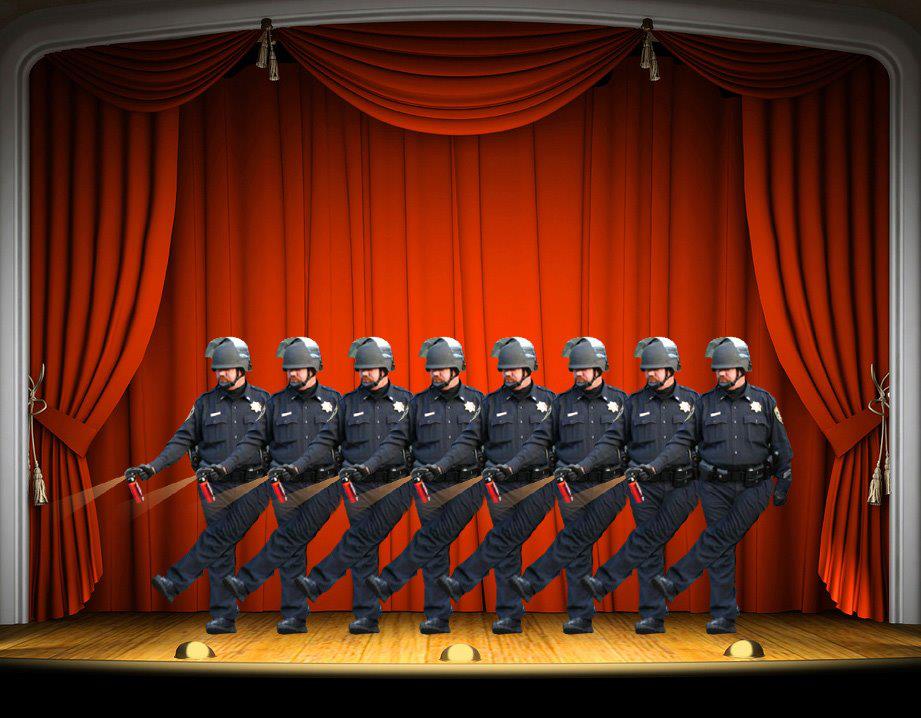
As the occupiers of Zuccotti Park, like those pepper-sprayed at UC Davis or the Marine veteran shot in Oakland, recently found out, the government’s ability to limit free speech, to stopper the First Amendment, to undercut the right to peaceably assemble and petition for redress of grievances, is perhaps the most critical issue our republic can face. If you were to write the history of the last decade in Washington, it might well be a story of how, issue by issue, the government freed itself from legal and constitutional bounds when it came to torture, the assassination of U.S. citizens, the holding of prisoners without trial or access to a court of law, the illegal surveillance of American citizens, and so on.  In the process, it has entrenched itself in a comfortable shadowland of ever more impenetrable secrecy, while going after any whistleblower who might shine a light in.

Now, it also seems to be chipping away at the most basic American right of all, the right of free speech, starting with that of its own employees.  As is often said, the easiest book to stop is the one that is never written; the easiest voice to staunch is the one that is never raised.

Crackdown On Occupy Draws Attention Of UN Special Rapporteur On Freedom Of Expression

"Citizens have the right to dissent with the authorities, and there's no need to use public force to silence that dissension."  UN Special Rapporteur Frank La Rue

Originally established in 1993, by the United Nations Commission on Human Rights (now the Human Rights Council), the Special Rapporteur on the promotion and protection of the right to freedom of opinion and expression has a mandate to investigate "violations of the right to freedom of opinion and expression, discrimination against, threats or use of violence, harassment, persecution or intimidation directed at persons seeking to exercise or to promote the exercise of the right to freedom of opinion and expression . . . "

While we like to think of the United States as a beacon of democracy and bastion of free expression, the use of tear gas, pepper spray and military-style tactics to disperse, remove and arrest Occupy protesters has caught the attention of the current Special Rapporteur, Frank La Rue.  As reported by Dan Froomkin at Huffington Post, La Rue, a long-time Guatemalan human rights lawyer, is "drafting an official communication to the U.S. government demanding to know why federal officials are not protecting the rights of Occupy demonstrators whose protests are being disbanded -- sometimes violently -- by local authorities."

La Rue, in a HuffPost interview asserted that the protesters have a right to occupy public spaces "as long as that doesn't severely affect the rights of others."  But, as we all know by now, Occupy encampments across the country have been disbanded, often with excessive force by police in riot gear.  La Rue acknowledged that while "the use of police force is legitimate to maintain public order," there must be a clear and present danger of real harm."  In addition, he stated, "there has to be a proportionality of the force employed to prevent a real danger."

It is clear to La Rue that the Occupy protesters are raising and addressing a fundamental issue. "There is legitimate reason to be indignant and angry about a crisis that was originated by greed and the personal interests of certain sectors," especially when the bankers "still earn very hefty salaries and common folks are losing their homes."  Thus, "in this case, the demonstrations are going to the center of the issue."

La Rue's "official communication" to the U.S. government will "ask what exactly is the position of the federal government in regards to understanding the human rights and constitutional rights vis-a-vis the use of local police and local authorities to disband peaceful demonstrations."

That is a very good question.

Sunday, December 4, 2011

Say It Ain't So, Jose

It is being reported that the Florida Marlins have signed (former) Met shortstop Jose Reyes to a six-year, $106 million deal.  The Mets weren't close, apparently not willing to commit to the money or years given, as the Times reports, that they "lost $70 million in 2011" and have "other financial burdens hanging over the club," which includes, of course, their entanglement with Bernie Madoff.

The Mets made what is probably a wise business decision but as a baseball move, it sucks.

Jose Reyes, only 28 years old, is one of the most exciting players in baseball and had long been the heart and soul of the Mets.   Since he first arrived in 2003, he has played with passion, joy and fire that has not only made him a delight to watch and root for, but often carried a team that has otherwise lacked those qualities.  The Mets have been a pretty miserable team since their devastating playoff loss in 2006, but it wasn't because of Jose.

I don't blame him for taking the years and the money (see Free Agency Floodgates), but I do blame the Mets ownership for their prior  atrocious decision-making and poor judgment that put them in such financial distress that they couldn't or wouldn't make Jose a seious offer.

Jazz Duos: More Than The Sum Of Their Parts

When a great singer is teamed with a great jazz instrumentalist, it can either feel shallow and contrived or each musician can bring out something in the other so that the whole is more than the sum of two remarkable parts.  I've previously identified a couple of these magical duets in the list of fifty.  (e.g., The Tony Bennett/Bill Evans Album; Sarah Vaughan with Clifford Brown.)  Here are a few more of my personal favorites, starting with the best:

John Coltrane and Johnny Hartman (1963).  I'm not sure there's a better version of Billy Strayhorn's composition Lush Life on record.  Hartman was not really a jazz singer, but the combination of his deep baritone voice and Coltrane's beautiful, relatively simple tenor playing (and the backing of Coltrane's great band) created a masterpiece.

Nancy Wilson and Cannonball Adderley (1961).  As one reviewer aptly describes:  "Wilson’s colorful and graceful singing of some lesser known repertoire from the standard songbook is a refreshing and soulful treat for anyone interested in jazz singing. Adderley’s uniquely blithe melodies add a counterpoint to the vocals that has helped this album stand the test of time."  Another reviewer says:  "Given the play list and the outstanding artists performing it, why any serious jazz collection would be without this classic album is difficult to comprehend."

Time for Two:  Anita O'Day and Cal Tjader (1962).  I recently wrote about the wonderful jazz singer, Anita O'Day.  Here she is teamed up with the Latin jazz great Cal Tjader and the Afro-Cuban feel of the album really works.  Some of the song selections are a little quirky, but overall it is a really fun, compelling album.

Ella & Basie (1963).  This was the first time these two jazz giants recorded together, and it is considered one of Ella's best albums, which is really saying something. 

Louis Armstrong Meets Oscar Peterson (1957).  Some reviewers find this album a bit predictable, with Armstrong singing, then playing a horn solo, followed by a little back and forth with Peterson's piano.  Probably true, but I don't mind.  For me, listening to Louis Armstrong is always worthwhile, including on these familiar standards with the great Oscar Peterson.

Saturday, December 3, 2011

Newt Or Mitt? Both Shovelling The Same Sh**


They no doubt have different styles and lifestyles.  Gingrich is undisciplined and abrasive, recently compared by a Republican insider to "Bigfoot dressed as a circus clown."  Romney is more of a smooth operator, but when pushed, as he was recently in a FOX interview, he can be a "whiny rich corporate boss with a temper."  As for substance, however, there isn't much daylight between the two.  -- Lovechilde

Bill Scher, writing at Campaign for America's Future compares Gingrich's "Contract With America" plan and  Romney's "Believe In America" plan:

More Tax Cuts For The Rich
 
Both believe we should double down on President George W. Bush's jobs strategy: cut taxes for corporations and millionaires.

When Bush did it, it resulted in the worst jobs record on record.

Yet, Romney says, cut the corporate tax rate from 35% to 25%. Gingrich goes farther, to 12.5%.

Romney says make the Bush tax cuts for the wealthy permanent, and praises Bush by name in his plan. Gingrich opts to make an even deeper cut for the wealthy by proposing an "optional" flat tax of 15%, which every millionaire would obviously choose over the current top rate of 35%.

And both would eliminate the inheritance tax for multimillionaire heirs.

Fewer Rules On Corporate Behavior

Both appear to believe that one enormous financial crisis a generation isn't enough, as both propose completely scrapping President's Obama Wall Street reform law.

Both even go as far as to criticize's President Bush's lone attempt to regulate businesses, the Sarbanes-Oxley accounting regulation law which responded to the Enron scandal -- Romney would partially repeal it to exempt "mid-size" businesses, and Gingrich would totally repeal it.

Romney proposes a "cap" on the cost of new regulations with no suggestion he would factor in the related benefits of any regulations, monetary or otherwise.

Both propose drastically scaling back environmental protections. Both propose loosening rules regarding oil drilling, as if the BP disaster never happened. (Romney briefly references the spill as merely something that happened which "provided political cover" for Obama's energy policy.)

Romney calls the Clean Air and Clean Water Acts "anachronisms" and calls the President's goal to create millions of jobs producing clean energy as an "unhealthy obsession." Gingrich proposes abolishing the EPA altogether, and replacing it with an "Environmental Solutions Agency" with little to no power to implement solutions.

Romney would change the Clean Air Act so the EPA would no longer have the power to address climate change. Gingrich wouldn't have an EPA anymore, which would achieve the same goal.

Of course, both used to be supporters of a cap-and-trade system to cut carbon emissions, but no longer.

Friday, December 2, 2011

The Greatest Hoax In The History Of Money: The Fed, The Banks, The Lies

By Richard (RJ) Eskow, cross-posted from Campaign for America's Future

It took the journalists at Bloomberg News two years - and presumably lots of legal fees - to pry information out of the Federal Reserve that should have been made public long ago. We now know that the Fed's secret $7.7 trillion lending program wasn't just the most massive bank bailout ever seen, and it wasn't just free money for mega-bankers - though it was certainly both of those things. It was also the greatest hoax in stock market history.

No, scratch that. It was the greatest hoax in the history of money. And it was built on lies. How many? Let us count the ways.

Here's the first one: The banks paid back all the money back that they were given. No, they didn't. They paid back the principal on these loans. But by obtaining loans at rates far below market value, we now know they received the equivalent of $13 billion in cash giveaways.

Here's another lie: Fed economists support a free-market economy.
 
Ben Bernanke is a conservative economist who claims to support a free-market system. But we now know that the Federal Reserve lent astonishing sums to US banks in secret, and Bernanke fought with all the resources at his disposal to ensure that this information didn't become public. He didn't just want it to be held back to avoid a panic during the crisis. He wanted it kept secret forever.

I don't know what you call somebody like that, but I know what you don't call him: A capitalist. Free markets need transparency, so that investors and customers can make informed decisions and 'the wisdom of the market' can prevail. Nobody wanted the market to do its job. When it came to banks, they wanted it to be blind, deaf, and dumb, unable to make sound judgments about their financial soundness.

Thursday, December 1, 2011

Scared Of Occupy's Message, Republicans Will Resort To Doublespeak To Protect The 1%

GOP strategist and pollster Frank Luntz is known, as David Atkins says, "for his ability to use the emotional power of language to bullshit the public at a slant, while maintaining a connection to reality and avoiding direct, outright lying."  Some of his greatest hits include advising Republicans to refer to the estate tax as the "death tax" and oil drilling as "energy exploration."

At a meeting of the Republican Governor's Association this week he admitted to being "so scared of this anti-Wall Street effort."  He said he was "frightened to death, because "they're having an impact on what the American people think of capitalism."

As Laura Clawson explains, "he had a lot of advice that was standard Luntzian stuff—find the worst-sounding way to describe a basic function of government and run with it, like rather than 'taxing the rich, describe it as 'taking from the rich,' as if taxes were jargon that needed translation."

Other examples, as described by Steve Benen: "'waste' and “government spending' are apparently supposed to be interchangeable. Calls for 'sacrifice' and 'compromise' are easily misunderstood. Voters don’t believe Republicans are defending the middle class, so GOP officials should instead talk about 'hardworking taxpayers.'"

Greg Sargent points to what is a "striking concession":
This longtime GOP pollster, adviser, and messaging expert is admitting that the Dem push for tax hikes on the rich has Republicans on the defensive, and that Republicans need to come up with a better way of obscuring what Dems are trying to achieve on the issue. He’s also admitting that the public isn’t inclined to believe Republicans represent the interests of the middle class.
There's more.  Luntz advised how one should respond to an Occupier or Occupy-sympathizer:
First off, here are three words for you all:  "I get it." . . . "I get that you're angry.  I get that you've seen inequality. I get that you want to fix the system."
Or as Clawson translates it:   "I get that you're angry. I get that you've seen inequality. I get that you want to fix the system. Here's my plan to make sure that the 1 percent gets even more of this country's wealth."

Seth Michaels sums it up well:  "Take these talking points for what they are—calculated falsehoods, and a cheap, transparent attempt to use real economic worries to support the same old 1% agenda."

Luntz's ideas don't seem particularly persuasive but he is right that the right should be scared.  As Atkins concludes:
One could argue here that Luntz is losing his magic touch here. But one could also say that conservatives are in enough of a message bind right now that this is all Luntz has to work with on the subjects of Wall St. and inequality. I tend to lean toward to the latter view.
This is a big glass jaw for the conservative movement, one they can only protect by attempting to steer the conversation to something, anything else. Dems and progressives need not to get distracted. They need to punch and punch hard.

Nice Work If You Can Get It

By Fuzzyone


Newt Gingrich was never a lobbyist. He just expressed his opinion like any other citizen and like any other citizen he was paid millions of dollars for it.

This Is What A Progressive Looks Like

As I have previously written, you won't find a better progressive candidate for Congress than Norman Solomon, who is running for a seat from the newly drawn Second Congressional District in California.
 
Solomon is one of a handful of Democrats who unequivocally supports Occupy Wall Street, stating, "We need democracy, not “corporatocracy.”

In a recent article, he made clear that his campaign is "very much in sync" with the Occupy movement.  The issues that have been at the core of his campaign and that he has emphasized for years "are part of the OWS focus - Wall Street's undemocratic power, the widening disparities between the rich and the rest of us, the need to eject corporate money from politics."

Solomon has just released his "Economic Agenda for Main Street" which pretty much mirrors a wish list for progressives:  (1) create new green jobs; (2) invest in our workers and communities;  (3)  stand up for workers, not Wall Street; (4) protect Social Security and Medicare; and (5) quality health care for all.

Here are the details:

HostGator promos

Torture, Indefinite Detention & The American Way

When the Senate took up the defense spending bill this week it included truly dreadful provisions allowing for indefinite military detention.  An amendment offered by Sen. Mark Udall (D-Colo.) that would have removed these provisions was defeated.  The amendment garnered only 38 votes, with 17 Democrats voting to reject it.   

The New York Times explains what the bill now includes:
[It] would require the government to place into military custody any suspected member of Al Qaeda or one of its allies connected to a plot against the United States or its allies. The provision would exempt American citizens, but would otherwise extend to arrests on United States soil. The executive branch could issue a waiver and keep such a prisoner in the civilian system.
A related provision would create a federal statute saying the government has the legal authority to keep people suspected of terrorism in military custody, indefinitely and without trial. It contains no exception for American citizens.
The National Defense Authorization Act goes to a conference committee next week, and if the provisions are not stripped there, it will be up to President Obama to follow through with his veto threat.  He would be the first president in fifty years to veto a defense spending bill. 

Meanwhile, another amendment to the defense bill by Sen. Kelly Ayotte (R-NH) hoped to authorize "enhanced interrogations," i.e., torture.  Her proposal would "roll back the 2009 Obama executive order against torture by re-establishing a secret 'classified' set of interrogation techniques and then attaching them to the current 'Army Field Manual' on human intelligence collection."  Apparently, the amendment was not voted upon this time, but there is concern that Ayotte will find another opportunity to offer it.

And we know from the most recent GOP presidential debate, that most of the Republican candidates for president proudly claimed they would reinstate waterboarding and other enhanced interrogation techniques.

It is in this context that Amy Davidson of The New Yorker writes about the chilling new United Nations report on Syria's use of torture and killing of children.  She points out that while Syria is not our ally, we have made use of Syria's prisons and its methods in our war on terror. As Davidson says, while we may not have committed torture ourselves of the prisoners we transferred to Syria via extraordinary rendition and we may not torture children, "we have used torture, and as we have learned in the Republican debates and on the floor of Congress, there is in no way a consensus that this is even a source of mild embarrassment. Some of our politicians seem proud of it."

The issuance of the UN's report, Davidson points out, unavoidably brings up the "the cost of torture generally, including, in this instance, to our own moral standing."  Indeed.  When "one would wish for a unified international chorus against the use of torture," and "when the world needs to let Syria know how unacceptable its behavior is," we are left with the Senate passing a provision allowing indefinite military detention, some Senators seeking to pass amendments to rescind the ban against using torture, and virtually all the Republicans seeking the presidency declaring to enthusiastic applause that they would authorize enhanced interrogation techniques and that waterbording isn't torture.

As Davidson remarks, "the idea that, as a nation, we ought to live in such a way as to always be able to make torturers feel ashamed is not such a radical thought."  At least it shouldn't be.