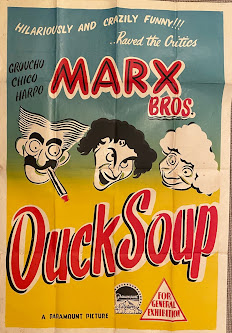
Showing posts with label Iraq. Show all posts

Wednesday, May 27, 2015

Intelligence Failure, Memory Loss And The Truth About Bush's War

"Who are you going to believe, me or your own eyes?"  -- Groucho Marx
"We're an empire now, and when we act, we create our own reality. And while you're studying that reality—judiciously, as you will—we'll act again, creating other new realities, which you can study too, and that's how things will sort out. We're history's actors…and you, all of you, will be left to just study what we do." -- Karl Rove
We aren't talking ancient history.  We aren't debating the origins of the Peloponnesian War or the War of 1812 or even the Vietnam War.  We are talking about the Iraq War.  We were all there.  Well, we weren't all over there -- we were here, where we experienced first hand the shameful manipulation of our post-9/11 trauma by the Bush Administration, the craven capitulation of the loyal opposition and mainstream media, and the disastrous consequences.

The latest focus on the question to, and remarkably inept responses by, yet another Bush running for president as to whether, knowing what we know now -- presumably, invading a country that was not a threat to us after lying about its head of state's complicity in 9/11 and the possession of weapons of mass destruction; destroying that country infrastructure, destabilizing the region and increasing the influence of that country's neighbors; using torture and committing other human rights abuses; and causing the deaths of thousands of Americans and hundreds of thousands of Iraqis -- he would have invaded Iraq as his brother did, ignores what was known then.  This conveniently lets those complicit in the debacle off the hook, and does little to inform us about the qualifications for presidency of Jeb Bush or his cohorts.

It is rapidly becoming conventional wisdom, thanks to the same vapid punditry that was so acquiescent back then, that the Bush Administration was the victim of poor intelligence -- that they were misled into war, not that they misled us into a war they wanted to launch all along.  But we know this is not true.  We can recall how they seized on whatever tiny shred of evidence no matter how unreliable to bolster the answers they wanted about WMDs and a Iraq-9/11 connection and ignored the vast majority of credible evidence that pointed to contrary conclusion?  Remember yellow cake, aluminum tubes, mushroom clouds?  Bush, Cheney, Rumsfeld and Rice manipulated the intelligence to sell a war to the public.

Another revisionist trope is that everyone believed the intelligence about WMD.  First, not everyone had the access to all of the intelligence that the Administration used and twisted for its purposes.  Further, most members of Congress who voted to authorize the war (including Hillary Clinton) failed, as Peter Beinart points out, to read the full classified National Intelligence Estimate on Iraq's weapons of mass destruction -- a report that convinced, for example, Senators Leahy and Graham to vote against the Iraq War resolution.  21 other Senators and 133 Representatives also just said "no."   And while some who voted "aye" may have done so because they believed the intelligence, most likely succumbed to coercive political pressure skillfully intensified by rhetoric out of the White House (e.g., you are "either with us or against us in the fight against terror.")

There was also some real journalism going on at the time -- from the reporters at Knight Ridder, for example -- who examined with skepticism the Bush Administrations' claims linking Saddam to 9/11 and WMDs.

As Matt Taibbi reminds us:  "It was obvious even back then, to anyone who made the faintest effort to look at the situation honestly, that the invasion was doomed, wrong, and a joke."
First you had to accept a fictional implied connection between Saddam Hussein and 9/11. Then you had to buy that this heavily-sanctioned secular dictator (and confirmed enemy of Islamic radicals) would be a likely sponsor of radical Islamic terror. Then after that you had to accept that Saddam even had the capability of supplying terrorists with weapons that could hurt us (the Bush administration's analysts famously squinted so hard their faces turned inside out trying to see that one).  And then, after all that, you still had to buy that all of these factors together added up to a threat so imminent that it justified the immediate mass sacrifice of American and Iraqi lives.
But now we are having to witness a parade of the same hapless politicians, pundits and experts who told us they were certain that Saddam Hussein was hiding nuclear weapons and was involved with 9/11, that taking him out with shock and awe would be quick and painless -- for us --  that we would be greeted as liberators, and that the consequent reordering of the Middle East would bring peace and freedom.  They were completely wrong about everything but are nevertheless unapologetically back on the airwaves and they are back advising Jeb Bush and the other Republican candidates.  And if any of these candidates actually ascends to the White House, they would be back making and selling policy. 

Instead of being asked about what they would have done in Iraq given what we know now, perhaps candidates could be asked under what circumstances they would use military force to overthrow a sovereign nation or whether they would manipulate intelligence if they believed it would convince the public to support their policy goals or under what conditions they would authorize torture.

What we knew then and what we surely know now is that the Iraq fiasco did not stem from intelligence failures but was a direct result of the reckless pursuit of a discredited neoconservative political theory.  Unfortunately, none of the Republican candidates seems to have learned this or anything else that would allow them to avoid another unmitigated disaster when confronted with a national crisis.


Friday, February 6, 2015

The Shame of U.S. Journalism Is The Destruction of Iraq, Not Fake Helicopter Stories


By Christian Christensen

The news that NBC’s Brian Williams was not, in fact, on a helicopter in 2003 that came under fire from an Iraqi Rocket-Propelled Grenade (RPG) should come as a surprise to noone. Williams had repeated the lie on several occasions over the course of a decade until a veteran, who was on the actual helicopter that was attacked, had enough of Williams’ war porn and called the TV host out on Facebook. In a quite pathetic effort to cover his tracks, the anchor—who makes in excess of $10 million per year— claimed that his fairy tale was, in fact, "a bungled attempt by me to thank one special veteran and by extension our brave military men and women" who had served in Iraq. Twelve years, it seems, is enough time for Williams to confuse being on a helicopter that came under fire from an RPG with being on a helicopter that did not.
 
Given that Williams works for NBC, his participation in the construction of a piece of fiction during the U.S. invasion and occupation of Iraq is apt. US network news, together with outlets such as CNN, aggressively cheer-led an invasion predicated on a massive falsehood: the Iraqi possession of WMD. What is jarring, however, is the fact that Williams’ sad attempt to inject himself into the fabric of the violence is getting more ink and airplay than the non-existence of WMD did back in the early-to-mid 2000s: a lie that provided the justification for a military action that has taken the lives of hundreds of thousands of Iraqi civilians.
 
From embedded journalists to ultra-militaristic news logos and music, U.S. television news media were more than willing to throw gas on the invasion fire. "Experts" in the studio were invariably ex-generals looking to pad their pensions, while anti-war activists (who spoke for sizable portions of the US and UK populations back in 2003) were avoided like the plague. After all, what news organization wants to be tarred with the “peace” brush when flag-waiving jingoism sells so incredibly well? The one-sidedness of coverage, particularly in the US, bordered on the morally criminal.
 
Despite some limited soul-searching by journalists a decade after 9/11 and the invasion of Iraq about the abject failure of the U.S. news to engage, in a truly critical fashion, with the falsehoods peddled by the Bush administration, the current focus on an inane untruth told by one celebrity news anchor has overshadowed the bigger picture about the US media and Iraq. And I don’t think that’s a coincidence.
 
In the post-9/11, pre-invasion period, U.S. citizens proved to be spectacularly misinformed about the 9/11 attacks, Iraq, Al Qaeda, Saddam Hussein and WMD. When the invasion began, many in the U.S. simply had no clue about what was going on. Was that all the fault of the US media? No, but it’s fair to say a pretty large chunk of the responsibility lay at their feet. Then, once the bombing and street fighting became banal and lost its attractiveness to audiences and advertisers, most U.S. media outlets simply abandoned an Iraq left to fend for itself in a vortex of violence, political instability and corruption. And, who wants to talk about that when you can write about Williams upping his War Zone Reporter street cred? But, if you do want to hear about violence in Iraq, you can rely on Fox News to suggest that this particular hell might also be a liberal conspiracy…
 
The number of Iraqi citizens who have died as a direct and indirect by-product of the U.S. invasion is enough to populate a mid-sized U.S. city, and thousands continue to die on a monthly basis in non-imaginary attacks.
 
Yet, here we are, over a decade later, still discussing celebrity fantasies. That isn’t just bad journalism, it’s an affront to all who lost their lives in a brutal and bloody deception. Williams is just sorry about the wrong thing.
 
Originally posted at Common Dreams.  Christian Christensen, American in Sweden, is Professor of Journalism at Stockholm University. Follow him on Twitter: @ChrChristensen

Thursday, September 11, 2014

Reverse Barometers and Perpetual War


General Custer to officer:  Anything that man tells me will be a lie.  Therefore, he will be perfect reverse barometer. . . .
Custer to Jack Crabb:  What should I do, mule skinner? . . . . Should I go down there, or withdraw? . . .  What's your answer, mule skinner?
Crabb:  General, you go down there.
Custer: You're saying, go into the coulee?
Crabb:  Yes, sir. 
Custer:  There are no Indians there, I suppose?
Crabb:  I didn't say that. There are thousands of Indians down there, and when they get done with you, there won't be nothing left but a greasy spot. . . . You go down there if you got the nerve.
Custer:  Still trying to outsmart me, aren't you, mule skinner? You want me to think that you don't want me to go down there, but the subtle truth is you really don't want me to go down there. . . Men of the Seventh! The hour of victory is at hand!  Onward to Little Bighorn and glory!

* * *
Near the close of the movie Little Big Man, General Custer (played by Richard Mulligan) realizes that Jack Crabb aka Little Big Man (Dustin Hoffman) who he hired as a scout, hates him so much that he will purposely give Custer the wrong advice.  Custer therefore treats Crabb as a "reverse barometer," doing the opposite of whatever Crabb tells him.  As the passage above shows, Crabb gets Custer completely flustered to the point where he is able to trick him into making the disastrous decision to attack at Little Bighorn. 

Dick Cheney, John McCain and their fellow War Mongers have much in common with Custer, as he was portrayed in this movie -- arrogant, unfettered by facts, unshakably stubborn and unable or unwilling to reverse a decision or admit a mistake.  They have been wrong about everything, particularly when it comes to terrorism and the Middle East.  But rather than being shamed into silence and appropriately shunned, they continue to seize center stage.  They plague us with their latest ideas for the latest crisis which, invariably, is the same wrong advice that got us into these messes in the first place: perpetual war.

In this way they should provide a useful service as reverse barometers.  Whatever they say, President Obama should enact the reverse.  When they insist that we stay in Iraq, rely less on diplomacy, employ troops on the ground and more bombs from the air in more places, we should do the opposite.  But it seems that, as in the movie, the reverse barometer can sow confusion.  And so after being relentlessly bombarded with the need to act quickly, decisively and, above all, militarily, the President, as William Greider puts it, "is embarking on another Long War in the Middle East."

The fact that we are only committed (for the time being) to air strikes with a limited amount of advisers on the ground is far from comforting.  Greider explains:  "President Obama’s vague assurances are doubtless sincere, but he has left a lot of open space to revise and reinterpret his intentions. If everything does not go well in Iraq, Obama will be pressured to escalate. War enthusiasts in the reserve army of pundits are already clamoring for him to do so. White House sources are already assuring reporters that Islamic State targets in Syria will be bombed. What happens if they don’t fold? The president will be pressed to send more troops—if not in regular uniforms, then as Special Forces, who will use clandestine methods."

Similarly, David Corn notes why it is difficult to "put the case for war back in the box" after commiting us to renewed military action even with a more nuanced approach than his predecessors:  "If US air strikes can make a difference, if other nations join in, if the Iraqi government gets it acts together, if the Iraqi military can do its job, then the United States will use its military might in a limited way to vanquish ISIS. A conditional case for war does not easily sync up with the stark nature of such an enterprise. If any of these ifs don't come to be, will Obama be cornered and forced by his rhetoric to do something? After depicting ISIS as a peril warranting a US military response—and with much of the American public convinced of that—can he then shrug his shoulders and say, "Never mind"? Will he provide the hawks an opening for political attacks and demands for greater military intervention? In his speech, the man who ran for president with the pledge to end the Iraq War declared, "We will not get dragged into another ground war in Iraq." But what if all else fails?"

Onward to Little Bighorn and glory!

Thursday, May 24, 2012

How To Forget On Memorial Day

Crosses of Lafayette
Whistling Past the Graveyard of Empires

By Tom Engelhardt, cross-posted from TomDispatch

It’s the saddest reading around: the little announcements that dribble out of the Pentagon every day or two -- those terse, relatively uninformative death notices: rank; name; age; small town, suburb, or second-level city of origin; means of death (“small arms fire,” “improvised explosive device,” “the result of gunshot wounds inflicted by an individual wearing an Afghan National Army uniform,” or sometimes something vaguer like “while conducting combat operations,” “supporting Operation Enduring Freedom,” or simply no explanation at all); and the unit the dead soldier belonged to.  They are seldom 100 words, even with the usual opening line: “The Department of Defense announced today the death of a soldier who was supporting Operation Enduring Freedom.” Sometimes they include more than one death.

They are essentially bureaucratic notices designed to draw little attention to themselves.  Yet cumulatively, in their hundreds over the last decade, they represent a grim archive of America’s still ongoing, already largely forgotten second Afghan War, and I’ve read them obsessively for years.

Into the Memory Hole

May is the official month of remembrance when it comes to our war dead, ending as it does on the long Memorial Day weekend when Americans typically take to the road and kill themselves and each other in far greater numbers than will die in Afghanistan.  It’s a weekend for which the police tend to predict rising fatalities and news reports tend to celebrate any declines in deaths on our roads and highways.

Quiz Americans and a surprising number undoubtedly won’t have thought about the “memorial” in Memorial Day at all -- especially now that it’s largely a marker of the start of summer and an excuse for cookouts.

How many today are aware that, as Decoration Day, it began in 1865 in a nation still torn by grief over the loss of -- we now know -- up to 750,000 dead in the first modern war, a wrenching civil catastrophe in a then-smaller and still under-populated country?  How many know that the first Decoration Day was held in 1865 with 10,000 freed slaves and some Union soldiers parading on a Charleston, South Carolina, race track previously frequented by planters and transformed in wartime into a grim outdoor prison?  The former slaves were honoring Union prisoners who had died there and been hastily buried in unmarked graves, but as historian Kenneth Jackson has written, they were also offering “a declaration of the meaning of the war and of their own freedom.”

Those ceremonies migrated north in 1866, became official at national cemeteries in 1868, and grew into ever more elaborate civic remembrances over the years.  Even the South, which had previously marked its grief separately, began to take part after World War I as the ceremonies were extended to the remembrance of all American war dead.  Only in 1968, in the midst of another deeply unpopular war, did Congress make it official as Memorial Day, creating the now traditional long holiday weekend.

And yet, when it comes to the major war the United States is still fighting, now in its 11th year, the word remembrance is surely inappropriate, as is the “Memorial” in Memorial Day.  It’s not just that the dead of the Afghan War have largely been tossed down the memory hole of history (even if they do get official attention on Memorial Day itself).  Even the fact that Americans are still dying in Afghanistan seems largely to have been forgotten, along with the war itself.

As the endlessly plummeting opinion polls indicate, the Afghan War is one Americans would clearly prefer to forget -- yesterday, not tomorrow.  It was, in fact, regularly classified as “the forgotten war” almost from the moment that the Bush administration turned its attention to the invasion of Iraq in 2002 and so declared its urge to create a Pax Americana in the Greater Middle East.  Despite the massive “surge” of troops, special operations forces, CIA agents, and civilian personnel sent to Afghanistan by President Obama in 2009-2010, and the ending of the military part of the Iraq debacle in 2011, the Afghan War has never made it out of the grave of forgetfulness to which it was so early consigned.

Tuesday, April 10, 2012

The Whistleblowers' Club

What We Lost In Iraq And Washington, 2009-2012

By Peter Van Buren, cross-posted from Tom Dispatch

People ask the question in various ways, sometimes hesitantly, often via a long digression, but my answer is always the same: no regrets.

In some 24 years of government service, I experienced my share of dissonance when it came to what was said in public and what the government did behind the public’s back. In most cases, the gap was filled with scared little men and women, and what was left unsaid just hid the mistakes and flaws of those anonymous functionaries.

What I saw while serving the State Department at a forward operating base in Iraq was, however, different. There, the space between what we were doing (the eye-watering waste and mismanagement), and what we were saying (the endless claims of success and progress), was filled with numb soldiers and devastated Iraqis, not scaredy-cat bureaucrats.

That was too much for even a well-seasoned cubicle warrior like me to ignore and so I wrote a book about it, We Meant Well: How I Helped Lose the War for the Hearts and Minds of the Iraqi People. I was on the spot to see it all happen, leading two Provincial Reconstruction Teams (PRTs) in rural Iraq while taking part up close and personal in what the U.S. government was doing to, not for, Iraqis. Originally, I imagined that my book’s subtitle would be “Lessons for Afghanistan,” since I was hoping the same mistakes would not be endlessly repeated there. Sometimes being right doesn’t solve a damn thing.

By the time I arrived in Iraq in 2009, I hardly expected to be welcomed as a liberator or greeted -- as the officials who launched the invasion of that country expected back in 2003 -- with a parade and flowers. But I never imagined Iraq for quite the American disaster it was either. Nor did I expect to be welcomed back by my employer, the State Department, as a hero in return for my book of loony stories and poignant moments that summed up how the United States wasted more than $44 billion in the reconstruction/deconstruction of Iraq. But I never imagined that State would retaliate against me.

In return for my book, a truthful account of my year in Iraq, my security clearance was taken away, I was sent home to sit on my hands for months, then temporarily allowed to return only as a disenfranchised teleworker and, as I write this, am drifting through the final steps toward termination.

Monday, March 19, 2012

Quote Of The Day

"If Iraq taught us nothing else, it should have taught us this: Before you deploy the troops, deploy the fact-checkers."
Bill Keller, New York Times

Keller, the former executive editor of the Times, was one of "Bush's Useful Idiots," a liberal hawk whose support for the Iraq War gave the Bush Administration critical cover.  Keller has since expressed some measure of regret, which proved unsatisfying to many.   In any event, he is at least asking some of the important questions this time around.  -- Lovechilde

Nine Years After We Were Lied Into War With Iraq

Those Who Objected Deserve Some Praise

By Meteor Blades, cross-posted from Daily Kos

Rep. Pete Stark
Monday marks the ninth anniversary of the beginning of the Iraq war and occupation.

The rationale for that war was fabricated in the highest reaches of the U.S. leadership.

First came the lies, so many it was impossible to keep up. Then came the shock and awe, the crudely invented Iraqi jubilation, the torture, the renditions, the secret prisons, the indefinite detentions, the deluge of unaccounted-for cash, the no-bid contracts, the flaccid media, the spectacle of "mission accomplished," the smug claims that there was no insurgency, the lousy armor ...

The endless flow of blood.

There is now a long list of the dead who would not be dead were it not for this war initiated out of bravado, rancid ideology and doctored "evidence." Thousands of dead Americans and allied troops. And, at the very least, 120,000 dead Iraqis, perhaps several hundred thousand. Deaths in any war are terrible enough. Deaths in a war of choice, a concocted war, an illegal preventive war, count as nothing short of murder. The list of the maimed, the widowed, the orphaned is far longer, the list of the psychologically impaired longer still.

Before George W. Bush was voted 5-4 by the Supreme Court into the presidency, those who lied us into this war were already plotting their justification for sinking deeper military and economic roots into the Middle East—petropolitics and neo-imperialist sophistry interlaced with arrogant disdain for Iraqis and Americans alike. When they stepped into office in the footsteps of the mediocrity they had chosen to manipulate, terrorism gave them no worries, as Richard Clarke later explained to us. They focused, as former Treasury Secretary Paul O'Neill later informed us, on finding the right excuse to persuade the American people to go to war with Saddam Hussein. This they perceived and planned as a prelude for going to war with some of his neighbors. Less than nine months later, the excuse dropped into their laps in the form of Osama bin Laden's kamikaze crews.

From that terrible day forward, Richard Cheney and Donald Rumsfeld and their fellow rogues engineered the invasion with eager nods from Bush. They saw the chance to carry out their invasion plan and moved every obstacle—most especially the truth—out of their way to make it happen.

It didn't have to. They could have been blocked. Due diligence and some spinal fortitude in Congress might have stopped the war in its tracks. But in October 2002, the Senate and the House voted for the Authorization for Use of Military Force Against Iraq Resolution. Five months and one week later, the bombs began falling on Baghdad.

The blame for that is widespread. But we typically forget those who voted against it.

On this ninth anniversary of the beginning of that atrocity, that series of atrocities, the 156 Congresspeople and Senators who voted against the AUMF deserve to be remembered. This isn't meant as praise for everything they ever did, before or since, merely acknowledgment that, on this, they were right when so many were so very, very wrong.

Wednesday, March 7, 2012

Un-Cheating Justice: Two Years Left To Prosecute Bush

By David Swanson, cross-posted from War Is A Crime.org

Elizabeth Holtzman knows something about struggles for justice in the U.S. government.  She was a member of Congress and of the House Judiciary Committee that voted for articles of impeachment against President Richard Nixon in 1973. She proposed the bill that in 1973 required that "state secrets" claims be evaluated on a case-by-case basis. She co-authored the special prosecutor law that was allowed to lapse, just in time for the George W. Bush crime wave, after Kenneth Starr made such a mockery of it during the Whitewater-cum-Lewinsky scandals.  She was there for the creation of the Foreign Intelligence Surveillance Act (FISA) in 1978. She has served on the Nazi War Crimes and Japanese Imperial Government Records Interagency Working Group, bringing long-escaped war criminals to justice.  And she was an outspoken advocate for impeaching George W. Bush.

Holtzman's new book, coauthored with Cynthia Cooper, is called "Cheating Justice: How Bush and Cheney Attacked the Rule of Law and Plotted to Avoid Prosecution -- and What We Can Do About It."  Holtzman begins by recalling how widespread and mainstream was the speculation at the end of the Bush nightmare that Bush would pardon himself and his underlings.  The debate was over exactly how he would do it.  And then he didn't do it at all.

Holtzman ends her book by pointing out that legal accountability can come after many years, as in the case of various Nazis, or of Chilean dictator Augusto Pinochet, or of the murderers of civil rights activists including Medgar Evers.

In between, for the bulk of the book, Holtzman, a former district attorney, lays out the prospects for a prosecution of Bush and others on charges of lying to Congress about the grounds for war, wiretapping Americans, and conspiring to torture.  This is an excellent sampling of the many horrors on the list of Bush's abuses, and clearly the three areas in which Holtzman believes a prosecution would stand the best chance of success.  Her analysis of the war lies parallels and builds on that of Elizabeth de la Vega, another former prosecutor who has written on the topic.  Holtzman adds an analysis of the steps Bush took to protect himself from prosecution in this and each other area.  She also examines his possible legal defenses, finding some of them strong and others easily overcome.

In each area Holtzman finds charges that would stick, if our laws were enforced.  She also finds charges that would have stuck, had the statute of limitations not elapsed, and others for which a couple of years yet remain.  Holtzman believes charges for conspiring to defraud the government with war lies could be brought until January 20, 2014.  She also believes that charges for violation of FISA could be brought until that same date, pointing out that changes made to the law have not provided immunity for prior violations of what the law used to be, and that immunity has been granted from civil suits but not from criminal prosecution.  Charges of torture, Holtzman concludes, could be brought at any time in the future.

Thursday, February 23, 2012

The Global War On Terror: From Liberation To Assassination

By Andrew Bacevich, cross-posted from Tom Dispatch

With the United States now well into the second decade of what the Pentagon has styled an “era of persistent conflict,” the war formerly known as the global war on terrorism (unofficial acronym WFKATGWOT) appears increasingly fragmented and diffuse.  Without achieving victory, yet unwilling to acknowledge failure, the United States military has withdrawn from Iraq.  It is trying to leave Afghanistan, where events seem equally unlikely to yield a happy outcome.

Elsewhere -- in Pakistan, Libya, Yemen, and Somalia, for example -- U.S. forces are busily opening up new fronts.  Published reports that the United States is establishing “a constellation of secret drone bases” in or near the Horn of Africa and the Arabian Peninsula suggest that the scope of operations will only widen further.  In a front-page story, the New York Times described plans for “thickening” the global presence of U.S. special operations forces.  Rushed Navy plans to convert an aging amphibious landing ship into an “afloat forward staging base” -- a mobile launch platform for either commando raids or minesweeping operations in the Persian Gulf -- only reinforces the point.

Yet as some fronts close down and others open up, the war’s narrative has become increasingly difficult to discern.  How much farther until we reach the WFKATGWOT’s equivalent of Berlin?  What exactly is the WFKATGWOT’s equivalent of Berlin?  In fact, is there a storyline here at all?

Viewed close-up, the “war” appears to have lost form and shape.  Yet by taking a couple of steps back, important patterns begin to appear.  What follows is a preliminary attempt to score the WFKATGWOT, dividing the conflict into a bout of three rounds.  Although there may be several additional rounds still to come, here’s what we’ve suffered through thus far.

Friday, January 20, 2012

Bradley Manning, Washington, And The Blood Of Civilians

By Chase Madar, cross-posted from Tom Dispatch

From animated piece by Michael Daly
Who in their right mind wants to talk about, think about, or read a short essay about... civilian war casualties?  What a bummer, this topic, especially since our Afghan, Iraq, and other ongoing wars were advertised as uplifting acts of philanthropy: wars to spread security, freedom, democracy, human rights, gender equality, the rule of law, etc.

A couple hundred thousand dead civilians have a way of making such noble ideals seem like dollar-store tinsel.  And so, throughout our decade-long foreign policy debacle in the Greater Middle East, we in the U.S. have generally agreed that no one shall commit the gaucherie of dwelling on (and “dwelling on” = fleetingly mentioned) civilian casualties. Washington elites may squabble over some things, but as for foreigners killed by our numerous wars, our Beltway crew adheres to a sullen code of omertà.

Club rules do, however, permit one loophole: Washington officials may bemoan the nightmare of civilian casualties -- but only if they can be pinned on a 24-year-old Army private first class named Bradley Manning.

Pfc. Manning, you will remember, is the young soldier who is soon to be court-martialed for passing some 750,000 military and diplomatic documents, a large chunk of them classified, to the website WikiLeaks.  Among those leaks, there was indeed some serious stuff about how Americans dealt with civilians in invaded countries.  For instance, the documents revealed that the U.S. military, then the occupying force in Iraq, did little or nothing to prevent Iraqi authorities from torturing prisoners in a variety of gruesome ways, sometimes to death.

Then there was that gun-sight video -- unclassified but buried in classified material -- of an American Apache helicopter opening fire on a crowd on a Baghdad street, gunning down a dozen men, including two Reuters employees, and injuring more, including children.  There were also those field reports about how jumpy American soldiers repeatedly shot down civilians at roadside checkpoints; about night raids gone wrong both in Iraq and Afghanistan; and a count of thousands of dead Iraqi civilians, a tally whose existence the U.S. military had previously denied possessing.

Together, these leaks and many others offered a composite portrait of military and political debacles in Iraq and Afghanistan whose grinding theme has been civilian casualties, a fact not much noted here in the U.S.  A tiny number of low-ranking American soldiers have been held to account for rare instances of premeditated murder of civilians, but most of the troops who kill civilians in the midst of the chaos of war are not tried, much less convicted.  We don’t talk about these cases a lot either.  On the other hand, officials of all types make free with lusty condemnations of Bradley Manning, whose leaks are luridly credited with potential (though not actual) deaths.

Thursday, December 29, 2011

Inspector General Okays Pentagon's Propaganda Machine

By Meteor Blades, cross-posted from Daily Kos


Bruce Ackerman writes:
This is a time of good cheer at the Pentagon—its watchdog, the inspector general, has just ruled that its Bush-era campaign to manipulate the media was entirely acceptable under Defense Department regulations. The report, dated Nov. 11, was held back until Christmas Eve, when it was released at the happiest time of the year. But we should not allow it to slip into oblivion.
No worries there. Since it's perfectly all right for the Pentagon to train and send scores of retired top officers out to spread propaganda that supports whatever project it has in mind—say another war of choice—we can expect to see it happen again in some new form.

It isn't bad enough that so many of these guys serve on the boards of the arms manufacturers. From those post-retirement perches, they work their past subordinates to obtain approval for the latest upgrade or new weapon. And they succeed by virtue of the fact it's hard to say no to someone who used to be your boss and may someday get you on the board of an arms maker. In addition, they now have the okay to get paid to shape public opinion as supposedly expert but objective analysts as long as they don't say anything contrary to what the Pentagon desires.

Monday, December 26, 2011

As We Leave Iraq, Remember How We Got In

By Eric Alterman.  This article was published by Center for American Progress

Two weeks ago in this space [at Center for American Progress], I employed the 70th anniversary of the Japanese attack on Pearl Harbor to examine the unhappy precedent set by President Franklin D. Roosevelt in failing to level with the American people about the level of conflict between the United States and the Axis Powers that preceded the attack.

Using this analogy, and speaking of the manner in which President Lyndon B. Johnson deliberately deceived the nation about the imaginary second Gulf of Tonkin incident and thereby entangled the nation in the unwinnable Vietnam War, I noted Sen. J. William Fulbright later remarked that “FDR’s deviousness in a good cause made it much easier for [LBJ] to practice the same kind of deviousness in a bad cause.”

The consequences of President Johnson’s campaign of deliberate deception regarding Vietnam could hardly have been more catastrophic for the nation, the military, the president, his party, and the presidency itself. And while there is no reason to minimize either the level of lying or its consequences, one cannot be impressed by the refusal of President George W. Bush and Vice President Dick Cheney to learn from his mistake.

As we salute the final American soldiers leaving Iraq, we also remember the enormous costs paid not only by our soldiers and our nation but also denizens of the region, millions of whom were turned into refugees and injured, hundreds of thousands of whom were killed, and countless who were tortured or otherwise abused. But it behooves us to recall the underhanded manner in which President Bush and Vice President Cheney manipulated a quiescent press corps into making it appear as if an American invasion of a nation that had no intention of harming us (and next-to-no capacity to do so, regardless of intentions, as it turned out) was warranted.

At the same time, if we care about our nation’s ability to act as a democracy, we need to ask ourselves and our mainstream media hard questions about how it happened. To do so, I return to some of the research I undertook for When Presidents Lie (where specific citations for all of the quotes below can be found).

The almost ostentatious lack of concern for veracity was evident in almost every area of governance but was most prominent in the administration’s foreign policy pronouncements. Recall the famous (albeit anonymous) Bush press aide who, in response to a string of revelations of falsehoods relating to the president’s reasons for the invasion, replied, “The President of the United States is not a fact-checker.”

Yet the case President Bush made to convince the nation to embark on its first-ever “preventative” war was riddled with deception from start to finish. The examples of purposeful fraud in the Bush White House’s portrayal of the level of alleged threat to Americans’ safety and security posed by Iraq’s Saddam Hussein are so extensive that only a few examples can be offered here.

Thursday, December 15, 2011

Iraq War Is "Officially" Over

I am proud to say that Barbara Lee, who represents California's 9th Congressional District, is my Congresswoman.  She is one of the few consistently progressive voices in the House of Representatives.  Not wanting to give a blank check to then-President Bush to "attack anyone involved in the September 11 events," she courageously voted against the authorization of the use of force -- the only member of Congress to do so.  She was an early and outspoken opponent of the Iraq War, and repeatedly proposed legislation seeking early U.S. troop withdrawal.  Who better to hear from upon the official declaration of end of the U.S. mission in Iraq. -- Lovechilde

By Congresswoman Barbara Lee, cross-posted from Daily Kos

This holiday season, our nation can relish the return of our brave men and women in uniform from Iraq.  One-hundred five months after the infamously non-existent weapons of mass destruction issue was used by President George W. Bush to justify an invasion of Iraq, we are marking the end of a massively costly endeavor that should have never happened in the first place.

Some have called the war in Iraq a “mistake,” but that label does not do justice to the sacrifices our nation’s warriors have made over the past eight years.  Far from a mistake or an accident, the Bush administration deliberately manipulated the media, Congress, and the American public into entering a war with a country that posed no immediate threat to our own.  This decision so far has cost over $800 billion and the lives of 4,483 service men and women.

Congress has had countless opportunities to end this war and save the lives of many thousands of Americans and Iraqis.  When on October 10, 2002 the House considered a measure to authorize the war in Iraq, I offered an amendment to the bill that would have allowed the United Nations to resolve the claim that Iraq was developing weapons of mass destruction.  Unfortunately, under the threat of a non-existent smoking gun and an evoked mushroom cloud, the Bush administration convinced enough of my colleagues in Congress to vote down the amendment, choosing military invasion over diplomacy.

We know now that had the United Nations weapons inspections teams been allowed to do their job, they would not have uncovered any weapons of mass destruction in Iraq.  The yellowcake in Niger, smuggled aluminum tubes, and fabricated ties between al-Qaeda and Iraq amounted to a web of falsehoods that succeeded in baiting a nation still deeply affected by the 9/11 attacks into a counterproductive conflict that created terrorists where before none had existed.

Tuesday, October 25, 2011

Condi's World: Fantasies and Post Hoc Fallacies

Condoleeza Rice, George W. Bush's former National Security Adviser and Secretary of State, has a disturbing habit of engaging in fantasy.  For example, her unsubstantiated assertion of Iraq's nuclear capability, culminating in her famous remark that "we don't want the smoking gun to be a mushroom cloud."  Of course, there was neither a smoking gun nor a mushroom cloud.

Then there was her embarrassing Freudian slip in which she appeared to refer to Bush as her husband.  Uh, no comment.

And now, in touting her memoir, Rice has the temerity to take credit for the Arab Spring, writing that it vindicates the Bush Administration's policies, including the invasion of Iraq.  More fantasy and a classic example of the Post Hoc Fallacy.

Post hoc ergo propter hoc or "after this, therefore because of this" is a logical fallacy in which one erroneously attributes cause and effect simply because one event occurs before the other.  Put differently, it is a fallacy to conclude that A causes B merely because A occurs before B.

Now, there is clearly a cause and effect between Bush's Iraq invasion and thousands of military and civilian deaths, a revitalized Taliban in Afghanistan, the spreading of Al Qaeda throughout the region, the strengthening of Iran, the tanking of the U.S. economy, and our disgraceful embrace of torture, extraordinary rendition, and other human rights violations.

But the Arab Spring?  Post hoc ergo ...

Digby put it more colorfully:
the logic behind Rice's view inexorably leads you to evaluate everyone in history through the lens of human progress --- which means that none of the great villains can be held responsible for their deeds and nothing can ever be learned from bad decisions of the past. As long as the world goes on you can always make the case that things will probably turn out ok in the long run. And that's hardly any comfort ---as the old saying goes, in the long run, we'll all be dead.

In fact, in the short run a whole lot of Iraqi people are dead because of the United States' inexplicable decision to invade their country. . .  If Iraq becomes a sane and prosperous nation some time from now, it will never render that policy, based on lies and propaganda, to be a good one --- and Bush, Cheney and Rice will never get credit for any future progress because of it. They need accept that the best they can hope for is to end up among history's inept clowns instead of history's villains. It's not much, but it's all they've got.
So, despite their best efforts to rewrite history, will Bush, Cheney and Rice be viewed as villains or inept clowns?  The answer can be found in another philosophical proposition:  The Unity of Opposites.  They can be villains and clowns.

Monday, September 26, 2011

America's Wars: The Logic Of Escalation

By Paul Rogers, cross-posted from openDemocracy

The United States political-military strategy for draw-down in Afghanistan is in trouble, even as Washington is tempted by increased high-tech military engagement in other theaters of war. 

The killing of Afghanistan’s former president Burhanuddin Rabbani in a suicide bomb-attack at his home in Kabul on 20 September 2011 removes a senior player who for decades was at the centre of the country’s political scene. A major incident in itself, which led the current Afghan president Hamid Karzai to return home from New York to attend the funeral, Rabbani’s death follows the concerted assault on key targets in central Kabul on 13-14 September that lasted twenty hours.

The exact responsibility for Rabbani's death is still to be established. But this and similar operations - such as attacks on Kabul hotels, and on the offices of the British Council in the city on 19 August - reflect the ability of the Taliban to hone tactics in recent months in response to the "surge" in United States troops into Afghanistan.

There is a specific and two-sided context here. First, the Taliban and other armed opposition groups have been seeking to maintain control of rural districts in parts of southern and eastern Afghanistan, using both subtle and violent means. The endemic government corruption and maladministration creates a base of support for these groups, many of whom can build on their pre-existing links with the same communities; such support can be supplemented by often ruthless intimidation.

Second, the paramilitaries face substantial dangers in engaging openly with the increasing numbers of US troops that can be deployed to suppress any large-scale insurgent activity. Such more open confrontation has worked in the past (especially against some of the more remote US outposts), but the Americans’ huge manpower and firepower superiority underpins a shift to assassinations and suicide-martyr missions.

The impact of the Taliban’s refocus may be less important militarily than in psychological and political terms. The death of Rabbani, who was involved in negotiation with the Taliban, makes any talks process less likely to produce results. The broader Kabul attacks, embarrassing as they are, don't of themselves constrain greatly US and other Nato troops; but they confirm that these forces do not control the country, and make it harder for them to contemplate an early withdrawal.

This is a real problem for the Barack Obama administration, which wants to accelerate the drawdown of forces as the US presidential-election campaign of 2012 begins to dominate calculations.

Tuesday, September 13, 2011

The Age Of High Tech War: After Libya

By Paul Rogers, cross-posted from openDemocracy
There is intense rethinking in the Pentagon about the “war on terror.”  The outcome of the Libyan conflict will reinforce its principal trends.
When Donald Rumsfeld was appointed George W Bush's defence secretary in 2001, he had the clear aim of fighting wars with minimal “boots on the ground”. From that point, the United States would fight its enemies mainly from the air and the sea.

This vision of a high-tech military age saw armies as increasingly redundant.

After the 9/11 atrocities this line of thinking was exemplified in the termination of the Taliban: the chief instruments were air-power, a rearming of the Northern Alliance of warlords, and the deployment of a few hundred special forces to target, coordinate and undertake some direct raids.
The vision gained further momentum in the destruction of the Saddam Hussein regime in March-April 2003: here the operation used air-power, multiple rocket-launchers, and far fewer troops than had been used to push the Iraqis out of Kuwait in 1991.

By 1 May 2003, when Bush made his famous “mission accomplished” speech on the flight deck of the USS Abraham Lincoln, Rumsfeld and his associates seemed vindicated. Afghanistan and Iraq were coming under western influence, including hosting big US bases; several central Asian republics were providing facilities that would increase US capabilities in an oil- and gas-rich region; and Iran, it was believed, would be constrained by the much bigger US military footprint in the region. Perhaps most welcome of all was the conviction that Paul Bremer's Coalition Provisional Authority (CPA) in Iraq would establish a truly free-market economy with minimal financial regulation, a flat-rate tax system and wholesale privatisation of state assets.

It all went desperately wrong. A new report by the Oxford Research Group maps the damage (see A War Gone Badly Wrong - The War on Terror Ten Years On, September 2011). This cites the Eisenhower Research Project study that estimates the human and financial cost at 225,000 people killed, 7.8 million refugees and $4,000 billion potentially spent (see "The harvest of war: from pain to gain", 28 October 2010).

The costs and the ambitions persist: plans are reported to keep US soldiers in Afghanistan until 2024, the withdrawal from an insecure Iraq is proving problematic, and al-Qaida affiliates are active in west and east Africa as well as south Asia (see "Al-Qaida: an enduring insurgency", 1 September 2011).

Sunday, September 11, 2011

After Today, Let's Let 9/11 Go

"But in a larger sense we cannot dedicate, we cannot consecrate, we cannot hallow this ground. The brave men, living and dead, who struggled here, have consecrated it far above our poor power to add or detract." -- Abraham Lincoln, Gettysburg Address
I don't live in New York anymore.  I haven't for almost 30 years.  I wasn't there on 9/11/01, and can't really grasp the palpable sense of vulnerability and loss or feel the power of community that those who lived through it continue to experience.  Nevertheless, as Tom Engelhardt says, "if it were only the reactions of those in New York City that we had to remember, both the dead and the living, the first responders and the last responders, the people who created impromptu memorials to the dead and message centers for the missing in Manhattan," I am sure that I too would recall 9/11 with a similar pride.

But, unfortunately, 9/11, ten years later also evokes George W. Bush and the damage that he, not Osama bin Laden, wreaked on our country.  We can all recite the litany:  Guantanamo, waterboarding and extraordinary rendition; the Patriot Act and wiretapping; mushroom clouds and yellow cake; war casualties and massive debt.

I am tired of hearing about how the world has changed since 9/11.  The world hasn't changed.  It is we who have changed, thanks in large part to a cynical government that capitalized on our fear.  E.J. Dionne put it well:   "While we worried that we would be destroyed by terrorists, we ignored the larger danger of weakening ourselves by forgetting what made us great."  We forgot that "American strength always depends first on our strength at home — on a vibrant, innovative and sensibly regulated economy, on levelheaded fiscal policies, on the ability of our citizens to find useful work, on the justice of our social arrangements."

So, as Dionne recommends:
After we honor the 10th anniversary of the attacks of Sept. 11, 2001, we need to leave the day behind. As a nation we have looked back for too long. We learned lessons from the attacks, but so many of them were wrong. The last decade was a detour that left our nation weaker, more divided and less certain of itself.
  Tom Engelhardt makes the case in more detail after the break. 

Friday, September 9, 2011

Solidarity Squandered

The attacks brought us together until we let them turn us against each other--and damn near everyone else.

By Rick Perlstein, originally published in The American Prospect

The day began in a dull civic deadness. It was an election day, the second Tuesday in September, in one of the world’s most political cities. The weather was perfect: a cloudless Indian-summer day. The polls opened at six in the morning. But no one was showing up. Did it even matter who governed? Seven and a half months earlier, a Republican had become president and the sky had not fallen. The federal budget was in surplus. New York was about to enjoy a fiscal windfall from a new 99-year lease on the World Trade Center. The hot issue in the mayoral primary, supposedly, was how the city would spend all the money. But nobody cared. When September 11, 2001, dawned, collective rituals of civic engagement felt like anachronism.

Until the hot issue was mooted when the center was transformed into twin, acrid clouds of debris and incinerated human flesh, and everything, as we used to say, changed. How did September 11 change America? We became, of course, so much more frightened that our oceans would no longer protect us from the rest of the world’s awful chaos. But at least at first, a more interesting answer presented itself, as the civic indifference—exemplified by the apathy of that mayoral election day in New York—gave way instantaneously to an almost radical burst of public-spiritedness.

In Brooklyn, we poured out into the streets, desperate to confirm that others were feeling what we were feeling. Cosmopolitans transformed themselves into villagers. TVs and radios blared from every storefront; the first tower collapsed into itself, and those same storefronts vacuumed people inside to watch. We needed to see it together.

Many of us were on our way to the hospital, where lines ran all the way around the block (until we were told to go home; there’d be too few survivors to require blood donations). In Manhattan, the campaign signs everyone had been ignoring were replaced by new signs we read obsessively: “Worked for Morgan Stanley. Any Information … Please Contact: Collette” “Have You Seen Me/ My Name is Ira Zazlow.”

We made collective pilgrimages to Union Square, the southernmost point people were allowed to travel—though some ventured farther south, ducking beneath security barriers, risking their health to help. Everyone, everywhere, was desperate to help. Heartland Evangelicals wept for Manhattan Jews. Nous sommes tous Americains. Newly patriotic youth talked about signing up for the military. Teach for America, AmeriCorps, and the Peace Corps fielded floods of recruits—a volunteer nation aborning. Even television ceased to be a commercial enterprise: 500 channels, and each one seemed to be showing a 9/11 feed.

I remember Friday, September 14, even more indelibly. My neighborhood, Park Slope, held a candlelight vigil. Our bodies spanned Seventh Avenue. Our candle wax slicked the sidewalk. When we passed a shrine of local heroes—Engine Company 220, garlanded with memorial wreaths—many, a bit ashamed, realized something (I know I did, and I discussed it with other people afterward): Why didn’t we think to honor firefighters all the time, just for doing what they do every day? I began to wonder what might be happening here. Maybe from this tragedy our flawed nation might become less solipsistic, narcissistic, recriminatory, and cruel. That afternoon, in his speech to the prayer convocation at the National Cathedral, President George W. Bush confirmed the shift. “Today,” he said, “we feel what Franklin Roosevelt called ‘the warm courage of national unity.’”

Then it was gone.

And we feel, now, how America ended up, against all our hopes, more solipsistic, narcissistic, recriminatory, and cruel. This is an article about how that happened and why.

Bush's Chutzpah

Who knows if he’s hiding in some cave or not. We haven’t heard from him in a long time. . . . I don’t know where he is. I really just don’t spend that much time on him, to be honest with you.  George W. Bush, 2002.
 He sure has "choot-spa, as Michele Bachmann would say.  We already know that George W. Bush is psychologically incapable of admitting mistakes, so it is hardly surprising that he continues to regret nothing about his post-9/11 actions, from misleading the country into war with Iraq to authorizing torture.  On the contrary, capitalizing on the opportunity afforded by our focus on the tenth anniversary of 9/11, the former president can be found boasting about his dismal record while trying to take credit where credit is not due.

In an interview with USA Today, the former president audaciously claims that his administration played a critical role in the the events that led to the death of al-Qaeda leader Osama bin Laden.
“The work that was done by intelligence communities during my presidency was part of putting together the puzzle that enabled us to see the full picture of how bin Laden was communicating and eventually where he was hiding,” he said. “It began the day after 9/11.”
Here in the reality-based community, we know different.  As Think Progress points out, it is "well documented that the Bush administration missed an opportunity to get bin Laden in Tora Bora in 2001."  In 2005, "Bush shut down the CIA’s unit dedicated to finding bin Laden in order to shift resources to Iraq."  And by 2006, Bush told reporters that that bin Laden was “not a top priority use of American resources.”

 Mission not accomplished.

Thursday, August 4, 2011

Lowering America's War Ceiling?

By Tom Engelhardt, cross-posted from TomDispatch.

By now, it seems as if everybody and his brother has joined the debt-ceiling imbroglio in Washington, perhaps the strangest homespun drama of our time.  It’s as if Washington’s leading political players, aided and abetted by the media’s love of the horserace, had eaten LSD-laced brownies, then gone on stage before an audience of millions to enact a psychotic spectacle of American decline.

And yet, among the dramatis personae we’ve been watching, there are clearly missing actors.  They happen to be out of town, part of a traveling roadshow.  When it comes to their production, however, there has, of late, been little publicity, few reviewers, and only the most modest media attention.  Moreover, unlike the scenery-chewing divas in Washington, these actors have simply been going about their business as if nothing out of the ordinary were happening.

On July 25th, for instance, while John Boehner raced around the Capitol desperately pressing Republican House members for votes on a debt-ceiling bill that Harry Reid was calling dead-on-arrival in the Senate, America’s new ambassador to Afghanistan, Ryan Crocker, took his oath of office in distant Kabul.

According to the New York Times, he then gave a short speech “warning” that “Western powers needed to ‘proceed carefully’” and emphasized that when it came to the war, there would “be no rush for the exits.”